More than 200 killed as strong quake rocks Iran-Iraq border

Agencies
November 13, 2017

Tehran, Nov 13: More than 200 people were killed and hundreds more injured when a 7.3-magnitude earthquake shook the mountainous Iran-Iraq border triggering landslides that hindered rescue efforts, officials said Monday.

The quake hit 30 kilometres (19 miles) southwest of Halabja in Iraqi Kurdistan at around 9.20 pm (1820 GMT) on Sunday, when many people would have been at home, the US Geological Survey said.

On Monday morning, Iran gave an provisional toll of more than 200 dead, while only six others were reported killed on the Iraq side of the border.

"There are 207 dead and around 1,700 injured", all in Iran's province of Kermanshah, Behnam Saidi, the deputy head of the Iranian government's crisis unit set up to handle the response to the quake, told state television.

Mojtaba Nikkerdar, the deputy governor of Kermanshah, said authorities there were "in the process of setting up three emergency relief camps".

Iran's emergency services chief Pir Hossein Koolivand said it was "difficult to send rescue teams to the villages because the roads have been cut off... there have been landslides".

The official IRNA news agency said 30 Red Cross teams had been sent to the quake zone, parts of which had experienced power cuts.

In Iraq, officials said the quake had killed six people in the northern province of Sulaimaniyah and injured around 150.

Footage posted on Twitter showed panicked people fleeing a building in Sulaimaniyah, as windows shattered at the moment the quake struck, while images from the nearby town of Darbandikhan showed major walls and concrete structures had collapsed.

In Sulaimaniyah, residents ran out onto the streets and some damage to property was reported.

"Four people were killed by the earthquake" in Darbandikhan, the town's mayor Nasseh Moulla Hassan said.

A child and an elderly person were killed in Kalar, according to the director of the hospital in the town about 70 kilometres (40 miles) south of Darbandikhan, and 105 people injured.

The quake, which struck at a relatively shallow depth of 25 kilometres, was felt for about 20 seconds in Baghdad, and for longer in other provinces of Iraq, AFP journalists said.

On the Iranian side of the border, the tremor shook several cities in the west of the country including Tabriz.

It was also felt in southeastern Turkey, "from Malatya to Van", an AFP correspondent said. In the town of Diyarbakir, residents were reported to have fled their homes.

The quake struck along a 1,500 kilometre fault line between the Arabian and Eurasian tectonic plates, a belt extending through western Iran and into northeastern Iraq.

The area sees frequent seismic activity. In 1990, a 7.4-magnitude quake near the Caspian sea in northern Iran killed 40,000 people and left 300,000 more injured and half a million homeless. Within seconds the quake reduced dozens of towns and nearly 2,000 villages to rubble.

Thirteen years later, a catastrophic quake struck the ancient southeast Iranian city of Bam, famed for its mud brick buildings, killing at least 31,000 people and flattening swathes of the city.

Since then, Iran has experienced at least two major quake disasters, one in 2005 that killed more than 600 and another in 2012 that left some 300 dead.

More recently, a 5.7-magnitude earthquake near Iran's border with Turkmenistan in May killed two people, injured hundreds and caused widespread damage.

Comments

Add new comment

  • Coastaldigest.com reserves the right to delete or block any comments.
  • Coastaldigset.com is not responsible for its readers’ comments.
  • Comments that are abusive, incendiary or irrelevant are strictly prohibited.
  • Please use a genuine email ID and provide your name to avoid reject.
News Network
November 26,2025

students.jpg

Bengaluru, Nov 26: Karnataka is taking its first concrete steps towards lifting a three-decade-old ban on student elections in colleges and universities. Deputy Chief Minister D.K. Shivakumar announced Wednesday that the state government will form a small committee to study the reintroduction of campus polls, a practice halted in 1989 following incidents of violence.

Speaking at a 'Constitution Day' event organised by the Karnataka Congress, Mr. Shivakumar underscored the move's aim: nurturing new political leadership from the grassroots.

"Recently, (Leader of the Opposition in Lok Sabha) Rahul Gandhi wrote a letter to me and Chief Minister (Siddaramaiah) asking us to think about restarting student elections," Shivakumar stated. "I'm announcing today that we'll form a small committee and seek a report on this."

Student elections were banned in Karnataka in 1989, largely due to concerns over violence and the infiltration of political party affiliates into campus life. The ban effectively extinguished vibrant student bodies and the pipeline of young leaders they often produced.

Mr. Shivakumar, who also serves as the Karnataka Congress president, said that former student leaders will be consulted to "study the pros and cons" of the re-introduction.

Acknowledging the history of the ban, he added, "There were many criminal activities taking place back then. We’ll see how we can conduct (student) elections by regulating such criminal activities."

The Deputy CM reminisced about his own journey, which began on campus. He recalled his political activism at Sri Jagadguru Renukacharya College leading to his first Assembly ticket in 1985 at the age of 23. "That's how student leadership was at the time. Such leadership has gone today. College elections have stopped," he lamented, adding that for many, college elections were "like a big movement" where leaders were forged.

The move, driven by the Congress high command's push to cultivate young talent, will face scrutiny from academics and university authorities who have, in the past, expressed concern that the return of polls could disrupt the peaceful academic environment and turn campuses into political battlegrounds.

Comments

Add new comment

  • Coastaldigest.com reserves the right to delete or block any comments.
  • Coastaldigset.com is not responsible for its readers’ comments.
  • Comments that are abusive, incendiary or irrelevant are strictly prohibited.
  • Please use a genuine email ID and provide your name to avoid reject.
coastaldigest.com news network
November 29,2025

health1.jpg

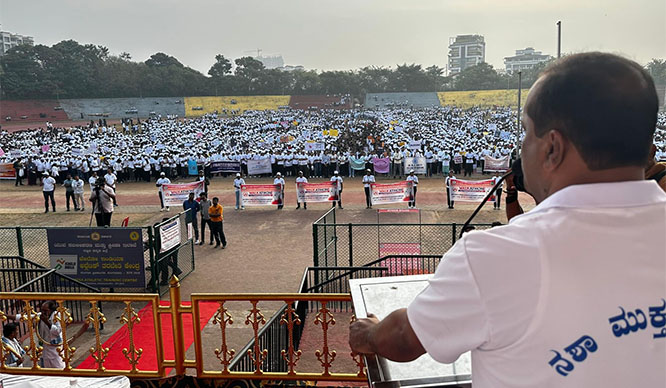
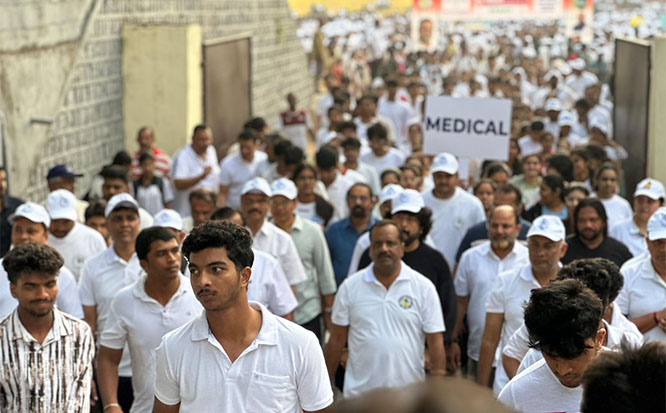
Mangaluru, Nov 29: Around 12,500 healthcare students from Medical, Dental, AYUSH, Pharmacy, Nursing, Physiotherapy and Allied Health Sciences colleges of Dakshina Kannada, affiliated to Rajiv Gandhi University of Health Sciences (RGUHS), took part in a massive walkathon to promote awareness on Organ Donation and Nasha Mukth Bharat.

The inaugural ceremony was held at Mangala Stadium. Dr Bhagavan B C, Hon’ble Vice-Chancellor of RGUHS, delivered the welcome address. The walkathon was flagged off by Shri U T Khader, Hon’ble Speaker of the Karnataka Legislative Assembly, and presided over by Shri Dinesh Gundu Rao, Hon’ble Minister for Health, Family Welfare and Dakshina Kannada District In-charge. Dakshina Kannada MP Shri Brijesh Chowta also addressed the students.

Music director Guru Kiran, MLA Dr Bharat Shetty (Mangalore North), Police Commissioner Shri Sudheer Kumar Reddy, Shri Manjunath Bhandary and Shri Harish Kumar were among those present.

Institution heads including Dr Haji U K Monu (Kanachur Colleges), Dr Shantharam Shetty (Tejaswini College), Dr Bhaskar Shetty (City Group of Colleges), Mr Abdul Rahiman (Kanachur Institute of Medical Sciences), and the District Health Officer, Mangalore, also participated.

The vote of thanks was delivered by Prof U T Ifthikar Fareed, Syndicate Member, RGUHS.

The event was organised by Dr U T Ifthikar Ali and Dr Shiva Sharan (Syndicate Members), Prof Vaishali (Senate Member), Prof Mohammad Suhail (Chairman, BOS Physiotherapy), Dr Sharan Shetty (Former Senate Member), along with principals and faculty of various colleges.

Students marched from Mangala Stadium to Karavali Grounds via MCC and Lalbagh signal. The event set a record as one of the largest gatherings of healthcare students for a social cause in the RGUHS Dakshina Kannada Zone.

health7.jpg

health6.jpg

health5.jpg

health4.jpg

health3.jpg

health2.jpg

Comments

Add new comment

  • Coastaldigest.com reserves the right to delete or block any comments.
  • Coastaldigset.com is not responsible for its readers’ comments.
  • Comments that are abusive, incendiary or irrelevant are strictly prohibited.
  • Please use a genuine email ID and provide your name to avoid reject.
News Network
November 22,2025

gaza.jpg

The Israeli regime’s forces have killed two Palestinian children in the Gaza Strip every day since the ceasefire began in early October, UNICEF has warned.

The UN children’s agency said on Friday that Israeli forces continue to attack Palestinians in Gaza even though the agreement was meant to stop the killing.

“Since 11 October, while the ceasefire has been in effect, at least 67 children have been killed in conflict-related incidents in the Gaza Strip. Dozens more have been injured. That is an average of almost two children killed every day since the ceasefire took effect,” UNICEF spokesperson Ricardo Pires said in Geneva, reminding that each number in the statistics represents a child whose life had ended violently.

“These are not statistics,” he said. “Each child had a story, a family, and a future that was stolen from them.”

Data from Palestinian factions, human rights groups, and government bodies recorded since the US-brokered ceasefire deal went into effect on October 10 show that Israeli forces have carried out numerous attacks, each constituting a separate ceasefire violation.

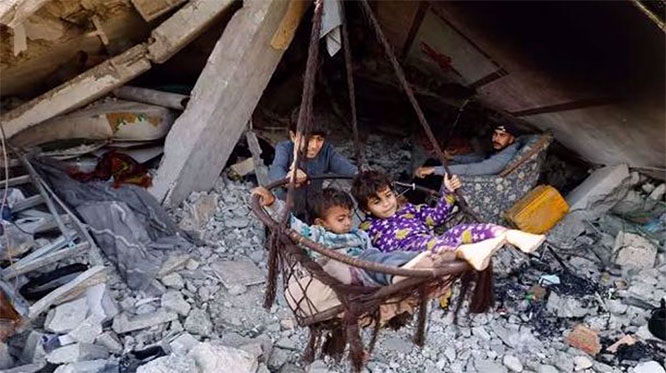
UNICEF teams say they repeatedly continue to witness heart-wrenching scenes of fearful Palestinian children sleeping outdoors with amputated limbs, while others live as orphans in flooded, makeshift shelters.

“I saw this myself in August. There is no safe place for them. The world cannot normalize their suffering,” Pires said, lamenting that the UN could “do a lot more if the aid that is really needed was entering faster.”

The UNICEF spokesperson warned that with the advent of winter, the risks for hundreds of thousands of displaced children will increase.

He warned, “The stakes are incredibly high” for children as winter acts as a threat multiplier, where children have no heating, no insulation, and few blankets. He said respiratory infections rise.

“Too many children have already paid the highest price,” Pires said. “Too many are still paying it, even under a ceasefire. The world promised them it would stop and that we would protect them.”

“Now we must act like it,” the UNICEF spokesperson added.

Since the Israeli regime launched its genocidal war against Palestinians in Gaza in October 2023, it has killed nearly 70,000 people in the territory, most of them women and children, and injured over 170,000 more, while reducing most of the structures in the enclave to rubble.

Comments

Add new comment

  • Coastaldigest.com reserves the right to delete or block any comments.
  • Coastaldigset.com is not responsible for its readers’ comments.
  • Comments that are abusive, incendiary or irrelevant are strictly prohibited.
  • Please use a genuine email ID and provide your name to avoid reject.