



Mukesh Ambani is now is 13th richest in world: Forbes

Agencies
March 6, 2019

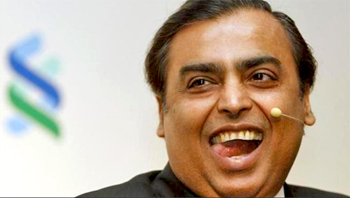
New York/New Delhi, Mar 6: Richest Indian Mukesh Ambani jumped six positions to rank 13th on Forbes World's Billionaire list released on Tuesday that was again topped by Jeff Bezos.
E-commerce colossus Amazon founder Bezos, 55, remains the world's richest person, ahead of Bill Gates and Warren Buffett, as his riches swelled by USD 19 billion in one year and is now worth USD 131 billion, Forbes said.

Ambani, 61, saw wealth soar from USD 40.1 billion in 2018 when he was placed 19th richest in the world, to USD 50 billion to be rank at 13th in 2019.

"Ambani chairs and runs USD 60 billion (revenue) oil and gas giant Reliance Industries, among India's most valuable companies," Forbes said. "In 2016, Reliance sparked a price war in India's hyper-competitive telecom market with the launch of 4G phone service Jio."

Jio, it said, has signed on 280 million customers by offering free domestic voice calls, dirt-cheap data services and virtually free smartphones.

Ambani leads the 106 billionaires from India on the Forbes list. Wipro Chairman Azim Premji is ranked 36th with a net worth of $22.6 billion dollars. Technology major HCL's co-founder Shiv Nadar, ranked 82nd and ArcelorMittal Chairman and CEO Lakshmi Mittal at the 91st rank come in within the top-100 billionaires in the world.

The list of Indian billionaires includes Aditya Birla Group Chairman Kumar Birla (122), Chairman and founder of the Adani Group Gautam Adani (167), Bharti Airtel head Sunil Mittal (244), co-founder of consumer goods giant Patanjali Ayurveda Acharya Balkrishna (365), Piramal Entreprises Chair Ajay Piramal (436), Biocon founder Kiran Mazumdar-Shaw (617), Infosys co-founder N R Narayana Murthy (962) and RCom chairman Reliance Anil Ambani (1349).

Facebook founder Mark Zuckerberg dropped three spots and former New York mayor Michael Bloomberg rose by two.

Gates, 63, saw his wealth grow to USD 96.5 billion, up from USD 90 billion last year while investment guru Buffett, 88, at third position saw fortunes slipping by USD 1.5 billion to USD 82.5 billion, the magazine said.

Ambani was placed at the 33rd position on the 2017 listing of Forbes.

Forbes said he is the richest Indian and ranked 32nd on the 2018 Powerful People listing of the magazine. He was ranked Global Game Changer in 2017.

Bernard Arnault, CEO of French luxury good company, LVMH, held on to fourth places while Zuckerberg lost USD 9 billion in networth to slip from fifth the to eighth position.

Ahead of Zuckerberg now are Mexican tycoon Carlos Slim, Zara and Inditex founder Amancio Ortega of Spain and Oracle co-founder Larry Ellison.

Forbes said the "list is a snapshot of wealth using stock prices and exchange rates from February 8, 2019."

Some people become richer or poorer within days of publication.

"We list individuals rather than multigenerational families who share fortunes, though we include wealth belonging to a billionaire's spouse and children if that person is the founder of the fortune," it said.

The 33rd annual ranking has 2,153 billionaires on the 2019 list, down from 2,208 in 2018. The total combined net worth of this year's billionaires is USD 8.7 trillion, down from USD 9.1 trillion in 2018, Forbes said.

"This represents the first decrease in billionaires and their combined wealth since 2016 and only the second decrease in the past decade," it said. "A record 994 individuals are worth less than a year ago; last year only 360 members got poorer. The average net worth of this year's billionaires is USD 4 billion, down from USD 4.1 billion in 2018."

Of the total, 1,450 members are self-made.

For this year's list, Forbes said "capitalism is taking some lumps" as for only the second year in a decade, both the number of billionaires and their total wealth shrank, "proving that even the wealthiest are not immune to economic forces and weak stock markets".

Among the regions, Asia-Pacific was the hardest hit, with 60 fewer 10-figure fortunes. That dip was led by China, which has 49 fewer billionaires than a year ago, Forbes said adding that Europe, the Middle East and Africa also lost ground.

The Americas, driven by a resurgent Brazil, and the US are the only two regions that have more billionaires than they did a year ago. There are now a record 609 in the U.S, including 14 of the world’s 20 richest.

Comments

Add new comment

  • Coastaldigest.com reserves the right to delete or block any comments.
  • Coastaldigset.com is not responsible for its readers’ comments.
  • Comments that are abusive, incendiary or irrelevant are strictly prohibited.
  • Please use a genuine email ID and provide your name to avoid reject.
News Network
December 19,2025

Mangaluru: The Mangaluru CEN police have arrested a 23-year-old man for allegedly posting provocative and misleading content on an Instagram page named “mr_a_titude”, targeting the Bajpe police.

Mangaluru Commissioner of Police Sudheer Kumar Reddy C H identified the arrested as Abhishek M, a resident of Katipalla in Mangaluru.

A case has been registered at the Bajpe Police Station under Sections 353(1)(c), 353(2), 56, and 57 read with Section 189 of the Bharatiya Nyaya Sanhita (BNS) in connection with the post.

According to police, the accused uploaded a photograph of a hotel on the Instagram page and alleged that accused persons in a murder case under the Bajpe police jurisdiction were being given “royal treatment” by the police, including being served beef meals daily from the hotel.

The post further accused the police of supporting criminals, misusing their authority, and betraying public trust. Police said the content was provocative in nature and aimed at inciting public outrage against the police.

Following the post, a case was registered at the Bajpe police station, and further investigation was transferred to the CEN police station.

Police records indicate that the accused has a criminal history, with multiple cases registered against him, including murder, attempt to murder, assault, and robbery at the Surathkal Police Station, and one case at the Kaup Police Station.

The Commissioner said the accused was traced and arrested using technical evidence.

Comments

Add new comment

  • Coastaldigest.com reserves the right to delete or block any comments.
  • Coastaldigset.com is not responsible for its readers’ comments.
  • Comments that are abusive, incendiary or irrelevant are strictly prohibited.
  • Please use a genuine email ID and provide your name to avoid reject.
News Network
December 13,2025

New Delhi: School-going children are picking up drug and smoking habits and engaging in consumption of alcohol, with the average age of introduction to such harmful substances found to be around 13 years, suggesting a need for earlier interventions as early as primary school, a multi-city survey by AIIMS-Delhi said.

The findings also showed substance use increased in higher grades, with grade XI/XII students two times more likely to report use of substances when compared with grade VIII students. This emphasised the importance of continued prevention and intervention through middle and high school.

The study led by Dr Anju Dhawan of AIIMS's National Drug Dependence Treatment Centre, published in the National Medical Journal of India this month, looks at adolescent substance use across diverse regions.

The survey included 5,920 students from classes 8, 9, 11 and 12 in urban government, private and rural schools across 10 cities -- Bengaluru, Chandigarh, Delhi, Dibrugarh, Hyderabad, Imphal, Jammu, Lucknow, Mumbai, and Ranchi. The data were collected between May 2018 and June 2019.

The average age of initiation for any substance was 12.9 (2.8) years. It was lowest for inhalants (11.3 years) followed by heroin (12.3 years) and opioid pharmaceuticals (without prescription; 12.5 years).

Overall, 15.1 per cent of participants reported lifetime use, 10.3 per cent reported past year use, and 7.2 per cent reported use in the past month of any substance, the study found.

The most common substances used in the past year, after tobacco (4 per cent) and alcohol (3.8 per cent), were opioids (2.8 per cent), followed by cannabis (2 per cent) and inhalants (1.9 per cent). Use of non-prescribed pharmaceutical opioids was most common among opioid users (90.2 per cent).

On being asked, 'Do you think this substance is easily available for a person of your age' separately for each substance category, nearly half the students (46.3 per cent) endorsed that tobacco products and more than one-third of the students (36.5 per cent) agreed that a person of their age can easily procure alcohol products.

Similarly, for Bhang (21.9 per cent), ganja/charas (16.1 per cent), inhalants (15.2 per cent), sedatives (13.7 per cent), opium and heroin (10 per cent each), the students endorsed that these can be easily procured.

About 95 per cent of the children, irrespective of their grade, agreed with the statement that 'drug use is harmful'.

The rates of substance use (any) among boys were significantly higher than those of girls for substance use (ever), use in the past year and use in the past 30 days. Compared to grade VIII students, grade IX students were more likely, and grade XI/XII students were twice as likely to have used any substance (ever).

The likelihood of past-year use of any substance was also higher for grade IX students and for grade XI/XII students as compared to grade VIII students.

About 40 per cent of students mentioned that they had a family member who used tobacco or alcohol each. The use of cannabis (any product) and opioid (any product) by a family member was reported by 8.2 per cent and 3.9 per cent of students, respectively, while the use of other substances, such as inhalants/sedatives by family was 2-3 per cent, the study found.

A relatively smaller percentage of students reported use of tobacco or alcohol among peers as compared to among family members, while a higher percentage reported inhalants, sedatives, cannabis or opioid use among peers.

Children using substances (past year) compared to non-users reported significantly higher any substance use by their family members and peers.

There were 25.7 per cent students who replied 'yes' to the question 'conflicts/fights often occur in your family'. Most students also replied affirmatively to 'family members are aware of how their time is being spent' and 'damily members are aware of with whom they spend their time'.

Comments

Add new comment

  • Coastaldigest.com reserves the right to delete or block any comments.
  • Coastaldigset.com is not responsible for its readers’ comments.
  • Comments that are abusive, incendiary or irrelevant are strictly prohibited.
  • Please use a genuine email ID and provide your name to avoid reject.
News Network
December 19,2025

Saudi Arabia has abolished fees on expatriate workers employed in licensed industrial establishments, signaling a strong push to empower national factories and enhance the Kingdom’s global industrial competitiveness. The move reflects the leadership’s commitment to building a sustainable and resilient industrial economy under Saudi Vision 2030.

The decision was approved by the Council of Ministers, chaired by Crown Prince and Prime Minister Mohammed bin Salman, following a recommendation from the Council of Economic and Development Affairs (CEDA). It forms part of a broader strategy to support, modernize, and strengthen the industrial sector.

By removing fees on foreign workers, industrial establishments gain greater operational flexibility and relief from financial pressures. This is expected to help factories expand production, improve efficiency, and compete more effectively in international markets, while reinforcing long-term sustainability.

The initiative aligns closely with Saudi Vision 2030, which identifies industry as a key pillar of economic diversification. A competitive and resilient industrial base is viewed as essential for driving innovation, attracting investment, and sustaining long-term economic growth.

Overall, the fee exemption underscores the Kingdom’s commitment to creating a supportive environment for industrial development and ensuring that Saudi factories remain globally competitive and capable of leading the nation’s economic transformation.

Comments

Add new comment

  • Coastaldigest.com reserves the right to delete or block any comments.
  • Coastaldigset.com is not responsible for its readers’ comments.
  • Comments that are abusive, incendiary or irrelevant are strictly prohibited.
  • Please use a genuine email ID and provide your name to avoid reject.