



Mumbai–Ahmedabad bullet train: India set to miss key target in Japan-backed project

Agencies
June 12, 2018

Palghar, Jun 12: India is set to miss a December deadline to acquire land for a Japan-backed $17 billion bullet train project following protests by fruit growers, government officials said, likely delaying one of Prime Minister Narendra Modi`s most ambitious projects.

PM Modi`s office is now monitoring the project week-to-week, as Indian officials seek to reassure Tokyo that the hurdles can be overcome through intense negotiations with sapota and mango growers in Maharashtra.

Protests, backed by local politicians, have flared up in recent months against attempts to secure sections of a 108-km (67-mile) stretch, which is around one-fifth of the entire bullet train corridor connecting Mumbai with Ahmedabad, the largest commercial city in Modi`s home state of Gujarat.

"I`ve worked hard for three decades to develop this plantation, and they are asking me to hand over this land," sapota farmer Dashrat Purav, 62, said as he showed his orchard in the town of Palghar, a three-hour-drive north of Mumbai.

"I haven`t worked hard to surrender land for the project. I did that for my children."

Purav said he would sell his land only if at least one of his two unemployed sons was promised a government job.

Protests against land acquisitions are common in India, where tens of millions of farmers till small holdings. A planned $44 billion refinery to be run by a consortium including Saudi Aramco, the world`s biggest oil producer, is also struggling to secure land in Maharashtra.

"Land acquisition for any project is complex in India," said Dhananjay Kumar, spokesman for the National High Speed Rail Corp Ltd (NHSRCL) that is overseeing the project. "Here also we are facing difficulty because of so much resistance."

Failure to procure the bullet train land by the deadline would delay disbursal of soft-loans by Japan International Cooperation Agency (JICA), a government development body, which is reviewing the project next month, said two senior officials with the state-run Indian Railways, declining to be named.

A JICA spokeswoman said that India must create relocation plans for local residents and make them public in order to enter into a loan agreement covering the main part of the bullet train project.

"It is possible that it takes time to sign a contract as India takes proper and careful measures in line with JICA`s guidelines for environmental and social considerations," she said.

To assuage Japan`s concerns, Indian officials have sought a meeting this month with transport ministry officials in Tokyo, one of the Indian officials said. India wants the project`s completion target to be advanced by a year to 2022, the 75th year of India`s independence.

A Japanese transport ministry official who deals with the bullet train project said that Indian officials had told them that "they can manage" the land acquisition.

"We will continue to work together with the Indian government to bring this project forward with an aim to start operation in 2023," the official said.

"NOT INSURMOUNTABLE"

Japan is majority-funding the train project through a 50-year loan. Japanese companies such as Nippon Steel and Sumitomo Metal Corp <5401.T>, JFE Holdings <5411.T>, Kawasaki Heavy Industries <7012.T>, Mitsubishi Heavy Industries <7011.T>, Toshiba Corp <6502.T> and Hitachi <6501.T> are likely to supply at least 70 percent of the core components of the rail line, sources told Reuters in January.

PM Modi has called the project crucial for his pet "Make in India" campaign aimed at lifting the share of manufacturing in India`s $2 trillion economy. The government also hopes to generate hundreds of jobs through the train project, and hence is pushing hard to finish it on time.

To sweeten the terms for people opposed to selling their land, Indian Railways has put its weight behind NHSRCL, pledging funds from its own welfare scheme to build schools and community halls, one of the officials said.

Ashwani Lohani, chairman of the Indian Railway Board, said the issues with farmers were not insurmountable.

The government has offered to buy land at a 25 percent premium to the market value, the two government officials said. Farmers are also being offered resettlement dues of 500,000 rupees ($7,409) or 50 percent of the land value, whichever is higher.

However, local political opposition in Palghar, ahead of a general election next year, has fanned the protests. Opponents say the bullet train is wasteful and the money would be better used upgrading the country`s rickety rail infrastructure. Farmers have threatened a hunger strike.

Last week, farmers and local activists disrupted a public hearing conducted by NHSRCL, its second attempt to hold such an event in less than a month. The first one last month was also cut short by protests.

"In coming weeks we will intensify the protests," said Nilam Gorhe, a spokesman for Shiv Sena, a Maharashtra regional party that has an on-off relationship with Modi`s ruling party.

Comments

Add new comment

  • Coastaldigest.com reserves the right to delete or block any comments.
  • Coastaldigset.com is not responsible for its readers’ comments.
  • Comments that are abusive, incendiary or irrelevant are strictly prohibited.
  • Please use a genuine email ID and provide your name to avoid reject.
News Network
December 19,2025

Mangaluru: The Mangaluru CEN police have arrested a 23-year-old man for allegedly posting provocative and misleading content on an Instagram page named “mr_a_titude”, targeting the Bajpe police.

Mangaluru Commissioner of Police Sudheer Kumar Reddy C H identified the arrested as Abhishek M, a resident of Katipalla in Mangaluru.

A case has been registered at the Bajpe Police Station under Sections 353(1)(c), 353(2), 56, and 57 read with Section 189 of the Bharatiya Nyaya Sanhita (BNS) in connection with the post.

According to police, the accused uploaded a photograph of a hotel on the Instagram page and alleged that accused persons in a murder case under the Bajpe police jurisdiction were being given “royal treatment” by the police, including being served beef meals daily from the hotel.

The post further accused the police of supporting criminals, misusing their authority, and betraying public trust. Police said the content was provocative in nature and aimed at inciting public outrage against the police.

Following the post, a case was registered at the Bajpe police station, and further investigation was transferred to the CEN police station.

Police records indicate that the accused has a criminal history, with multiple cases registered against him, including murder, attempt to murder, assault, and robbery at the Surathkal Police Station, and one case at the Kaup Police Station.

The Commissioner said the accused was traced and arrested using technical evidence.

Comments

Add new comment

  • Coastaldigest.com reserves the right to delete or block any comments.
  • Coastaldigset.com is not responsible for its readers’ comments.
  • Comments that are abusive, incendiary or irrelevant are strictly prohibited.
  • Please use a genuine email ID and provide your name to avoid reject.
News Network
December 7,2025

envoy.jpg

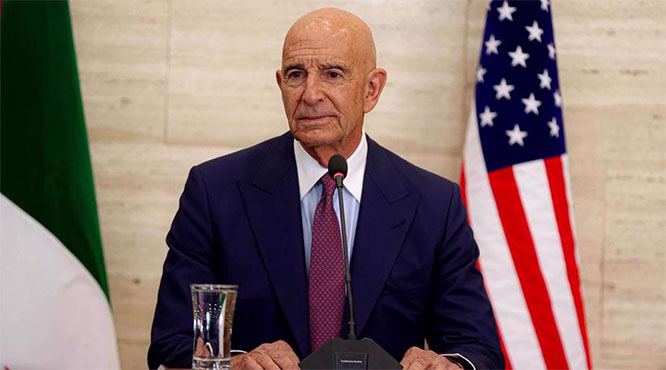
Since 1946, the United States has attempted 93 coups or “regime change” operations across the world — including two in Iran, US Special Envoy for Syria Tom Barrack has admitted.

Speaking to the UAE-based IMI Media Group, in remarks published by The National, Barrack said Washington tried twice to overthrow the Iranian government but failed both times. 

“For (Trump) then to be imputed with regime change — we had two regime changes in Iran already. Neither one worked. So I think wisely leave it to the region to solve,” said Barrack, who also serves as the US ambassador to Turkey.

His comments come six months after the US joined Israel in airstrikes against Iran during ongoing indirect nuclear negotiations between Tehran and Washington.

On June 13, Israel launched an attack on Iran that killed at least 1,064 people and hit civilian infrastructure. Days later, the United States targeted three nuclear facilities — Fordow, Natanz and Isfahan — in what Iran called a clear violation of international law. Iranian retaliation eventually forced a halt to the assault on June 24.

Barrack further claimed that US President Donald Trump and Foreign Secretary Marco Rubio are “not into regime change” and prefer a regional approach driven by Middle Eastern countries themselves. According to him, regional dialogue and non-interference by outside powers offer a more durable path forward.

He added that Washington is still open to an agreement with Tehran if Iranian authorities show “seriousness” and willingness to engage constructively.

However, Iran maintains the US has not shown readiness for meaningful talks. In an interview with Japan’s Kyodo News, Iranian Foreign Minister Abbas Araghchi said negotiations could advance only if Washington acknowledges Iran’s right to peaceful nuclear energy and lifts unilateral sanctions.

Comments

Add new comment

  • Coastaldigest.com reserves the right to delete or block any comments.
  • Coastaldigset.com is not responsible for its readers’ comments.
  • Comments that are abusive, incendiary or irrelevant are strictly prohibited.
  • Please use a genuine email ID and provide your name to avoid reject.
News Network
December 13,2025

New Delhi: School-going children are picking up drug and smoking habits and engaging in consumption of alcohol, with the average age of introduction to such harmful substances found to be around 13 years, suggesting a need for earlier interventions as early as primary school, a multi-city survey by AIIMS-Delhi said.

The findings also showed substance use increased in higher grades, with grade XI/XII students two times more likely to report use of substances when compared with grade VIII students. This emphasised the importance of continued prevention and intervention through middle and high school.

The study led by Dr Anju Dhawan of AIIMS's National Drug Dependence Treatment Centre, published in the National Medical Journal of India this month, looks at adolescent substance use across diverse regions.

The survey included 5,920 students from classes 8, 9, 11 and 12 in urban government, private and rural schools across 10 cities -- Bengaluru, Chandigarh, Delhi, Dibrugarh, Hyderabad, Imphal, Jammu, Lucknow, Mumbai, and Ranchi. The data were collected between May 2018 and June 2019.

The average age of initiation for any substance was 12.9 (2.8) years. It was lowest for inhalants (11.3 years) followed by heroin (12.3 years) and opioid pharmaceuticals (without prescription; 12.5 years).

Overall, 15.1 per cent of participants reported lifetime use, 10.3 per cent reported past year use, and 7.2 per cent reported use in the past month of any substance, the study found.

The most common substances used in the past year, after tobacco (4 per cent) and alcohol (3.8 per cent), were opioids (2.8 per cent), followed by cannabis (2 per cent) and inhalants (1.9 per cent). Use of non-prescribed pharmaceutical opioids was most common among opioid users (90.2 per cent).

On being asked, 'Do you think this substance is easily available for a person of your age' separately for each substance category, nearly half the students (46.3 per cent) endorsed that tobacco products and more than one-third of the students (36.5 per cent) agreed that a person of their age can easily procure alcohol products.

Similarly, for Bhang (21.9 per cent), ganja/charas (16.1 per cent), inhalants (15.2 per cent), sedatives (13.7 per cent), opium and heroin (10 per cent each), the students endorsed that these can be easily procured.

About 95 per cent of the children, irrespective of their grade, agreed with the statement that 'drug use is harmful'.

The rates of substance use (any) among boys were significantly higher than those of girls for substance use (ever), use in the past year and use in the past 30 days. Compared to grade VIII students, grade IX students were more likely, and grade XI/XII students were twice as likely to have used any substance (ever).

The likelihood of past-year use of any substance was also higher for grade IX students and for grade XI/XII students as compared to grade VIII students.

About 40 per cent of students mentioned that they had a family member who used tobacco or alcohol each. The use of cannabis (any product) and opioid (any product) by a family member was reported by 8.2 per cent and 3.9 per cent of students, respectively, while the use of other substances, such as inhalants/sedatives by family was 2-3 per cent, the study found.

A relatively smaller percentage of students reported use of tobacco or alcohol among peers as compared to among family members, while a higher percentage reported inhalants, sedatives, cannabis or opioid use among peers.

Children using substances (past year) compared to non-users reported significantly higher any substance use by their family members and peers.

There were 25.7 per cent students who replied 'yes' to the question 'conflicts/fights often occur in your family'. Most students also replied affirmatively to 'family members are aware of how their time is being spent' and 'damily members are aware of with whom they spend their time'.

Comments

Add new comment

  • Coastaldigest.com reserves the right to delete or block any comments.
  • Coastaldigset.com is not responsible for its readers’ comments.
  • Comments that are abusive, incendiary or irrelevant are strictly prohibited.
  • Please use a genuine email ID and provide your name to avoid reject.