Mumbai civic body withdraws ban on slaughter and sale of meat

September 11, 2015

Mumbai, Sep 11: Under fire for its decision to ban slaughter and sale of meat in the city for two days during Jain festival 'Paryushan', the Municipal Corporation of Greater Mumbai (MCGM) today told the Bombay High Court that it has decided to withdraw its decision.
Meat

MCGM informed the court of its decision during the hearing of a petition filed by meat sellers challeging the four-day ban on meat sales, which included two-day ban by the state government.

While the civic body announced the ban for September 13 and 18, the government had banned it for September 10 and 17.

BMC's decision would mean that the city would now go without meat only on September 17.

Senior counsel N V Walawalkar, appearing for MCGM, told a division bench of Justices Anoop V Mohta and Amjad Sayyed that the civic body today decided to withdraw its September 1 circular imposing a ban on slaughter as well as sale of mutton and chicken in the city on September 13 and 18.

"Keeping public interest and the sentiments of Mumbaikars, in mind it has been decided to withdraw the circular," Walawalkar said.

The high court was hearing a petition filed by Bombay Mutton Dealers Association challenging the ban. The petition also challenged the state government's decision banning sale of meat on September 10 and 17.

After the civic body informed the High Court about its decision to withdraw the ban, the bench, which had concluded hearing arguments of all the parties, posted the matter for orders on September 14.

During hearing of the petition, the high court today criticised the civic body and government's decision and said such restrictions cannot be imposed in a city like Mumbai.

"Mumbai city is cosmopolitan and multi-faceted where there is no sizeable amount of population from one sect. Hence can such a ban be imposed? In a city like Mumbai, there cannot be such bans. We are concerned about people who eat non-vegetarian food more. There are certain communities who do not eat vegetarian much," the court said.

"There is a progressive look attached with Mumbai. Such decisions are regressive in nature. What to eat is an individual choice. How can you restrict that?" the court said.

The court also sought to know the rationale behind permitting sale of fish, seafood and eggs. "How are fish and eggs different? Killing them is not violent? What is the rationale behind such a decision?" it said.

To this, Advocate General Anil Singh said "fish dies the moment it is taken out of water. Hence, there is no death due to slaughter."

The court also felt that the ban on some days during the nine-day Prayushan was absurd.

"What is the idea of having the ban on some days and allowing slaughter and sale of meat on other days? Is it that there is no sentiment on one day and the next day you are filled with sentiment? What is the idea behind this?" the court said.

The High Court also suggested that the government formulate a uniform policy throughout the state.

"In Mira Bhayandar, the ban is for eight days while here in Mumbai it is for four days. Why cannot the government formulate a uniform policy that will be applicable to all the corporations and district councils?" it said.

Advocate General Anil Singh argued that the government has to take care of all communities. "The ban is only on slaughter and sale of meat on those two days. There is no ban on consumption of meat. We are not going to go into people's kitchen and say you cannot eat meat."

Apart from the mutton dealers, the Poultry Association also filed an application challenging the ban.

Senior counsel Zubin Behramkamdin argued that while it can agree to ban on slaughter of meat on the two days declared by the government, there cannot be a ban on sale. "Sale should be allowed. All communities have fasting period. If tomorrow every community starts asking for ban, then will the authority allow it? We are losing our livelihood," he said.

The petitioners have claimed that the decision is unconstitutional as it affects the livelihood of a section of people and favours a small percentage of population. It also goes against the secular fabric of the constitution, they have said.

Comments

Add new comment

  • Coastaldigest.com reserves the right to delete or block any comments.
  • Coastaldigset.com is not responsible for its readers’ comments.
  • Comments that are abusive, incendiary or irrelevant are strictly prohibited.
  • Please use a genuine email ID and provide your name to avoid reject.
News Network
December 16,2025

jordan.jpg

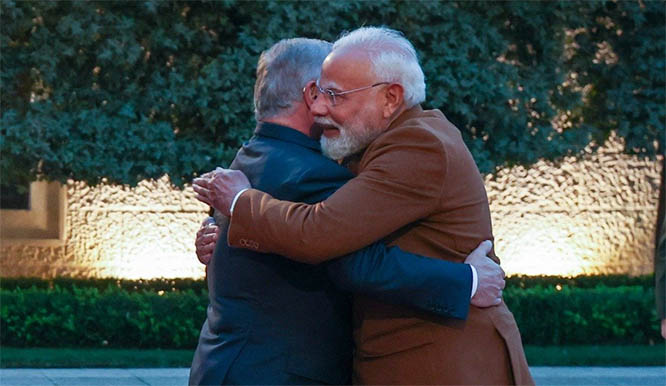
Prime Minister Narendra Modi on Monday held talks with Jordan’s King Abdullah II in Amman, during which the two leaders discussed ways to further strengthen bilateral relations, with the Prime Minister outlining an eight-point vision covering key areas of cooperation.

Describing the meeting as “productive”, PM Modi said he shared a roadmap focused on trade and economy, fertilisers and agriculture, information technology, healthcare, infrastructure, critical and strategic minerals, civil nuclear cooperation, and people-to-people ties.

In a post on social media platform X, the Prime Minister praised King Abdullah II’s personal commitment to advancing India–Jordan relations, particularly as both countries mark the 75th anniversary of the establishment of diplomatic ties this year.

“Held productive discussions with His Majesty King Abdullah II in Amman. His personal commitment towards vibrant India-Jordan relations is noteworthy. This year, we are celebrating the 75th anniversary of our bilateral diplomatic relations,” PM Modi said.

The meeting took place at the Al Husseiniya Palace, where the two leaders also exchanged views on regional and global issues of mutual interest. According to the Ministry of External Affairs (MEA), both sides agreed to further deepen cooperation in areas including trade and investment, defence and security, counter-terrorism and de-radicalisation, fertilisers and agriculture, infrastructure, renewable energy, tourism, and heritage.

The MEA said both leaders reaffirmed their united stand against terrorism.

PM Modi arrived in Amman earlier on Monday and was received by Jordanian Prime Minister Jafar Hassan, who accorded him a formal welcome. Following the talks, King Abdullah II hosted a banquet dinner in honour of the Prime Minister, reflecting the warmth of bilateral ties.

Jordan is the first leg of PM Modi’s three-nation tour. From Amman, the Prime Minister will travel to Ethiopia at the invitation of Prime Minister Abiy Ahmed Ali, marking his first official visit to the African nation. The tour will conclude with a visit to Oman.

Comments

Add new comment

  • Coastaldigest.com reserves the right to delete or block any comments.
  • Coastaldigset.com is not responsible for its readers’ comments.
  • Comments that are abusive, incendiary or irrelevant are strictly prohibited.
  • Please use a genuine email ID and provide your name to avoid reject.
News Network
December 5,2025

indigoCEO.jpg

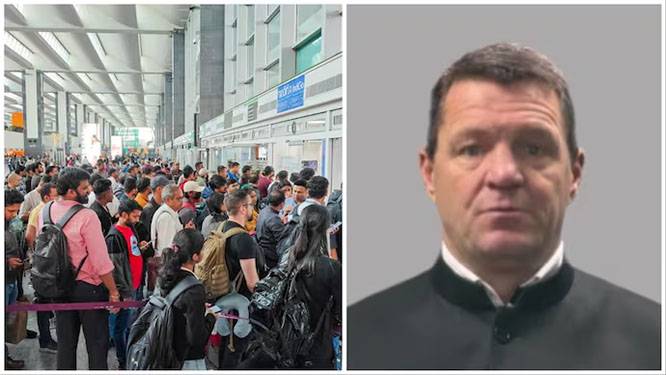
New Delhi, Dec 5: IndiGo CEO Pieter Elbers issued a public apology this evening after more than a thousand flights were cancelled today, making it the "most severely impacted day" in terms of cancellations. The biggest airline of the country cancelled "more than half" of its daily number of flights on Friday, said Elbers. He also said that even though the crisis will persist on Saturday, the airline anticipates fewer than 1,000 flight cancellations.

"Full normalisation is expected between December 10 and 15, though IndiGo cautions that recovery will take time due to the scale of operations," the IndiGo CEO said. 

IndiGo operates around 2,300 domestic and international flights daily.

Pieter Elbers, while apologising for the major inconvenience due to delays and cancellations, said the situation is a result of various causes.

The crisis at IndiGo stems from new regulations that boost pilots' weekly rest requirements by 12 hours to 48 and allow only two night-time landings per week, down from six. IndiGo has attributed the mass cancellations to "misjudgment and planning gaps".

Elbers also listed three lines of action that the airline will adopt to address the issue.

"Firstly, customer communication and addressing your needs, for this, messages have been sent on social media. And just now, a more detailed communication with information, refunds, cancellations and other customer support measures was sent," he said.

The airline has also stepped up its call centre capacity.

"Secondly, due to yesterday's situation, we had customers stranded mostly at the nation's largest airports. Our focus was for all of them to be able to travel today itself, which will be achieved. For this, we also ask customers whose flights are cancelled not to come to the airports as notifications are sent," the CEO said.

"Thirdly, cancellations were made for today to align our crew and planes to be where they need to start tomorrow morning afresh. Earlier measures of the last few days, regrettable, have proven not to be enough, but we have decided today to reboot all our systems and schedules, resulting in the highest numbers of cancellations so far, but imperative for progressive improvements starting from tomorrow," he added.

As airports witnessed chaotic scenes, the Directorate General of Civil Aviation (DGCA) stepped in to grant IndiGo a temporary exemption from stricter night duty rules for pilots. It also allowed substitution of leaves with a weekly rest period. 

Civil Aviation Minister Ram Mohan Naidu has said a high-level inquiry will be ordered and accountability will be fixed.

Comments

Add new comment

  • Coastaldigest.com reserves the right to delete or block any comments.
  • Coastaldigset.com is not responsible for its readers’ comments.
  • Comments that are abusive, incendiary or irrelevant are strictly prohibited.
  • Please use a genuine email ID and provide your name to avoid reject.
News Network
December 16,2025

bengal.jpg

The deletion of over 58 lakh names from West Bengal’s draft electoral rolls following a Special Intensive Revision (SIR) has sparked widespread concern and is likely to deepen political tensions in the poll-bound state.

According to the Election Commission, the revision exercise has identified 24 lakh voters as deceased, 19 lakh as relocated, 12 lakh as missing, and 1.3 lakh as duplicate entries. The draft list, published after the completion of the first phase of SIR, aims to remove errors and duplication from the electoral rolls.

However, the scale of deletions has raised fears that a large number of eligible voters may have been wrongly excluded. The Election Commission has said that individuals whose names are missing can file objections and seek corrections. The final voter list is scheduled to be published in February next year, after which the Assembly election announcement is expected. Notably, the last Special Intensive Revision in Bengal was conducted in 2002.

The development has intensified the political row over the SIR process. Chief Minister Mamata Banerjee and her Trinamool Congress have strongly opposed the exercise, accusing the Centre and the Election Commission of attempting to disenfranchise lakhs of voters ahead of the elections.

Addressing a rally in Krishnanagar earlier this month, Banerjee urged people to protest if their names were removed from the voter list, alleging intimidation during elections and warning of serious consequences if voting rights were taken away.

The BJP, meanwhile, has defended the revision and accused the Trinamool Congress of politicising the issue to protect what it claims is an illegal voter base. Leader of the Opposition Suvendu Adhikari alleged that the ruling party fears losing power due to the removal of deceased, fake, and illegal voters.

The controversy comes amid earlier allegations by the Trinamool Congress that excessive work pressure during the SIR led to the deaths by suicide of some Booth Level Officers (BLOs), for which the party blamed the Election Commission. With the draft list now out, another round of political confrontation appears imminent.

As objections begin to be filed, the focus will be on whether the correction mechanism is accessible, transparent, and timely—critical factors in ensuring that no eligible voter is denied their democratic right ahead of a crucial election.

Comments

Add new comment

  • Coastaldigest.com reserves the right to delete or block any comments.
  • Coastaldigset.com is not responsible for its readers’ comments.
  • Comments that are abusive, incendiary or irrelevant are strictly prohibited.
  • Please use a genuine email ID and provide your name to avoid reject.