The myth of the Indian vegetarian nation

Soutik Biswas for BBC
April 7, 2018

What are the most common myths and stereotypes about what Indians eat?

The biggest myth, of course, is that India is a largely vegetarian country.

But that's not the case at all. Past "non-serious" estimates have suggested that more than a third of Indians ate vegetarian food.

If you go by three large-scale government surveys, 23%-37% of Indians are estimated to be vegetarian. By itself this is nothing remarkably revelatory.

But new research by US-based anthropologist Balmurli Natrajan and India-based economist Suraj Jacob, points to a heap of evidence that even these are inflated estimations because of "cultural and political pressures". So people under-report eating meat - particularly beef - and over-report eating vegetarian food.

Taking all this into account, say the researchers, only about 20% of Indians are actually vegetarian - much lower than common claims and stereotypes suggest.

Hindus, who make up 80% of the Indian population, are major meat-eaters. Even only a third of the privileged, upper-caste Indians are vegetarian.

The government data shows that vegetarian households have higher income and consumption - are more affluent than meat-eating households. The lower castes, Dalits (formerly known as untouchables) and tribes-people are mainly meat eaters.

Vegetarian cities in India

             Indore: 49%

             Meerut: 36%

             Delhi: 30%

             Nagpur: 22%

             Mumbai: 18%

             Hyderabad: 11%

             Chennai: 6%

             Kolkata: 4%

(Average incidence of vegetarianism. Source: National Family Health Survey)

On the other hand, Dr Natrajan and Dr Jacob find the extent of beef eating is much higher than claims and stereotypes suggest.

At least 7% of Indians eat beef, according to government surveys.

But there is evidence to show that some of the official data is "considerably" under-reported because beef is "caught in cultural political and group identity struggles in India".

Narendra Modi's ruling Hindu nationalist BJP promotes vegetarianism and believes that the cow should be protected, because the country's majority Hindu population considers them holy. More than a dozen states have already banned the slaughter of cattle. And during Mr Modi's rule, vigilante cow protection groups, operating with impunity, have killed people transporting cattle.

The truth is millions of Indians, including Dalits, Muslims and Christians, consume beef. Some 70 communities in Kerala, for example, prefer beef to the more expensive goat meat.

Dr Natrajan and Dr Jacob conclude that in reality, closer to 15% of Indians - or about 180 million people - eat beef. That's a whopping 96% more than the official estimates.

And then there are the stereotypes of Indian food.

Delhi, where only a third of residents are thought to be vegetarian, may well deserve its reputation for being India's butter chicken capital.

But, the stereotype of Chennai as the hub of India's "south Indian vegetarian meal" is completely misplaced. Reason: only 6% of the city's residents are vegetarian, one survey suggests.

Many continue to believe that Punjab is "chicken loving" country. But the truth is that 75% of people in the northern state are vegetarian.

So how has the myth that India is a largely vegetarian country been spread so successfully?

For one, Dr Natrajan and Dr Jacob told me, in a "highly diverse society with food habits and cuisines changing every few kilometres and within social groups, any generalisation about large segments of the population is a function of who speaks for the group".

"This power to represent communities, regions, or even the entire country is what makes the stereotypes."

Also, they say, "the food of the powerful comes to stand in for the food of the people".

"The term non-vegetarian is a good case in point. It signals the social power of vegetarian classes, including their power to classify foods, to create a 'food hierarchy' wherein vegetarian food is the default and is having a higher status than meat. Thus it is akin to the term 'non-whites' coined by 'whites' to capture an incredibly diverse population who they colonised."

Migration

Secondly, the researchers say, some of the stereotype is enabled by migration.

So when south Indians migrate to northern and central India, their food comes to stand in for all south Indian cuisine. This is similarly true for north Indians who migrate to other parts of the country.

Finally, some of the stereotypes are perpetuated by the outsider - north Indians stereotype south Indians just by meeting a few of them without thinking about the diversity of the region and vice versa.

The foreign media, say the researchers, is also complicit "as it seeks to identify societies by a few essential characteristics".

Also, the study shows up the differences in food habits among men and women. More women, for example, say they are vegetarian than men.

The researchers say this could be partly explained by the fact that more men eat outside their homes and with "greater moral impunity than women", although eating out may not by itself result in eating meat.

Patriarchy - and politics - might have something to do with it.

"The burden of maintaining a tradition of vegetarianism falls disproportionately on the women," say Dr Natrajan and Dr Jacob.

Couples are meat eaters in about 65% of the surveyed households and vegetarians only in 20%. But in 12% of the cases the husband was a meat eater, while the wife was a vegetarian. Only in 3% cases was the reverse true.

Clearly, the majority of Indians consume some form of meat - chicken and mutton, mainly - regularly or occasionally, and eating vegetarian food is not practiced by the majority.

So why does vegetarianism exert a far greater influence on representations of India and Indians around the world? Does it have to do with "policing" of food choices and perpetuating food stereotypes in a vastly complex and multicultural society?

Comments

Add new comment

  • Coastaldigest.com reserves the right to delete or block any comments.
  • Coastaldigset.com is not responsible for its readers’ comments.
  • Comments that are abusive, incendiary or irrelevant are strictly prohibited.
  • Please use a genuine email ID and provide your name to avoid reject.
News Network
December 4,2025

Udupi: A 40-year-old NRI from Udupi has reportedly lost more than Rs 12.25 lakh in an online investment scam operated through Telegram.

According to a complaint filed at the CEN police station, Leo Jerome Mendonsa, who has been working in Dubai for the past 15 years in computer accessories sales, maintains NRI accounts in Karkala and Nitte.

On November 12, 2025, Mendonsa was added to a Telegram group called Instaflow Earnings by unknown individuals. Users identified as Priya and Dipannita persuaded him to invest in “Revenue Tasks.” Initially, Mendonsa transferred Rs 1,100 multiple times and received the promised returns, encouraging him to continue.

On November 14, another user, Nishmitha Shetty, directed him to register on a website, digitvisionuoce.cc, and invest Rs 4 lakh in various shares. Over the next few days, he made multiple transfers totaling Rs 12,25,000, including Rs 50,000 via Google Pay, believing the scheme was legitimate.

After receiving the money, the alleged handlers stopped responding, and neither the invested amount nor the promised profits were returned.

The CEN police have registered a case under Sections 66(C) and 66(D) of the IT Act and Section 318(4) of the Bharatiya Nyaya Sanhita (BNS), and investigations are ongoing.

Comments

Add new comment

  • Coastaldigest.com reserves the right to delete or block any comments.
  • Coastaldigset.com is not responsible for its readers’ comments.
  • Comments that are abusive, incendiary or irrelevant are strictly prohibited.
  • Please use a genuine email ID and provide your name to avoid reject.
News Network
December 2,2025

DKSsiddu.jpg

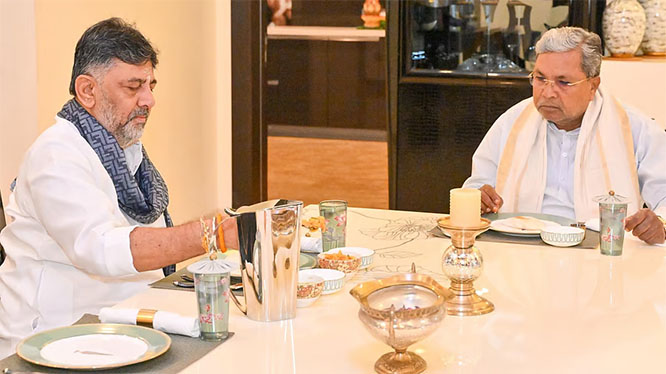
Bengaluru: 'Nati koli saaru' (country chicken curry) considered one of Chief Minister Siddaramaiah’s favourites along with steaming hot idlis was on the breakfast menu at Deputy CM D K Shivakumar’s residence on Tuesday, according to official sources.

The spread also included 'nati koli' fry, vada and pongal, among other items, they said.

In an apparent show of unity, Siddaramaiah visited Shivakumar’s residence for breakfast, just days after the two leaders shared a meal amid a simmering power tussle in the state Congress.

Siddaramaiah drove to the Deputy CM’s residence in Sadashivanagar, where he was received by Shivakumar and his brother D K Suresh, who is a former Congress MP.

Suresh and Kunigal MLA H D Ranganath, a relative of Shivakumar, joined them for breakfast, which featured a mix of vegetarian and non-vegetarian dishes.

Speaking to reporters later, Siddaramaiah said Shivakumar had invited him during his visit to the CM’s residence for breakfast on Saturday.

Asked about the difference between the two meals, the chief minister said, "At his (Shivakumar’s) house it was non-veg, while at my house it was veg. He is a vegetarian, I am a non-vegetarian. I had not prepared non-veg. I told DK to get chicken from the village as you won’t get the original in Bengaluru."

Shivakumar said he had initially invited Siddaramaiah to his residence, but the CM had suggested visiting his place first and reciprocating later. "It was a vegetarian breakfast at the CM’s house on Saturday," he noted.

"Today, I invited him (the CM) to my house. He enjoyed the breakfast, which had his Mysuru taste," Shivakumar added. At this point, Siddaramaiah remarked that Shivakumar’s wife is also from Mysuru.

Saturday’s breakfast at Siddaramaiah’s official residence, held as part of efforts by the Congress high command to ease tensions in the leadership dispute between the two, reportedly included idlis and sambar, according to official sources.

Comments

Add new comment

  • Coastaldigest.com reserves the right to delete or block any comments.
  • Coastaldigset.com is not responsible for its readers’ comments.
  • Comments that are abusive, incendiary or irrelevant are strictly prohibited.
  • Please use a genuine email ID and provide your name to avoid reject.
News Network
November 21,2025

israel.jpg

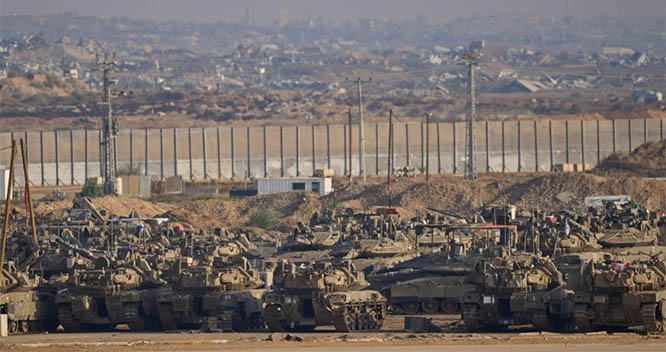
Local authorities say the Israeli military has expanded the so-called “yellow line” truce demarcation in Gaza City and repositioned its forces deeper into the territory in violation of a ceasefire agreement that came into force on October 10, besieging dozens of Palestinian families.

Gaza’s Government Media Office announced in a statement on Thursday that Israeli forces widened the boundary by shifting the markers, and advanced roughly 300 meters (984 feet) into the neighborhoods of Ash-Shaaf, An-Nazzaz and Baghdad Street.

The move pushed further into civilian areas, trapping families who were unable to flee as tanks rolled forward, it added.

“The fate of many of these families remains unknown amidst the shelling that targeted the area,” the office said, adding that the expansion of the yellow line shows a “blatant disregard” for the ceasefire deal.

On Friday, sources said the Israeli military carried out continued air and artillery strikes inside the so-called “yellow line” east of Khan Younis in the southern Gaza Strip.

According to the reports, Israeli warplanes and tanks targeted areas within the zone. One Palestinian was reported killed and several others wounded in the strikes, the sources said.

The fresh aggression came only a day after 25 Palestinians were killed in Israeli airstrikes on Gaza City and Khan Younis on Wednesday.

The media office reported that Israel has consistently violated the truce deal since its implementation last month, with near-daily attacks by air, artillery and direct shootings.

The office said over 400 violations have been documented. These breaches have resulted in the deaths of more than 300 Palestinians and left hundreds injured.

The Government Media Office in Gaza urged the guarantors of the ceasefire — the US, Egypt, Qatar and Turkey — to take swift action to halt the ongoing violations and facilitate the delivery of food, shelter materials, medical aid, and infrastructure equipment.

The so-called “yellow line,” set out in the agreement between Israel and Hamas resistance movement, refers to a non-physical partition where the Israeli military repositioned itself when the truce deal took effect.

It has allowed Israel, which routinely fires at Palestinians who approach the line, to retain control over more than half of the Gaza Strip.

International bodies, including the UN Independent International Commission of Inquiry, the International Association of Genocide Scholars, Amnesty International, Human Rights Watch, B’Tselem, and other rights groups, have concluded that the Israeli war on Gaza amounts to genocide.

In the attacks in Gaza since October 2023, Israel has killed at least 69,546 people and injured 170,833 others, leveling large swaths of the territory and displacing almost all of the population. 

Comments

Add new comment

  • Coastaldigest.com reserves the right to delete or block any comments.
  • Coastaldigset.com is not responsible for its readers’ comments.
  • Comments that are abusive, incendiary or irrelevant are strictly prohibited.
  • Please use a genuine email ID and provide your name to avoid reject.