



Buoyed by 'Ram wave', BJP chalks out plans to topple Congress govt in Karnataka after LS polls

News Network
January 20, 2024

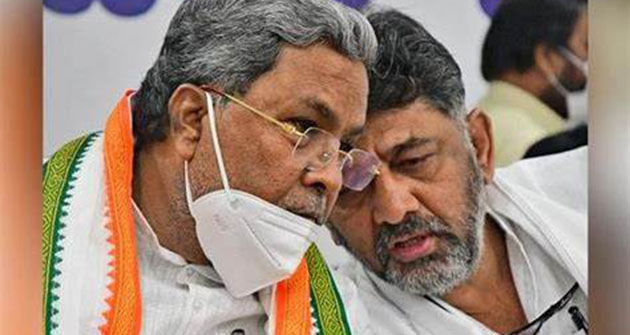
siddaramaiah.jpg

Bengaluru, Jan 20: The BJP camp, which was in a shambles until recently in Karnataka, is gaining momentum following a favourable wave generated by the victory in the Assembly elections of three states late last year and in the run-up to the so called Pran Pratishtha ceremony at the Ram Temple built after destroying Babri Masjid.

Winning the maximum seats in Karnataka seems like an achievable goal, and now the aim is to wrestle power from the state's ruling Congress party, according to BJP sources.

Looking at the developments in the Congress, with a bunch of cabinet ministers targeting Deputy Chief Minister D.K. Shivakumar by demanding more Deputy Chief Minister posts to cut short his influence, and the appeal by Dr. Yathindra, son of Chief Minister Siddaramaiah, that the people should strengthen the hands of his father to help him stay in the post for the full term, very much indicate a tussle for power within their party.

And it is only a matter of time, the BJP sources claimed.

Shivakumar and Siddaramaiah have already spoken about the attempts by the BJP to topple the government, similar to how the Shiv Sena, NCP and the Congress coalition government was brought down in Maharashtra in 2022.

Discussions are already underway within the state's political circles about the BJP’s grand plans to bring down the ruling Congress government after the Lok Sabha polls.

Former Chief Minister H.D. Kumaraswamy had stated that there are Ajit Pawars and Eknath Shindes in Karnataka politics as well, and anything can happen after the Lok Sabha elections.

The Congress is struggling to pacify its MLAs as sufficient funds could not be provided to their constituencies due to the implementation of guarantee schemes.

It is no longer a secret that the BJP is waiting for an appropriate time to strike, explains a prominent leader.

On the other hand, by forging an alliance with the JD(S), the saffron party wants to win over the south Karnataka region and face Congress unitedly in the rest of the state.

After appointing former Chief Minister B.S. Yediyurappa’s son B.Y. Vijayendra as the BJP state President and senior leader R. Ashoka as the Leader of the Opposition, the saffron party is confident of consolidating major Lingayat and Vokkaliga community votes in Karnataka ahead of the general elections.

BJP leaders have claimed that since 1991, the state has voted for their party in the Lok Sabha elections.

The alliance with JD (S) and the Ram Temple wave will help the party get 15 lakh additional votes from south Karnataka districts, which had gone to the Congress with the projection of Shivakumar to the post of Chief Minister during the May 2023 Assembly elections.

In the 2019 general election and riding high on the Prime Minister Narendra Modi wave following the Balakot strike, the BJP had won 25 of the total 28 MP seats.

The party, which looked weak opposite Siddaramaiah and Shivakumar, now seems fully charged and on attack mode.

Although the BJP has distanced itself from Karwar BJP MP Anantkumar Hegde’s derogatory remarks against Siddaramaiah, sources have confirmed that it is part of a strategy to counter the Chief Minister’s criticism of Prime MInister Modi, Union Home Minister Amit Shah, the RSS and Hindutva.

Surprisingly, Siddaramaiah is appearing defensive.

Social media is flooded with pictures of the statue of Ram Lalla and Ayodhya gearing up for the inaugural feat.

The BJP and Hindutva forces are successfully carrying out the campaign on social media and on the ground as well.

The RSS in Karnataka has outlined a plan and reached out to over 29,000 villages in Karnataka ahead of the highly-anticipated Ayodhya event.

The organisation had carried out the Sampark Abhiyaan between January 1 and 15, during which it claimed of reaching out to all the 29,500 villages in the state.

'Mantrakshate' (sacred rice used for worship), a photograph of the Ram Temple in Ayodhya, and handbills brought from Ayodhya have been distributed to the people.

On January 22, the main temples in every Karnataka village will organise 'satsang' and 'Ram Jaap' programs.

LED screens will be erected for the live telecase of the grand event.

Prime Minister Modi had called on every household to light five diyas in the direction of Ayodhya on the evening of January 22.

The BJP is fully confident of garnering goodwill and reaping political gains, party leaders explained.

The saffron camp is growing in confidence in the state, following the internal fights within the Congress government.

Political experts also maintain that Karnataka is going to witness a political struggle between developed castes and backwards, Dalits, and minorities.

Karnataka is all set to witness an intense and close fight between the BJP and Congress in the coming days and creation of rift in the society is also feared in the backdrop of development such as the controversial proposal to implement caste census report.


Comments

Add new comment

  • Coastaldigest.com reserves the right to delete or block any comments.
  • Coastaldigset.com is not responsible for its readers’ comments.
  • Comments that are abusive, incendiary or irrelevant are strictly prohibited.
  • Please use a genuine email ID and provide your name to avoid reject.
News Network
January 23,2026

Mangaluru: The Karnataka Government Polytechnic (KPT), Mangaluru, has achieved autonomous status from the All India Council for Technical Education (AICTE), becoming the first government polytechnic in the country to receive such recognition in its 78-year history. The status was granted by AICTE, New Delhi, and subsequently approved by the Karnataka Board of Technical Education in October last year.

Officials said the autonomy was conferred a few months ago. Until recently, AICTE extended autonomous status only to engineering colleges, excluding diploma institutions. However, with a renewed national focus on skill development, several government polytechnics across India have now been granted autonomy.

KPT, the second-largest polytechnic in Karnataka, was established in 1946 with four branches and has since expanded to offer eight diploma programmes, including computer science and polymer technology. The institution is spread across a 19-acre campus.

Ravindra M Keni, the first dean of the institution, told The Times of India that AICTE had proposed autonomous status for polytechnic institutions that are over 25 years old. “Many colleges applied. In the first round, 100 institutions were shortlisted, which was further narrowed down to 15 in the second round. We have already completed one semester after becoming an autonomous institution,” he said. He added that nearly 500 students are admitted annually across eight three-year diploma courses.

Explaining the factors that helped KPT secure autonomy, Keni said the institution has consistently recorded 100 per cent admissions and placements for its graduates. He also noted its strong performance in sports, with the college emerging champions for 12 consecutive years, along with active student participation in NCC and NSS activities.

Autonomous status allows KPT to design industry-oriented curricula, conduct examinations, prepare question papers, and manage academic documentation independently. The institution can also directly collaborate with industries and receive priority funding from AICTE or the Ministry of Education. While academic autonomy has been granted, financial control will continue to rest with the state government.

“There will be separate committees for examinations, question paper setting, boards of studies, and boards of examiners. The institution will now have the freedom to conduct admissions without government notifications and issue its own marks cards,” Keni said, adding that new academic initiatives would be planned after a year of functioning under the autonomous framework.

Comments

Add new comment

  • Coastaldigest.com reserves the right to delete or block any comments.
  • Coastaldigset.com is not responsible for its readers’ comments.
  • Comments that are abusive, incendiary or irrelevant are strictly prohibited.
  • Please use a genuine email ID and provide your name to avoid reject.
News Network
January 19,2026

trump.jpg

Donald Trump has linked his repeated threats to seize Greenland to his failure to win the Nobel Peace Prize, in a letter to Norwegian Prime Minister Jonas Gahr Støre.

The authenticity of the letter, in which Trump says he no longer feels obligated to “think purely of peace,” was confirmed by Støre to the Norwegian newspaper VG.

“Considering your country decided not to give me the Nobel Peace Prize for having stopped eight wars plus, I no longer feel an obligation to think purely of peace,” Trump wrote, adding he can now “think about what is good and proper for the United States.”

Støre said Trump’s letter was in response to a short message he had sent earlier, on behalf of himself and Finland’s President Alexander Stubb.

Trump has escalated rhetoric toward Greenland, a self-governing Danish territory, insisting the US will take control “one way or the other.” Over the weekend, he tweeted: “Now it is time, and it will be done!!!”

On Saturday, Trump threatened a 10% tariff on imports from Denmark, Norway, Sweden, France, Germany, the UK, the Netherlands, and Finland from 1 February until the US is allowed to purchase the island. EU diplomats met for emergency talks on possible retaliatory tariffs and sanctions.

In his letter, Trump argued Denmark “cannot protect” Greenland from Russia or China, questioning Danish ownership: “There are no written documents; it’s only that a boat landed there hundreds of years ago.” He added that NATO should support the US, claiming the world is “not secure unless we have complete and total control of Greenland.”

Trump’s stance has unsettled the EU and NATO, as he refused to rule out military action to take control of the mineral-rich island.

The Nobel Peace Prize is awarded by the independent Norwegian Nobel Committee, not the government. Trump had campaigned for last year’s prize, which went to Venezuelan opposition leader María Corina Machado, who dedicated her award to him.

Støre reiterated that the Nobel Prize decision rests solely with the committee.

Comments

Add new comment

  • Coastaldigest.com reserves the right to delete or block any comments.
  • Coastaldigset.com is not responsible for its readers’ comments.
  • Comments that are abusive, incendiary or irrelevant are strictly prohibited.
  • Please use a genuine email ID and provide your name to avoid reject.
News Network
January 20,2026

Mangaluru: In a major step towards strengthening rural innovation, the Office of the Principal Scientific Adviser (PSA) to the Government of India is supporting the establishment of RuTAGe Smart Village Centres (RSVCs) across the country through collaborations with academic institutions, civil society organisations and philanthropic partners.

As part of this national initiative, Nitte (Deemed to be University) will set up the first RSVCs in the region at Nitte GP in Udupi district and at the Nitte Health Centre, Sevanjali Trust, Farangipete, in Dakshina Kannada district. The centres will be inaugurated on January 21. In South India, the programme is being implemented by the Section Infin-8 Foundation (SI-8).

Speaking to reporters on Monday, SI-8 founder-director Vishwas US said experts from Nitte University and SI-8 would work closely with farmers, students, youth and local entrepreneurs to adapt and deploy technologies tailored to local needs.

Project head Prof Iddya Karunasagar, representing Nitte DU, said the RSVCs at Nitte and Farangipete would serve as demonstration hubs for a wide range of agriculture, energy, skill-development and assistive technologies. These include solar dryers for fruits, vegetables and crops; soil-testing solutions; power weeders and women-friendly farm tools; wind-powered devices for rural artisans; grain storage systems; grass-cutting and tree-climbing equipment; and liquid fertiliser production using cowshed waste.

SI-8 CEO Aravind C Kumar said the centres would also provide access to digital and knowledge-based platforms such as ISRO applications, government scheme portals, market linkage tools and gamified learning resources, along with assistive technologies for persons with visual impairments.

Highlighting the broader impact of the initiative, Principal Scientific Adviser Prof Ajay Kumar Sood said it demonstrated how applied research could bridge the rural–urban divide and help create self-reliant, technology-enabled villages.

The initiative has been made possible through philanthropic support from Dr NC Murthy of ACM Business Solutions, LLC, USA. Dr Sapna Poti, Director (Strategic Alliances) at the Office of the Principal Scientific Adviser, said the long-term objective is to build self-sufficient, technology-driven communities capable of generating sustainable livelihoods on their own.

Comments

Add new comment

  • Coastaldigest.com reserves the right to delete or block any comments.
  • Coastaldigset.com is not responsible for its readers’ comments.
  • Comments that are abusive, incendiary or irrelevant are strictly prohibited.
  • Please use a genuine email ID and provide your name to avoid reject.