



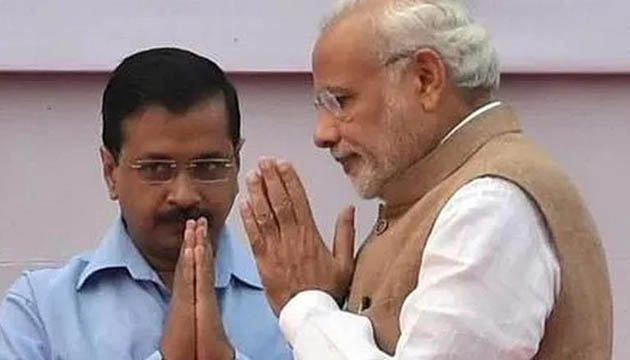
Gujarat HC quashes order to show Modi's PG degree, imposes fine on CM Kejriwal

News Network
March 31, 2023

Kejrimodi.jpg

The Gujarat High Court allowed a petition moved by Gujarat University (GU) challenging direction of Central Information Commission (CIC) asking the varsity to provide post graduate degree of Prime Minister Narendra Modi under Right to Information Act (RTI) to Delhi Chief Minister Arvind Kejriwal. 
 
While setting aside the direction of CIC, Justice Biren Vaishnav also imposed a fine of Rs 25,000 on Delhi CM Kejriwal. The Delhi CM was party respondent in the case. The court refused to stay its order after a request by Kejriwal's lawyer for appealing the verdict. 
 
In 2016, GU had moved the court challenging the order passed by CIC directing it to provide information to Delhi chief minister Arvind Kejriwal on the graduation degree of Modi. 
 
The then information commissioner M Sridhar Acharyulu had passed the direction to the Prime Minister's Office to provide information of Modi's graduation and post graduation degrees to GU as well as Delhi University to help them in searching those documents. GU approached the court stating that CIC didn't have jurisdiction to pass such an order and pleaded the court to quash it.
 
The Delhi Chief Minister himself never filed any formal RTI application. It happened after he provided information about his electoral photo identity but criticised CIC publicly saying that it was "obstructing information on Modi's degrees." 
 
The CIC took cognisance of Delhi CM's response as an application and issued notice to PMO to provide "specific number and year" of degrees of "Narendra Damodardas Modi" for making the search for the documents easy for GU and Delhi University.
 
Solicitor General Tushar Mehta had appeared for the state government-run university and argued, "Although the varsity had nothing to hide, a very short and significant question arises for consideration before the court is whether, in principle, the Right to Information Act be applied either for extraneous purpose to satisfy somebody's curiosity or to give a job opportunity to a few individuals who are misusing the provisions. So, in principle the university is contesting." 
 
Mehta had argued, "No objection so far as degree is concerned... degree is in public domain.. degree was placed in public domain in more than one forum. This particular degree nobody is hiding. But, in principle, this needs to be examined." Mehta argued that seeking education qualification of a public person has to satisfy the RTI exemption clauses that it must be in public interest. He said that "just because the public is interested, it can't be held that it is of public interest." 
 
Mehta said that elections can't be questioned on the basis of educational qualification. "Can you seek any personal information merely because you are curious about it? Can a CM seek information about the health of a PM?," Mehta argued. He gave examples of federal laws of the United States of America and the United Kingdom, which guard personal information of citizens.
 
At the end of his submission, he had told the court that the varsity's petition should be allowed with a cost. "Otherwise, we would be doing a great disservice to the Act, which is intended for something else but it is used for something else...it is used for settling political scores, used for childish jabs against opponents."
 
Appearing for Kejriwal, senior lawyer Percy Kavina responded, saying "Settling political scores and politics is inextricably linked with this matter because of the allied parties who are politically antithetical to each other. He stated that provisions under RTI are clear that one shouldn't be required to give the purpose of seeking information.
 
Kavina argued that direction is to furnish information to the public information officer (PIO) of Gujarat University under RTI Act and not the varsity itself. There is no order against the university. 
 
"The university is a statutory body which can't hold the brief for somebody else no matter how desirable it is. The commission directed the PIO of the Prime Minister's Office and Gujarat University. Why should GU spring to the defence of a person who has not chosen to challenge this order. The PIO of the PMO, public information officer of PMO, is the principal directee... he has not chosen to challenge this order," Kavina argued. He also said that instead of challenging it in the high court, an alternative remedy was available for filing an appeal against the commission's order.
 
He argued that when a candidate contesting elections discloses his or her educational qualification, he goes out of the purview of exemption under RTI Act. "An attempt was made and we inquired that a person doesn't hold qualification. It is an offence to file wrong information. Kavina also contended that no information related to the degree was available in the public domain.
 
"Entire case of the university is being pleaded for by a person who is not before the court. If the university is directed to comply with an order then it is for the person whose information is to be given to be asked yes or no. The order can be treated as a request. Do you have a problem? If you have, I will consider it...it is how the rule of law operates. Ex-US president Donald Trump and US president Joe Biden's houses were also investigated by the FBI. No one is above the law," Kavina had argued. 

Comments

Add new comment

  • Coastaldigest.com reserves the right to delete or block any comments.
  • Coastaldigset.com is not responsible for its readers’ comments.
  • Comments that are abusive, incendiary or irrelevant are strictly prohibited.
  • Please use a genuine email ID and provide your name to avoid reject.
News Network
January 23,2026

oscar.jpg

The Voice of Hind Rajab, inspired by the tragic final moments of a young Palestinian girl killed by Israeli fire in Gaza, has been nominated for an Academy Award in the Best International Feature Film category.

Directed by Tunisian filmmaker Kaouther Ben Hania, the film recounts the true story of five-year-old Hind Rajab, who lost her life in January 2024 while fleeing Israeli bombardment with her family.

The film features the real audio of Hind’s desperate call to the Palestinian Red Crescent Society, where she pleaded for help moments before the vehicle she was in was struck by 355 bullets.

The haunting narrative begins with a brief call made from the besieged Tel al-Hawa neighborhood of Gaza, where gunfire and armored vehicles drowned out every sound.

After witnessing the brutal killing of her family, she made a trembling call, her voice reduced to a whisper as she spoke of the massacre and her unbearable loneliness as the sole survivor.

Premiering at the Venice International Film Festival in September 2025, The Voice of Hind Rajab garnered widespread acclaim, receiving a record-setting 23-minute standing ovation and the Silver Lion Grand Jury Prize, the festival’s second-highest honor.

In her acceptance speech, Ben Hania dedicated the film to humanitarian workers and first responders in Gaza, emphasizing that Hind's voice symbolizes countless civilians affected by war.

She aims to give voice to victims often reduced to mere statistics, highlighting the broader suffering of civilians in war zones.

The film’s Oscar nomination underscores its powerful storytelling and ethical approach to depicting real-life tragedy, making it a crucial piece of contemporary cinema.

It serves not only as a narration of individual tragedy but also as an artistic and documentary response to the silence and censorship that often overshadow West Asian struggles and wars.

Using an innovative method she calls docufiction, Ben Hania bridges unvarnished reality and narrative structure, creating a work that is both artistically valuable and socially impactful.

Born in 1977 in Sidi Bouzid—later the epicenter of the Arab revolution—her background profoundly influenced her worldview and artistic approach.

She is a graduate of the Higher School of Audiovisual Arts of Tunis, Pantheon-Sorbonne University, and La Fémis in Paris, where her studies equipped her with the technical and theoretical tools needed to address complex subjects. 

Comments

Add new comment

  • Coastaldigest.com reserves the right to delete or block any comments.
  • Coastaldigset.com is not responsible for its readers’ comments.
  • Comments that are abusive, incendiary or irrelevant are strictly prohibited.
  • Please use a genuine email ID and provide your name to avoid reject.
News Network
February 1,2026

Bengaluru: The Karnataka High Court has refused to quash an investigation against a WhatsApp group administrator accused of allowing the circulation of obscene and offensive images depicting Hindutva politicians and idols in 2021.

Justice M Nagaprasanna observed that, prima facie, the ingredients of the offence under Section 295A of the Indian Penal Code were made out. “The offence under Section 295A of the IPC is met to every word of its ingredient, albeit prima facie,” the judge said.

The petitioner, Sirajuddin, a resident of Belthangady taluk in Dakshina Kannada district, had challenged the FIR registered against him at the CEN (Cyber, Economics and Narcotics) police station, Mangaluru, for offences under Section 295A of the IPC and Section 67 of the Information Technology Act. Section 295A relates to punishment for deliberate and malicious acts intended to outrage the religious feelings of any class of citizens.

According to the complaint filed by K Jayaraj Salian, also a resident of Belthangady taluk, he received a WhatsApp group link from an unknown source and was added to the group after accessing it. The group reportedly had six administrators and around 250 participants, where obscene and offensive images depicting Hindu deities and certain political figures were allegedly circulated repeatedly.

Sirajuddin was arrested in connection with the case and later released on bail on February 16, 2021. He argued before the court that he was being selectively targeted, while other administrators—including the creator of the group—were neither arrested nor investigated. He also contended that the Magistrate could not have taken cognisance of the offence under Section 295A without prior sanction under Section 196(1) of the CrPC.

Rejecting the argument, Justice Nagaprasanna held that prior sanction is required only at the stage of taking cognisance, and not at the stage of registration of the crime or during investigation.

The judge noted that the State had produced the entire investigation material before the court. “A perusal of the material reveals depictions of Hindu deities in an extraordinarily obscene, demeaning and profane manner. The content is such that its reproduction in a judicial order would itself be inappropriate,” the court said, adding that the material, on its face, had the tendency to outrage religious feelings and disturb communal harmony.

Observing that the case was still at the investigation stage, the court said it could not interdict the probe at this juncture. However, it expressed concern that the investigating officer appeared to have not proceeded uniformly against all administrators. The court clarified that if the investigation revealed the active involvement of any member in permitting the circulation of such content, they must also be proceeded against.

“At this investigative stage, any further observation by this Court would be unnecessary,” the order concluded.

Comments

Add new comment

  • Coastaldigest.com reserves the right to delete or block any comments.
  • Coastaldigset.com is not responsible for its readers’ comments.
  • Comments that are abusive, incendiary or irrelevant are strictly prohibited.
  • Please use a genuine email ID and provide your name to avoid reject.
News Network
February 1,2026

US President Donald Trump on Saturday claimed that the government of India led by Prime Minister Narendra Modi has made a deal to buy Venezuelan oil, as opposed to purchasing it from Iran.

"We've already made that deal, the concept of the deal," he told reporters on Air Force One.

Trump had imposed 25% tariffs on countries buying Venezuelan oil, including India, in March 2025. He had also hit India with tariffs for buying Russian oil, saying it was "funding" President Vladimir Putin's war against Ukraine.

Trump has said that the US has taken control of the oil-rich Venezuela after capturing former President Nicolas Maduro in January.

A fleet of 18 ships loaded with crude oil bound for refineries in Texas, Louisiana, and Mississippi in January, the most since December 2024, according to a report by the news agency Bloomberg.

Combined crude deliveries to the US will reach about 2,75,000 barrels a day, more than doubling volumes seen in December last year. Shipments to China, which averaged 4,00,000 barrels a day last year, fell to zero in January.

PM Modi, Venezuelan President Agree To Expand Ties

Prime Minister Narendra Modi and Venezuela's acting President Delcy Rodriguez spoke on Friday and agreed to take the bilateral relations to "new heights" in the years ahead.

It was the first phone call between the two leaders since the capture of Maduro and his wife by the US on January 3.

"Spoke with Acting President of Venezuela, Ms. Delcy Rodriguez. We agreed to further deepen and expand our bilateral partnership in all areas, with a shared vision of taking India-Venezuela relations to new heights in the years ahead," PM Modi said in a post on X.

A statement from Prime Minister Modi's office said the two leaders agreed to further expand and deepen the India-Venezuela partnership in all areas, including trade and investment, energy, digital technology, health, agriculture, and people-to-people ties.

They exchanged views on various regional and global issues of mutual interest and underscored the importance of their close cooperation for the Global South, the statement said.

Rodriguez also said that they discussed partnerships in the fields of agriculture, science and technology, mining, and tourism, as well as the pharmaceutical and automotive industries.

Comments

Add new comment

  • Coastaldigest.com reserves the right to delete or block any comments.
  • Coastaldigset.com is not responsible for its readers’ comments.
  • Comments that are abusive, incendiary or irrelevant are strictly prohibited.
  • Please use a genuine email ID and provide your name to avoid reject.
