



Here are key takeaways from Karnataka Budget 2024

News Network
February 16, 2024

budget.jpg

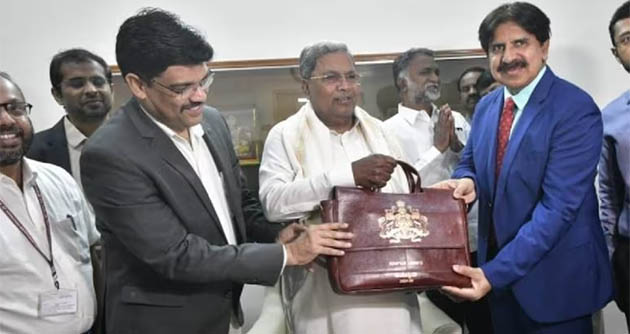
Karnataka Chief Minister Siddaramaiah on Friday presented his record 15th Budget as Finance Minister, and the second under the present Congress regime. In his address to the Karnataka Assembly, he emphasised that his government was striving to establish a new standard of development, known as the 'Karnataka Model of Development,' based on the principles of justice, equality, and fraternity enshrined in the Constitution.

Agriculture:

1) Siddaramaiah announced the implementation of ‘Karnataka Raitha Samruddhi Yojane’ to encourage integrated farming by consolidating various pro-farmer schemes.

2) He also announced the formation of Agriculture Development Authority to facilitate effective implementation of policies related to agriculture and allied activities coming under various departments.

3) Establishment of food parks at airports in Sogane of Shivamogga, Ittangihala of Vijayapura and Pujenahalli of Bengaluru Rural district.

Horticulture:

1) Setting up of Kissan Malls in select districts to provide farmers with horticulture-related technical guidance, market connectivity, farming implements and agro-products under one roof.

2) State-of-the-art international floriculture market to be established in Bengaluru city under Public-Private Partnership.

Animal Husbandry:

1) Construction of new building to 200 veterinary institutions which are in dilapidated condition at a cost of Rs 100 crore.

Fisheries:

1) Rs 7 crore for purchase of sea ambulance for protection of fishermen.
2) Financial assistance to 10,000 houseless fishermen for construction of houses under various housing schemes.

Co-operation:

1) Target of providing record crop loan of Rs 27,000 crore to more than 36 lakh famers in the state.

2) The Karnataka government will also urge the Centre to announce MSP for important crops such as arecanut, onion, grapes, mango, banana and other horticultural crops and to fix MSP based on the formula of cost of cultivation plus 50 per cent profit as per the report by Swaminathan panel.

Water resource:

1) Rs 365 crore project of flowing water from Bhima and Kagina Rivers to Bennetora reservoir to provide drinking water to Kalaburagi city.

School Education and Literacy:

1) 2000 Government Primary Schools to be converted as bi-lingual medium schools to enhance quality of education.

2) NEET/ JEE/ CET coaching to be imparted to 20,000 science students of Government PU Colleges.

Higher Education Department:

1) Rs 100 crore to develop University Visveswaraya College of Engineering on the lines of IIT.

2) Rs 30 crore to upgrade 30 women’s colleges and government women’s polytechnics.

Health:

1) Rs 187 crore to construct critical care block buildings in seven districts.

2) 50 new blood storage units to be established in North Karnataka in next two years.

Medical Education:

1) Rs 20 crore for robotic surgery facility in Institute of Nephro-Urology in Bengaluru.

2) Health repository to be created under Digital Health Society to make treatment details available from single source.

Woman and Child Development:

1) Rs 28,608 crore allocated for Gruhalakshmi gurarantee scheme.

2) Rs 90 crore to be spent on providing 75,938 smartphones to Anganwadi workers and supervisors.

3) Rs 200 crore to construct 1,000 Anganwadis.

4) Enhancement of Pension under Maithri scheme to the linguistic minorities from Rs 800 to Rs 1,200.

Social Welfare:

1) Monthly food allowance to be enhanced by Rs 100 per student for students studying in residential schools and hostels under the social welfare, tribal welfare, backward classes and minority welfare departments.

2) A corpus fund of Rs 35 crore to be set up to bear the cost for treatment of rare diseases and expensive treatments for SC and ST communities.

Scheduled Tribe Welfare:

1) The Ashram schools working under Scheduled Tribe Welfare Department to be re-named as Maharshi Valmiki Adivasi Budakattu Vasathi Shale, and Class 6 & 8 will be started in schools with Class 5 and 7 respectively. The student strength to be enhanced from 25 to 40 in each class.

2) Rs 15,000 stipend to be paid to 200 engineering graduates who got admission in IISc, IIT and NIT for short term professional training courses.

Minorities Welfare:

1) Rs 50 crore for Jain pilgrimage centres and Rs 200 crore for the development of Christian community.

2) Rs 2 crore for the welfare of Sikligar Sikh community, Rs 1 crore to gurudwara in Bidar.

3) Rs 10 crore to encourage minority women SHGs to take up self- employment activities

Housing:

1) Target of construction of three lakh houses this year.

Food, Civil Supplies and Consumer Affairs:

1) Rs 4,595 transferred to 4.02 crore beneficiaries under Annabhagya till January, 2024.

2) Anna-Suvidha programme to be launched to facilitate senior citizens above the age of 80 by door delivery of food grains.

Skill Development:

1) Café Sanjeevini, rural canteens and 2,500 coffee kiosks to be established for women.

2) 50,000 Women SHG owned micro-enterprises to be developed in next two years.

Rural Development and Panchayath Raj:

1) Solar street lights to be installed in 50 panchayaths and systematic metering to be done in 200 panchayaths to reduce electricity charges.

2) Circular economy to be encouraged for sustainable solid waste management in rural areas.

3) The monthly incentive to freed persons from bonded labour system to be increased to Rs 2,000.

Urban Development:

1) Brand Bengaluru launched to develop Bengaluru as a world class city.

2) Efforts to ease traffic congestion will be made by completing white topping works, tunnel to be constructed in Hebbal Junction on pilot basis and installing Area Traffic Signal Control System in 28 importance junctions of the city.

3) Peripheral ring road to be developed under new concept as Bengaluru Business Corridor.

4) 250 meter tall sky-deck to be built in Bengaluru city.

5) 44-km length to be added for the Bengaluru Metro Rail network by March 2025.

6) Feasibility report to extend Metro to Tumkur from BIEC and to Devanahalli from KIAL.

7) 1,334 new electric buses and 820 BS VI diesel buses to be added to the fleet of buses in BMTC.

8) The Cauvery Stage 5 project at a cost of Rs 5,550 crore providing drinking water to 12 lakh people will be commissioned by May 2024.

9) The curbs on businesses during night time to be extended till 1 am in Bengaluru and 10 city corporations in the state.

10) The towns on the outskirts of Bengaluru such as Devanahalli, Nelamangala, Hosakote, Doddaballapura, Magadi and Bidadi will be developed as satellite towns with road and train connectivity.

Energy:

1) 1.65 crore consumers registered under Gruha Jyoti Scheme.

2) Under Phase II of solarisation of IP set feeder, 4.30 lakh IP sets to be solarised by implementing solar projects of 1,192 MW.

PWD:

1) 875-km state highway development at a cost of Rs 5,736 crore with the assistance of external financial institutes under KSHIP-4 in the current year.

2) Construction of six railway overbridges at a cost of Rs 350 crore.

3) Action to construct dedicated economic corridors from Mangaluru port to Bengaluru and Bidar to Bengaluru.

Commerce and Industries:

1) A grant of Rs 50 crore for supplemental infrastructure to the mega textile park project establishing in Kalburgi district in collaboration with state and central government.

Kannada and Culture:

1) A grant of Rs one crore to undertake literature survey, collection, publication and propagation programmes including Tatvapada, Keerthana Sahitya and Bhakti movement through Saintpoet Kanakadasa Study Centre.

2) Steps will be taken to ensure that 60 per cent of signage is in Kannada in the nameplates of all offices, shops and various commercial enterprises under Kannada Language Comprehensive Development Act.

Forest, Ecology and Environment:

1) To address man-animal conflict, measures to form one new task force in Bandipur this year. Allocation of Rs 10 crore to strengthen these task forces.

Excise:

1) IML and beer slab to be revised by rationalising the declared slabs of liquor.

 

Comments

Add new comment

  • Coastaldigest.com reserves the right to delete or block any comments.
  • Coastaldigset.com is not responsible for its readers’ comments.
  • Comments that are abusive, incendiary or irrelevant are strictly prohibited.
  • Please use a genuine email ID and provide your name to avoid reject.
News Network
January 19,2026

New Delhi: Setting speculation to the rest, the CPI(M) has made it clear that it is open to have an electoral understanding with the Congress “to defeat” the Trinamool Congress and the BJP in West Bengal Assembly election even as it is all set to take on the grand old party in Kerala accusing it of “found wanting” in fighting the Hindutva forces.

The CPI(M) also said that it will contest the Tamil Nadu election “with DMK and its allies to defeat the BJP and its allies”, amid a section in the Congress triggering confusion about its participation in the M K Stalin-led coalition over demand over power-sharing and more seats. It is also willing to join hands with Congress and others in Assam and Puducherry to defeat the BJP.

The decisions came at a three-day meeting of the CPI(M) Central Committee in Thiruvananthapuram, which ended on Sunday after reviewing the poll preparations in the poll-bound states.

The CPI(M)'s decision came even as a section led by West Bengal Congress president Subhankar Sarkar is averse to tying up with the Left Front, claiming that their party is not benefitted by the electoral understanding. Both Congress and CPI(M)-led Left Front had electoral understanding in 2016 and 2021 Assembly elections and 2024 Lok Sabha polls.

Congress and the Left Front fought together for the first time in 2016 when Congress won 44 seats and the CPI(M) got 26. In 2021, the Left Front and the Congress drew a blank. In the 2024 Lok Sabha polls, Congress managed to win one seat while the Left did not win any. In the 2019 Lok Sabha polls, both fought against each other with Congress winning two and the Left none.

“In Bengal, the party will work for the defeat of both the TMC and the BJP, which are trying to polarise the society. We will try to rally all the forces that are ready to work against them,” the CPI(M) said in a statement without naming Congress by name. Senior leaders said there is no change in its strategy of pooling all non-BJP, non-TMC votes.

However, the party was critical of the Congress in Kerala where both will fight against each other.

The CPI(M) said it would "expose the BJP-led Union government’s denial of rightful dues to Kerala, the fiscal constraints imposed and the overall attack on federalism" as also "expose the failure of the Congress to effectively counter this attack on federalism, as the largest opposition party in the Parliament".

"The Congress, especially in Kerala, was found wanting in the fight against communal RSS-BJP, ideologically and this will also be exposed before the people," it added.

In Assam, it said, the CPI(M) will work for the mobilisation of all the anti-BJP parties and forces and defeat the rabidly communal and divisive BJP government. The Left parties are cooperating with Congress in the north-eastern state. In Puducherry, it said it will work for the defeat of the BJP alliance government.

Comments

Add new comment

  • Coastaldigest.com reserves the right to delete or block any comments.
  • Coastaldigset.com is not responsible for its readers’ comments.
  • Comments that are abusive, incendiary or irrelevant are strictly prohibited.
  • Please use a genuine email ID and provide your name to avoid reject.
News Network
January 23,2026

Mangaluru: The Karnataka Government Polytechnic (KPT), Mangaluru, has achieved autonomous status from the All India Council for Technical Education (AICTE), becoming the first government polytechnic in the country to receive such recognition in its 78-year history. The status was granted by AICTE, New Delhi, and subsequently approved by the Karnataka Board of Technical Education in October last year.

Officials said the autonomy was conferred a few months ago. Until recently, AICTE extended autonomous status only to engineering colleges, excluding diploma institutions. However, with a renewed national focus on skill development, several government polytechnics across India have now been granted autonomy.

KPT, the second-largest polytechnic in Karnataka, was established in 1946 with four branches and has since expanded to offer eight diploma programmes, including computer science and polymer technology. The institution is spread across a 19-acre campus.

Ravindra M Keni, the first dean of the institution, told The Times of India that AICTE had proposed autonomous status for polytechnic institutions that are over 25 years old. “Many colleges applied. In the first round, 100 institutions were shortlisted, which was further narrowed down to 15 in the second round. We have already completed one semester after becoming an autonomous institution,” he said. He added that nearly 500 students are admitted annually across eight three-year diploma courses.

Explaining the factors that helped KPT secure autonomy, Keni said the institution has consistently recorded 100 per cent admissions and placements for its graduates. He also noted its strong performance in sports, with the college emerging champions for 12 consecutive years, along with active student participation in NCC and NSS activities.

Autonomous status allows KPT to design industry-oriented curricula, conduct examinations, prepare question papers, and manage academic documentation independently. The institution can also directly collaborate with industries and receive priority funding from AICTE or the Ministry of Education. While academic autonomy has been granted, financial control will continue to rest with the state government.

“There will be separate committees for examinations, question paper setting, boards of studies, and boards of examiners. The institution will now have the freedom to conduct admissions without government notifications and issue its own marks cards,” Keni said, adding that new academic initiatives would be planned after a year of functioning under the autonomous framework.

Comments

Add new comment

  • Coastaldigest.com reserves the right to delete or block any comments.
  • Coastaldigset.com is not responsible for its readers’ comments.
  • Comments that are abusive, incendiary or irrelevant are strictly prohibited.
  • Please use a genuine email ID and provide your name to avoid reject.
News Network
February 1,2026

Bengaluru: The Karnataka High Court has refused to quash an investigation against a WhatsApp group administrator accused of allowing the circulation of obscene and offensive images depicting Hindutva politicians and idols in 2021.

Justice M Nagaprasanna observed that, prima facie, the ingredients of the offence under Section 295A of the Indian Penal Code were made out. “The offence under Section 295A of the IPC is met to every word of its ingredient, albeit prima facie,” the judge said.

The petitioner, Sirajuddin, a resident of Belthangady taluk in Dakshina Kannada district, had challenged the FIR registered against him at the CEN (Cyber, Economics and Narcotics) police station, Mangaluru, for offences under Section 295A of the IPC and Section 67 of the Information Technology Act. Section 295A relates to punishment for deliberate and malicious acts intended to outrage the religious feelings of any class of citizens.

According to the complaint filed by K Jayaraj Salian, also a resident of Belthangady taluk, he received a WhatsApp group link from an unknown source and was added to the group after accessing it. The group reportedly had six administrators and around 250 participants, where obscene and offensive images depicting Hindu deities and certain political figures were allegedly circulated repeatedly.

Sirajuddin was arrested in connection with the case and later released on bail on February 16, 2021. He argued before the court that he was being selectively targeted, while other administrators—including the creator of the group—were neither arrested nor investigated. He also contended that the Magistrate could not have taken cognisance of the offence under Section 295A without prior sanction under Section 196(1) of the CrPC.

Rejecting the argument, Justice Nagaprasanna held that prior sanction is required only at the stage of taking cognisance, and not at the stage of registration of the crime or during investigation.

The judge noted that the State had produced the entire investigation material before the court. “A perusal of the material reveals depictions of Hindu deities in an extraordinarily obscene, demeaning and profane manner. The content is such that its reproduction in a judicial order would itself be inappropriate,” the court said, adding that the material, on its face, had the tendency to outrage religious feelings and disturb communal harmony.

Observing that the case was still at the investigation stage, the court said it could not interdict the probe at this juncture. However, it expressed concern that the investigating officer appeared to have not proceeded uniformly against all administrators. The court clarified that if the investigation revealed the active involvement of any member in permitting the circulation of such content, they must also be proceeded against.

“At this investigative stage, any further observation by this Court would be unnecessary,” the order concluded.

Comments

Add new comment

  • Coastaldigest.com reserves the right to delete or block any comments.
  • Coastaldigset.com is not responsible for its readers’ comments.
  • Comments that are abusive, incendiary or irrelevant are strictly prohibited.
  • Please use a genuine email ID and provide your name to avoid reject.