



Here are key takeaways from Karnataka Budget 2024

News Network
February 16, 2024

budget.jpg

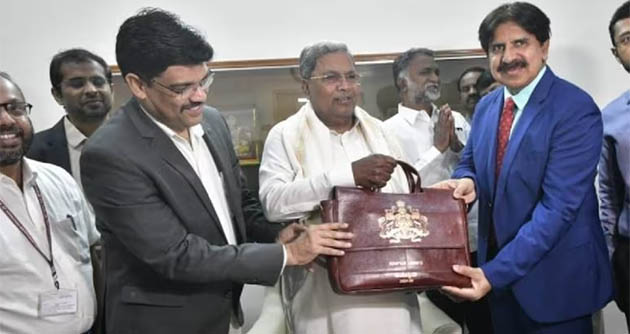
Karnataka Chief Minister Siddaramaiah on Friday presented his record 15th Budget as Finance Minister, and the second under the present Congress regime. In his address to the Karnataka Assembly, he emphasised that his government was striving to establish a new standard of development, known as the 'Karnataka Model of Development,' based on the principles of justice, equality, and fraternity enshrined in the Constitution.

Agriculture:

1) Siddaramaiah announced the implementation of ‘Karnataka Raitha Samruddhi Yojane’ to encourage integrated farming by consolidating various pro-farmer schemes.

2) He also announced the formation of Agriculture Development Authority to facilitate effective implementation of policies related to agriculture and allied activities coming under various departments.

3) Establishment of food parks at airports in Sogane of Shivamogga, Ittangihala of Vijayapura and Pujenahalli of Bengaluru Rural district.

Horticulture:

1) Setting up of Kissan Malls in select districts to provide farmers with horticulture-related technical guidance, market connectivity, farming implements and agro-products under one roof.

2) State-of-the-art international floriculture market to be established in Bengaluru city under Public-Private Partnership.

Animal Husbandry:

1) Construction of new building to 200 veterinary institutions which are in dilapidated condition at a cost of Rs 100 crore.

Fisheries:

1) Rs 7 crore for purchase of sea ambulance for protection of fishermen.
2) Financial assistance to 10,000 houseless fishermen for construction of houses under various housing schemes.

Co-operation:

1) Target of providing record crop loan of Rs 27,000 crore to more than 36 lakh famers in the state.

2) The Karnataka government will also urge the Centre to announce MSP for important crops such as arecanut, onion, grapes, mango, banana and other horticultural crops and to fix MSP based on the formula of cost of cultivation plus 50 per cent profit as per the report by Swaminathan panel.

Water resource:

1) Rs 365 crore project of flowing water from Bhima and Kagina Rivers to Bennetora reservoir to provide drinking water to Kalaburagi city.

School Education and Literacy:

1) 2000 Government Primary Schools to be converted as bi-lingual medium schools to enhance quality of education.

2) NEET/ JEE/ CET coaching to be imparted to 20,000 science students of Government PU Colleges.

Higher Education Department:

1) Rs 100 crore to develop University Visveswaraya College of Engineering on the lines of IIT.

2) Rs 30 crore to upgrade 30 women’s colleges and government women’s polytechnics.

Health:

1) Rs 187 crore to construct critical care block buildings in seven districts.

2) 50 new blood storage units to be established in North Karnataka in next two years.

Medical Education:

1) Rs 20 crore for robotic surgery facility in Institute of Nephro-Urology in Bengaluru.

2) Health repository to be created under Digital Health Society to make treatment details available from single source.

Woman and Child Development:

1) Rs 28,608 crore allocated for Gruhalakshmi gurarantee scheme.

2) Rs 90 crore to be spent on providing 75,938 smartphones to Anganwadi workers and supervisors.

3) Rs 200 crore to construct 1,000 Anganwadis.

4) Enhancement of Pension under Maithri scheme to the linguistic minorities from Rs 800 to Rs 1,200.

Social Welfare:

1) Monthly food allowance to be enhanced by Rs 100 per student for students studying in residential schools and hostels under the social welfare, tribal welfare, backward classes and minority welfare departments.

2) A corpus fund of Rs 35 crore to be set up to bear the cost for treatment of rare diseases and expensive treatments for SC and ST communities.

Scheduled Tribe Welfare:

1) The Ashram schools working under Scheduled Tribe Welfare Department to be re-named as Maharshi Valmiki Adivasi Budakattu Vasathi Shale, and Class 6 & 8 will be started in schools with Class 5 and 7 respectively. The student strength to be enhanced from 25 to 40 in each class.

2) Rs 15,000 stipend to be paid to 200 engineering graduates who got admission in IISc, IIT and NIT for short term professional training courses.

Minorities Welfare:

1) Rs 50 crore for Jain pilgrimage centres and Rs 200 crore for the development of Christian community.

2) Rs 2 crore for the welfare of Sikligar Sikh community, Rs 1 crore to gurudwara in Bidar.

3) Rs 10 crore to encourage minority women SHGs to take up self- employment activities

Housing:

1) Target of construction of three lakh houses this year.

Food, Civil Supplies and Consumer Affairs:

1) Rs 4,595 transferred to 4.02 crore beneficiaries under Annabhagya till January, 2024.

2) Anna-Suvidha programme to be launched to facilitate senior citizens above the age of 80 by door delivery of food grains.

Skill Development:

1) Café Sanjeevini, rural canteens and 2,500 coffee kiosks to be established for women.

2) 50,000 Women SHG owned micro-enterprises to be developed in next two years.

Rural Development and Panchayath Raj:

1) Solar street lights to be installed in 50 panchayaths and systematic metering to be done in 200 panchayaths to reduce electricity charges.

2) Circular economy to be encouraged for sustainable solid waste management in rural areas.

3) The monthly incentive to freed persons from bonded labour system to be increased to Rs 2,000.

Urban Development:

1) Brand Bengaluru launched to develop Bengaluru as a world class city.

2) Efforts to ease traffic congestion will be made by completing white topping works, tunnel to be constructed in Hebbal Junction on pilot basis and installing Area Traffic Signal Control System in 28 importance junctions of the city.

3) Peripheral ring road to be developed under new concept as Bengaluru Business Corridor.

4) 250 meter tall sky-deck to be built in Bengaluru city.

5) 44-km length to be added for the Bengaluru Metro Rail network by March 2025.

6) Feasibility report to extend Metro to Tumkur from BIEC and to Devanahalli from KIAL.

7) 1,334 new electric buses and 820 BS VI diesel buses to be added to the fleet of buses in BMTC.

8) The Cauvery Stage 5 project at a cost of Rs 5,550 crore providing drinking water to 12 lakh people will be commissioned by May 2024.

9) The curbs on businesses during night time to be extended till 1 am in Bengaluru and 10 city corporations in the state.

10) The towns on the outskirts of Bengaluru such as Devanahalli, Nelamangala, Hosakote, Doddaballapura, Magadi and Bidadi will be developed as satellite towns with road and train connectivity.

Energy:

1) 1.65 crore consumers registered under Gruha Jyoti Scheme.

2) Under Phase II of solarisation of IP set feeder, 4.30 lakh IP sets to be solarised by implementing solar projects of 1,192 MW.

PWD:

1) 875-km state highway development at a cost of Rs 5,736 crore with the assistance of external financial institutes under KSHIP-4 in the current year.

2) Construction of six railway overbridges at a cost of Rs 350 crore.

3) Action to construct dedicated economic corridors from Mangaluru port to Bengaluru and Bidar to Bengaluru.

Commerce and Industries:

1) A grant of Rs 50 crore for supplemental infrastructure to the mega textile park project establishing in Kalburgi district in collaboration with state and central government.

Kannada and Culture:

1) A grant of Rs one crore to undertake literature survey, collection, publication and propagation programmes including Tatvapada, Keerthana Sahitya and Bhakti movement through Saintpoet Kanakadasa Study Centre.

2) Steps will be taken to ensure that 60 per cent of signage is in Kannada in the nameplates of all offices, shops and various commercial enterprises under Kannada Language Comprehensive Development Act.

Forest, Ecology and Environment:

1) To address man-animal conflict, measures to form one new task force in Bandipur this year. Allocation of Rs 10 crore to strengthen these task forces.

Excise:

1) IML and beer slab to be revised by rationalising the declared slabs of liquor.

 

Comments

Add new comment

  • Coastaldigest.com reserves the right to delete or block any comments.
  • Coastaldigset.com is not responsible for its readers’ comments.
  • Comments that are abusive, incendiary or irrelevant are strictly prohibited.
  • Please use a genuine email ID and provide your name to avoid reject.
News Network
January 20,2026

Mangaluru: In a major step towards strengthening rural innovation, the Office of the Principal Scientific Adviser (PSA) to the Government of India is supporting the establishment of RuTAGe Smart Village Centres (RSVCs) across the country through collaborations with academic institutions, civil society organisations and philanthropic partners.

As part of this national initiative, Nitte (Deemed to be University) will set up the first RSVCs in the region at Nitte GP in Udupi district and at the Nitte Health Centre, Sevanjali Trust, Farangipete, in Dakshina Kannada district. The centres will be inaugurated on January 21. In South India, the programme is being implemented by the Section Infin-8 Foundation (SI-8).

Speaking to reporters on Monday, SI-8 founder-director Vishwas US said experts from Nitte University and SI-8 would work closely with farmers, students, youth and local entrepreneurs to adapt and deploy technologies tailored to local needs.

Project head Prof Iddya Karunasagar, representing Nitte DU, said the RSVCs at Nitte and Farangipete would serve as demonstration hubs for a wide range of agriculture, energy, skill-development and assistive technologies. These include solar dryers for fruits, vegetables and crops; soil-testing solutions; power weeders and women-friendly farm tools; wind-powered devices for rural artisans; grain storage systems; grass-cutting and tree-climbing equipment; and liquid fertiliser production using cowshed waste.

SI-8 CEO Aravind C Kumar said the centres would also provide access to digital and knowledge-based platforms such as ISRO applications, government scheme portals, market linkage tools and gamified learning resources, along with assistive technologies for persons with visual impairments.

Highlighting the broader impact of the initiative, Principal Scientific Adviser Prof Ajay Kumar Sood said it demonstrated how applied research could bridge the rural–urban divide and help create self-reliant, technology-enabled villages.

The initiative has been made possible through philanthropic support from Dr NC Murthy of ACM Business Solutions, LLC, USA. Dr Sapna Poti, Director (Strategic Alliances) at the Office of the Principal Scientific Adviser, said the long-term objective is to build self-sufficient, technology-driven communities capable of generating sustainable livelihoods on their own.

Comments

Add new comment

  • Coastaldigest.com reserves the right to delete or block any comments.
  • Coastaldigset.com is not responsible for its readers’ comments.
  • Comments that are abusive, incendiary or irrelevant are strictly prohibited.
  • Please use a genuine email ID and provide your name to avoid reject.
News Network
February 1,2026

Bengaluru, Feb 1: For travelers landing at Kempegowda International Airport (KIA), the sleek, wood-paneled curves of Terminal 2 promise a world-class welcome. But the famed “Garden City” charm quickly withers at the curb. As India’s aviation sector swells to record numbers—handling over 43 million passengers in Bengaluru alone this past year—the “last mile” has turned into a marathon of frustration.

The Bengaluru Logjam: Rules vs Reality

While the city awaits the 2027 completion of the Namma Metro Blue Line, the interim has been chaotic. Recent “decongestion” rules at Terminal 1 have pushed app-based cab pickups to distant parking zones, forcing weary passengers into a 20-minute walk with luggage.

“I landed after ten months away and felt like a stranger in my own city,” says Ruchitha Jain, a Koramangala resident. “My driver couldn’t find me, staff couldn’t guide me, and the so-called ‘Premium’ lane is just a fancy tax on convenience.”

•    The Cost of Distance: A 40-km cab ride can now easily cross ₹1,500, driven by demand pricing and airport surcharges.

•    The Bus Gap: While Vayu Vajra remains a lifeline, its ₹300–₹400 fare is often cited as the most expensive airport bus service in the country.

A National Pattern of Disconnect

The struggle is not unique to Karnataka. From Chennai’s coast to Hyderabad’s plateau, India’s airports tell a familiar story: brilliant runways, broken exits.

City:    Primary Issue   |    Recent Development

Bengaluru:    Cab pickup restrictions & distance  |    App-based taxis shifted to far parking zones; long walks and fare spikes reported

Chennai:    Multi-Level Parking (MLCP) hike  |    Passengers report 40-minute walks to reach cab pickup points

Hyderabad:    “Taxi mafia” & touting  |    Over 440 touting cases reported; security presence intensified

Mumbai:    Fare scams  |     Tourists charged ₹18,000 for just 400 metres, triggering police action

In Hyderabad, travelers continue to battle entrenched local groups that intimidate Uber and Ola drivers, pushing passengers toward overpriced private taxis. Chennai flyers, meanwhile, complain that reaching the designated pickup zones now takes longer than short-haul flights from cities like Coimbatore.

The ‘Budget Day’ Hope

As Finance Minister Nirmala Sitharaman presents the Union Budget 2026 today, the aviation sector is watching closely. With the government’s renewed emphasis on multimodal integration, there is cautious hope for funding toward seamless airport-metro-bus hubs.

The vision is clear: a future where planes, trains, and metros speak the same language. Until then, passengers at KIA—and airports across India—will continue to discover that the hardest part of flying isn’t the thousands of kilometres in the air, but the last few on the ground.

Comments

Add new comment

  • Coastaldigest.com reserves the right to delete or block any comments.
  • Coastaldigset.com is not responsible for its readers’ comments.
  • Comments that are abusive, incendiary or irrelevant are strictly prohibited.
  • Please use a genuine email ID and provide your name to avoid reject.
News Network
January 23,2026

Karnataka Governor Thaawarchand Gehlot read only three lines from the 122-paragraph address prepared by the Congress-led state government while addressing the joint session of the Legislature on Thursday, effectively bypassing large sections critical of the BJP-led Union government.

The omitted portions of the customary Governor’s address outlined what the state government described as a “suppressive situation in economic and policy matters” under India’s federal framework. The speech also sharply criticised the Centre’s move to replace the Mahatma Gandhi National Rural Employment Guarantee Act (MGNREGA) with the Viksit Bharat–Guarantee for Rozgar and Ajeevika Mission (Gramin) Act, commonly referred to as the VB-GRAM (G) Act.

Governor Gehlot had earlier conveyed his objection to several paragraphs that were explicitly critical of the Union government. On Thursday, he confined himself to the opening lines — “I extend a warm welcome to all of you to the joint session of the State legislature. I am extremely pleased to address this august House” — before jumping directly to the concluding sentence of the final paragraph.

He ended the address by reading the last line of paragraph 122: “Overall, my government is firmly committed to doubling the pace of the State’s economic, social and physical development. Jai Hind — Jai Karnataka.”

According to the prepared speech, the Karnataka government demanded the scrapping of the VB-GRAM (G) Act, describing it as “contractor-centric” and detrimental to rural livelihoods, and called for the full restoration of MGNREGA. The state government argued that the new law undermines decentralisation, weakens labour protections, and centralises decision-making in violation of constitutional norms.

Key points from the unread sections of the speech:

•    Karnataka facing a “suppressive” economic and policy environment within the federal system

•    Repeal of MGNREGA described as a blow to rural livelihoods

•    VB-GRAM (G) Act accused of protecting corporate and contractor interests

•    New law alleged to weaken decentralised governance

•    Decision-making said to be imposed by the Centre without consulting states

•    Rights of Adivasis, women, backward classes and agrarian communities curtailed

•    Labourers allegedly placed under contractor control

•    States facing mounting fiscal stress due to central policies

•    VB-GRAM (G) Act accused of enabling large-scale corruption

Comments

Add new comment

  • Coastaldigest.com reserves the right to delete or block any comments.
  • Coastaldigset.com is not responsible for its readers’ comments.
  • Comments that are abusive, incendiary or irrelevant are strictly prohibited.
  • Please use a genuine email ID and provide your name to avoid reject.