



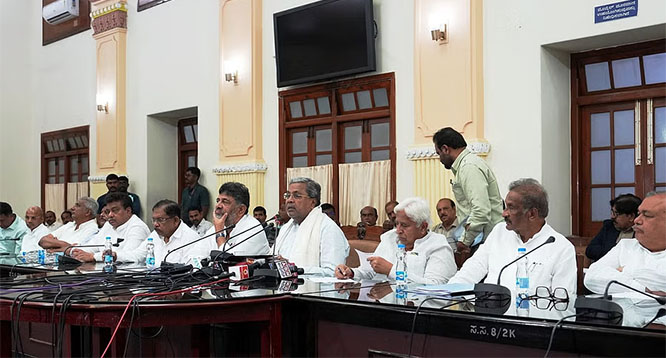
Karnataka Cabinet Accepts Caste Census Report as Six Ministers Skip Meeting

News Network
April 11, 2025

cabinet.jpg

Bengaluru, Apr 11: In a significant development, the Karnataka Cabinet on Friday formally accepted the controversial Socio-Economic and Educational Survey, popularly known as the caste census, nearly a decade after it was conducted. The report will be taken up for detailed discussion in a special Cabinet meeting on April 17.

The survey was originally carried out in 2015 by the Karnataka State Commission for Backward Classes under the chairmanship of H. Kantharaj, and finalised in February 2024 by his successor, K. Jayaprakash Hegde. The long-awaited report—comprising 50 volumes of detailed caste- and community-related data—was placed before the Cabinet in a sealed cover, which was opened during Friday’s meeting.

Backward Classes Welfare Minister Shivaraj Tangadagi, while briefing the media, said the report would now be distributed to all Cabinet ministers so they could examine its findings ahead of the April 17 meeting. Though the government did not disclose the contents of the report, it sought to validate the survey’s legitimacy by presenting statistical data.

“As per the 2011 Census, Karnataka’s population was 6.11 crore. By 2015, when the survey was conducted, it had grown to an estimated 6.35 crore. The survey covered 5.98 crore people—a coverage of 94.17 percent,” Tangadagi said.
He added that only 37 lakh people, or 5.83 percent, were left out of the enumeration process.

Highlighting the scale of the operation, the minister said 1.6 lakh government officials participated in the survey. An expert committee was constituted, which developed 54 criteria to guide the data collection. The state government also engaged Bharat Electronics Limited (BEL) to manage the survey data under a ₹43 crore agreement, with the total expenditure reaching ₹165 crore.

Law and Parliamentary Affairs Minister H. K. Patil announced that a special Cabinet session will be held on April 17 to deliberate on the report's contents. When asked about concerns over the completeness of the data, Patil responded, “Even in the national Census, some people are left out. A 94 percent coverage is a very significant achievement.”

The caste census remains a politically sensitive issue in Karnataka. Dominant communities such as the Lingayats and Vokkaligas have questioned the methodology of the 2015 survey, alleging undercounting. In contrast, Other Backward Classes (OBCs) and SC/ST groups have welcomed the report, arguing that it sheds light on social realities long ignored.

The Congress party had pledged to act on the caste census in its manifestos for the 2023 Karnataka Assembly elections and the 2024 Lok Sabha polls. National party leader Rahul Gandhi has also been advocating for a nationwide caste census.

The Cabinet’s acceptance of the report comes just days after Chief Minister Siddaramaiah’s meeting with Rahul Gandhi in New Delhi, and the Congress Working Committee’s session in Ahmedabad.

Six Ministers Skip Cabinet Meeting

At least six ministers were notably absent from Friday’s Cabinet meeting. These included:

    S. S. Mallikarjun and Laxmi Hebbalkar (both Lingayats)

    M. C. Sudhakar and K. Venkatesh (both Vokkaligas)

    R. B. Timmapur (SC)

    Madhu Bangarappa (Idiga community)

However, Minister Patil clarified that despite their absence, all ministers have endorsed the Cabinet’s collective decision, regardless of caste or community affiliations.


Comments

Add new comment

  • Coastaldigest.com reserves the right to delete or block any comments.
  • Coastaldigset.com is not responsible for its readers’ comments.
  • Comments that are abusive, incendiary or irrelevant are strictly prohibited.
  • Please use a genuine email ID and provide your name to avoid reject.
News Network
January 23,2026

modIKERALA.jpg

Prime Minister Narendra Modi, during his visit to Thiruvananthapuram on Friday, January 23, indicated that the Bharatiya Janata Party (BJP) is aiming to expand its political footprint in Kerala ahead of the Assembly elections scheduled in the coming months.

Speaking at a BJP-organised public meeting, Modi drew parallels between the party’s early electoral gains in Gujarat and its recent victory in the Thiruvananthapuram Municipal Corporation. The civic body win, which ended decades of Left control, was cited by the Prime Minister as a possible starting point for the party’s broader ambitions in the state.

Recalling BJP’s political trajectory in Gujarat, Modi said the party was largely insignificant before 1987 and received little media attention. He pointed out that the BJP’s first major breakthrough came with its victory in the Ahmedabad Municipal Corporation that year.

“Just as our journey in Gujarat began with one city, Kerala’s journey has also started with a single city,” Modi said, suggesting that the party’s municipal-level success could translate into wider electoral acceptance.

The Prime Minister alleged that successive governments led by the Left Democratic Front (LDF) and the United Democratic Front (UDF) had failed to adequately develop Thiruvananthapuram. He accused both fronts of corruption and neglect, claiming that basic infrastructure and facilities were denied to the capital city for decades.

According to Modi, the BJP’s control of the civic body represents a shift driven by public dissatisfaction with the existing political alternatives. He asserted that the BJP administration in Thiruvananthapuram had begun working towards development, though no specific details or timelines were outlined.

Addressing the gathering at Putharikandam Maidan, Modi said the BJP intended to project Thiruvananthapuram as a “model city,” reiterating his party’s commitment to governance-led change.

The Prime Minister’s visit to Kerala also included the inauguration of several development projects and the flagging off of new train services, as the BJP intensifies its political outreach in the poll-bound state.

Comments

Add new comment

  • Coastaldigest.com reserves the right to delete or block any comments.
  • Coastaldigset.com is not responsible for its readers’ comments.
  • Comments that are abusive, incendiary or irrelevant are strictly prohibited.
  • Please use a genuine email ID and provide your name to avoid reject.
News Network
January 20,2026

Mangaluru: In a major step towards strengthening rural innovation, the Office of the Principal Scientific Adviser (PSA) to the Government of India is supporting the establishment of RuTAGe Smart Village Centres (RSVCs) across the country through collaborations with academic institutions, civil society organisations and philanthropic partners.

As part of this national initiative, Nitte (Deemed to be University) will set up the first RSVCs in the region at Nitte GP in Udupi district and at the Nitte Health Centre, Sevanjali Trust, Farangipete, in Dakshina Kannada district. The centres will be inaugurated on January 21. In South India, the programme is being implemented by the Section Infin-8 Foundation (SI-8).

Speaking to reporters on Monday, SI-8 founder-director Vishwas US said experts from Nitte University and SI-8 would work closely with farmers, students, youth and local entrepreneurs to adapt and deploy technologies tailored to local needs.

Project head Prof Iddya Karunasagar, representing Nitte DU, said the RSVCs at Nitte and Farangipete would serve as demonstration hubs for a wide range of agriculture, energy, skill-development and assistive technologies. These include solar dryers for fruits, vegetables and crops; soil-testing solutions; power weeders and women-friendly farm tools; wind-powered devices for rural artisans; grain storage systems; grass-cutting and tree-climbing equipment; and liquid fertiliser production using cowshed waste.

SI-8 CEO Aravind C Kumar said the centres would also provide access to digital and knowledge-based platforms such as ISRO applications, government scheme portals, market linkage tools and gamified learning resources, along with assistive technologies for persons with visual impairments.

Highlighting the broader impact of the initiative, Principal Scientific Adviser Prof Ajay Kumar Sood said it demonstrated how applied research could bridge the rural–urban divide and help create self-reliant, technology-enabled villages.

The initiative has been made possible through philanthropic support from Dr NC Murthy of ACM Business Solutions, LLC, USA. Dr Sapna Poti, Director (Strategic Alliances) at the Office of the Principal Scientific Adviser, said the long-term objective is to build self-sufficient, technology-driven communities capable of generating sustainable livelihoods on their own.

Comments

Add new comment

  • Coastaldigest.com reserves the right to delete or block any comments.
  • Coastaldigset.com is not responsible for its readers’ comments.
  • Comments that are abusive, incendiary or irrelevant are strictly prohibited.
  • Please use a genuine email ID and provide your name to avoid reject.