



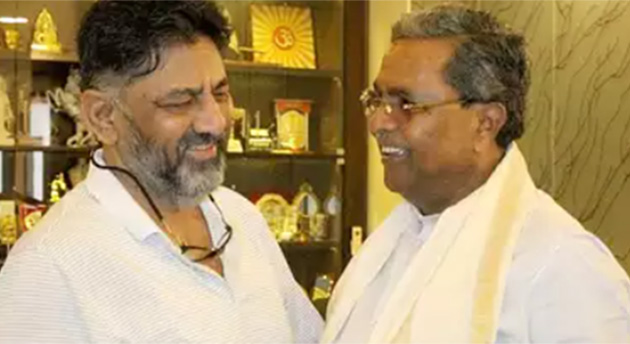
Karnataka CM race: SWOC analysis of DKS and Siddaramaiah

News Network
May 15, 2023

SidDKS.jpg

After the Congress's emphatic 135-seat win in the May 10 Karnataka Assembly polls, the focus has now shifted to the all-important question, "who will be the Chief Minister."

And the race for the top post has heated up between old warhorses Siddaramaiah and DK Shivakumar, with both leaders making no secret of their ambition to lead the southern state. The Congress Legislature Party (CLP) has unanimously authorised All India Congress Committee (AICC) President M Mallikarjun Kharge to pick its leader, who will be the next chief minister of the state.

Here is a SWOT (Strengths, Weaknesses, Opportunities and Challenges) analysis of the two aspiring CMs.

Siddaramaiah:

Strengths:
•    Mass appeal across the state
•    Popular among a large section of Congress legislators
•    Experience of having run a full-term government as Chief Minister (2013-18).
•    Able administrator with experience of having presented 13 budgets.
•    Clout among the AHINDA (Kannada acronym for minorities, backward classes and Dalits).
•    Strong ability to take on BJP and JD(S), most importantly PM Modi and his government on issues.
•    Considered close to Rahul Gandhi and apparently has his backing.

Weaknesses: 
•    Not so much organisationally connected with the party.
•    Failure in bringing the Congress government back to power in 2018 under his leadership.
•    Still considered an outsider by a section of Congress old guard. He was formerly with the JD(S).
•    Age factor- Sidddaramiah is 75.

Opportunities: 
*Acceptability, appeal and experience to take along every one to run a government with a decisive mandate, and strengthen Congress for the 2024 Lok Sabha polls.
* IT, ED and CBI cases against opponent Shivakumar, who is also eyeing the CM post.
*Last election and last chance to become CM.
 
Challenges:
•    Uniting of senior Congress old guards like Mallikarjun Kharge, G Parameshwara, who have missed becoming CM because of Siddaramaiah, also B K Hariprasad, K H Muniyappa among others against him.
•    Call for a Dalit CM. *Shivakumar's organisational strength, party's 'troubleshooter' tag, loyalty image across the country, and closeness to Gandhi family, especially Sonia Gandhi and Priyanka Gandhi Vadra.

D K Shivakumar: 

Strengths:
•    Strong organisational capabilities and having led the party to victory in elections.
•    Known for party loyalty.
•    Considered Congress' ace troubleshooter during difficult times.
•    Resourceful leader.
•    Has the backing of the dominant Vokkaliga community, its influential seers and leaders.
•    Closeness to Gandhi family. * Age factor on his side.
•    Long political experience; has handled various portfolios.

Weaknesses:
•     Cases against him before IT, ED and CBI.
•    Jail term in Tihar
•    Lesser mass appeal and experience compared to Siddaramaiah. 
•    Clout by and large limited to the Old Mysuru region.
•    Not having much backing from other communities.

Opportunities: 
•    Congress' domination of the Old Mysuru region would go to Shivakumar, a Vokkaliga.
•    KPCC President, as the natural choice to be the CM, like in the case of SM Krishna and Veerendra Patil.
•    Chances of the party old guard backing him.

Challenges:
•    Siddaramaiah's experience, seniority and mass appeal.
•    Chances of large number of MLAs backing Siddaramaiah.
•    Legal hurdles because of cases filed by central agencies.
•    Call for a Dalit or Lingayat CM.
•    Rahul Gandhi's apparent backing of Siddaramaiah.

Comments

Add new comment

  • Coastaldigest.com reserves the right to delete or block any comments.
  • Coastaldigset.com is not responsible for its readers’ comments.
  • Comments that are abusive, incendiary or irrelevant are strictly prohibited.
  • Please use a genuine email ID and provide your name to avoid reject.
News Network
January 20,2026

Mangaluru: In a major step towards strengthening rural innovation, the Office of the Principal Scientific Adviser (PSA) to the Government of India is supporting the establishment of RuTAGe Smart Village Centres (RSVCs) across the country through collaborations with academic institutions, civil society organisations and philanthropic partners.

As part of this national initiative, Nitte (Deemed to be University) will set up the first RSVCs in the region at Nitte GP in Udupi district and at the Nitte Health Centre, Sevanjali Trust, Farangipete, in Dakshina Kannada district. The centres will be inaugurated on January 21. In South India, the programme is being implemented by the Section Infin-8 Foundation (SI-8).

Speaking to reporters on Monday, SI-8 founder-director Vishwas US said experts from Nitte University and SI-8 would work closely with farmers, students, youth and local entrepreneurs to adapt and deploy technologies tailored to local needs.

Project head Prof Iddya Karunasagar, representing Nitte DU, said the RSVCs at Nitte and Farangipete would serve as demonstration hubs for a wide range of agriculture, energy, skill-development and assistive technologies. These include solar dryers for fruits, vegetables and crops; soil-testing solutions; power weeders and women-friendly farm tools; wind-powered devices for rural artisans; grain storage systems; grass-cutting and tree-climbing equipment; and liquid fertiliser production using cowshed waste.

SI-8 CEO Aravind C Kumar said the centres would also provide access to digital and knowledge-based platforms such as ISRO applications, government scheme portals, market linkage tools and gamified learning resources, along with assistive technologies for persons with visual impairments.

Highlighting the broader impact of the initiative, Principal Scientific Adviser Prof Ajay Kumar Sood said it demonstrated how applied research could bridge the rural–urban divide and help create self-reliant, technology-enabled villages.

The initiative has been made possible through philanthropic support from Dr NC Murthy of ACM Business Solutions, LLC, USA. Dr Sapna Poti, Director (Strategic Alliances) at the Office of the Principal Scientific Adviser, said the long-term objective is to build self-sufficient, technology-driven communities capable of generating sustainable livelihoods on their own.

Comments

Add new comment

  • Coastaldigest.com reserves the right to delete or block any comments.
  • Coastaldigset.com is not responsible for its readers’ comments.
  • Comments that are abusive, incendiary or irrelevant are strictly prohibited.
  • Please use a genuine email ID and provide your name to avoid reject.
News Network
February 1,2026

Bengaluru: The Karnataka High Court has refused to quash an investigation against a WhatsApp group administrator accused of allowing the circulation of obscene and offensive images depicting Hindutva politicians and idols in 2021.

Justice M Nagaprasanna observed that, prima facie, the ingredients of the offence under Section 295A of the Indian Penal Code were made out. “The offence under Section 295A of the IPC is met to every word of its ingredient, albeit prima facie,” the judge said.

The petitioner, Sirajuddin, a resident of Belthangady taluk in Dakshina Kannada district, had challenged the FIR registered against him at the CEN (Cyber, Economics and Narcotics) police station, Mangaluru, for offences under Section 295A of the IPC and Section 67 of the Information Technology Act. Section 295A relates to punishment for deliberate and malicious acts intended to outrage the religious feelings of any class of citizens.

According to the complaint filed by K Jayaraj Salian, also a resident of Belthangady taluk, he received a WhatsApp group link from an unknown source and was added to the group after accessing it. The group reportedly had six administrators and around 250 participants, where obscene and offensive images depicting Hindu deities and certain political figures were allegedly circulated repeatedly.

Sirajuddin was arrested in connection with the case and later released on bail on February 16, 2021. He argued before the court that he was being selectively targeted, while other administrators—including the creator of the group—were neither arrested nor investigated. He also contended that the Magistrate could not have taken cognisance of the offence under Section 295A without prior sanction under Section 196(1) of the CrPC.

Rejecting the argument, Justice Nagaprasanna held that prior sanction is required only at the stage of taking cognisance, and not at the stage of registration of the crime or during investigation.

The judge noted that the State had produced the entire investigation material before the court. “A perusal of the material reveals depictions of Hindu deities in an extraordinarily obscene, demeaning and profane manner. The content is such that its reproduction in a judicial order would itself be inappropriate,” the court said, adding that the material, on its face, had the tendency to outrage religious feelings and disturb communal harmony.

Observing that the case was still at the investigation stage, the court said it could not interdict the probe at this juncture. However, it expressed concern that the investigating officer appeared to have not proceeded uniformly against all administrators. The court clarified that if the investigation revealed the active involvement of any member in permitting the circulation of such content, they must also be proceeded against.

“At this investigative stage, any further observation by this Court would be unnecessary,” the order concluded.

Comments

Add new comment

  • Coastaldigest.com reserves the right to delete or block any comments.
  • Coastaldigset.com is not responsible for its readers’ comments.
  • Comments that are abusive, incendiary or irrelevant are strictly prohibited.
  • Please use a genuine email ID and provide your name to avoid reject.
News Network
January 23,2026

Karnataka Governor Thaawarchand Gehlot read only three lines from the 122-paragraph address prepared by the Congress-led state government while addressing the joint session of the Legislature on Thursday, effectively bypassing large sections critical of the BJP-led Union government.

The omitted portions of the customary Governor’s address outlined what the state government described as a “suppressive situation in economic and policy matters” under India’s federal framework. The speech also sharply criticised the Centre’s move to replace the Mahatma Gandhi National Rural Employment Guarantee Act (MGNREGA) with the Viksit Bharat–Guarantee for Rozgar and Ajeevika Mission (Gramin) Act, commonly referred to as the VB-GRAM (G) Act.

Governor Gehlot had earlier conveyed his objection to several paragraphs that were explicitly critical of the Union government. On Thursday, he confined himself to the opening lines — “I extend a warm welcome to all of you to the joint session of the State legislature. I am extremely pleased to address this august House” — before jumping directly to the concluding sentence of the final paragraph.

He ended the address by reading the last line of paragraph 122: “Overall, my government is firmly committed to doubling the pace of the State’s economic, social and physical development. Jai Hind — Jai Karnataka.”

According to the prepared speech, the Karnataka government demanded the scrapping of the VB-GRAM (G) Act, describing it as “contractor-centric” and detrimental to rural livelihoods, and called for the full restoration of MGNREGA. The state government argued that the new law undermines decentralisation, weakens labour protections, and centralises decision-making in violation of constitutional norms.

Key points from the unread sections of the speech:

•    Karnataka facing a “suppressive” economic and policy environment within the federal system

•    Repeal of MGNREGA described as a blow to rural livelihoods

•    VB-GRAM (G) Act accused of protecting corporate and contractor interests

•    New law alleged to weaken decentralised governance

•    Decision-making said to be imposed by the Centre without consulting states

•    Rights of Adivasis, women, backward classes and agrarian communities curtailed

•    Labourers allegedly placed under contractor control

•    States facing mounting fiscal stress due to central policies

•    VB-GRAM (G) Act accused of enabling large-scale corruption

Comments

Add new comment

  • Coastaldigest.com reserves the right to delete or block any comments.
  • Coastaldigset.com is not responsible for its readers’ comments.
  • Comments that are abusive, incendiary or irrelevant are strictly prohibited.
  • Please use a genuine email ID and provide your name to avoid reject.