



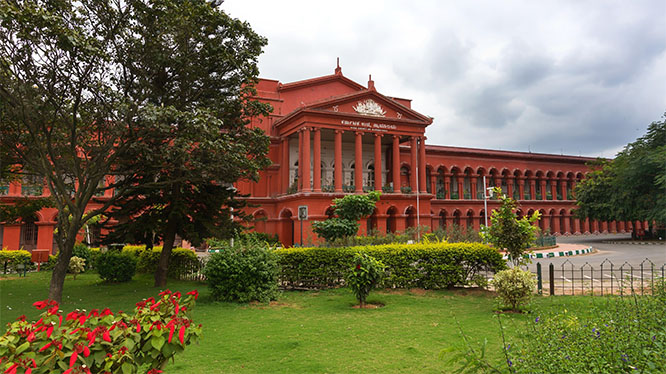
Bengaluru, Sept 25: The Karnataka High Court today refused to halt the state government's controversial socio-economic survey, but imposed stringent conditions on its execution, focusing heavily on privacy and consent.
A division bench of Chief Justice Vibhu Bakhru and Justice CM Joshi permitted the ongoing data collection exercise to continue but issued a clear directive: the state must ensure the confidentiality of all collected data and publicly clarify that participation is entirely voluntary.
The Court's Directives
The court's decision, which came after hearing a batch of petitions challenging the survey, mandates two critical safeguards:
Data Confidentiality: The data collected by the Karnataka State Backwards Classes Commission "shall not be disclosed to any person." The Commission has been directed to ensure the data is "fully protected and kept confidential." The Commission is also required to file an affidavit within one working day outlining the steps taken for the confidentiality of the data.
Voluntary Participation: The Commission must issue a public notification clarifying that the survey is voluntary, and "no person is obligated to disclose any information." Enumerators must inform participants of this voluntary nature right "at the threshold stage." Furthermore, if a participant declines, enumerators are strictly forbidden from taking any "further steps to persuade or cajol" them to divulge information.
Arguments in Court
The petitions challenged the state government's order approving the survey, which aims to collect data on the social and educational status of citizens.
Privacy Concerns: Senior Advocate Vivek Subba Reddy argued that the collection of personal information, especially after the landmark KS Puttaswamy case on the Right to Privacy, was problematic. He submitted that this exercise risked leaving personal data in an "uncontrolled field" and amounted to an invasion of privacy that must be tested against the principle of proportionality.
Survey or Census? A key point of contention raised by Senior Advocate S. Sriranga was that while the state labels the exercise a "survey," its official handbook refers to it as a "census." The petitioners contended that a full-scale census is in the exclusive domain of the Union Government.
Government's Defence: Senior Advocate Ravivarma Kumar, representing the Backwards Classes Commission, countered that the process had been re-examined, and enumerators were already instructed that there was no compulsion to participate. The survey, he submitted, is crucial for capturing data on whether a particular class or caste is adequately represented.
Regarding concerns over data security, particularly the potential linkage with Aadhaar, the Court clarified that the information collected is not linked to Aadhaar, but merely the fact that a participant has an Aadhaar number would be stored.
Ultimately, the division bench declined to "interdict" the ongoing survey, allowing the collection of data to proceed but firmly establishing the mandatory nature of data protection and voluntary consent for all citizens.

Comments
Add new comment