




Karnataka police boss Saleem’s sweeping order: ‘zero FIR’, zero corruption, respect citizens, no night summons for women

News Network
October 25, 2025

saleem.jpg

Bengaluru, Oct 25: In a decisive move to redefine the relationship between law enforcement and citizens, Karnataka’s Director General and Inspector General of Police (DG & IGP) M. A. Saleem has issued comprehensive, stringent guidelines to the state’s police personnel. The circular, released today, mandates a complete overhaul in public interaction, placing dignity, respect, and courtesy at the core of all police duties.

This directive is being seen as a critical step towards enhancing police accountability and transparency, a long-standing demand of civil society and a key focus area under police reforms in India.

Zero Tolerance for Misconduct, Total Transparency

The circular emphasizes that every officer must maintain absolute transparency in official proceedings. Crucially, it directs police stations to treat all visitors equally, irrespective of their social or economic background. Public grievances must be heard patiently, and the prompt, lawful registration of complaints—without unnecessary delay—is mandatory. Officers have been explicitly told to refrain completely from using harsh or offensive language and must communicate politely and respectfully at all times.

In a strong message against corruption, the DGP has directed personnel to reject any illegal benefits, favours, or assistance from individuals or organizations. This strict emphasis on upholding moral conduct and departmental ethics is intended to rebuild public trust which has often been eroded by instances of misconduct.

Safeguarding the Vulnerable and the 'Zero FIR' Mandate

A vital component of the new guidelines is the heightened sensitivity required when dealing with victims, women, senior citizens, and children. Police are expected to show special care and keep complainants informed about the status of their cases, underscoring a victim-centric approach.
The circular particularly stresses two key procedural reforms:

1.    Zero FIR: Reaffirming judicial and central government guidelines, the police have been instructed to register a 'Zero FIR' immediately, even if the crime falls outside their station's jurisdiction, and then transfer the case to the appropriate police station. This closes a notorious loophole where complainants were often turned away by police citing jurisdictional issues.

2.    Protection for Women: The directive strictly reiterates that women should not be called to the police station for inquiry or statement recording after 6 PM, a long-standing legal protection aimed at ensuring their safety and dignity.

Technology, Accountability, and Community Outreach

Beyond behaviour, the DG&IGP’s instructions cover investigative and administrative duties. Accurate and systematic maintenance of station house diaries and case files is a must, with transparency and accountability required at every investigation stage. Officers are reminded not to cause unnecessary hardship to citizens during inquiries.

Furthermore, the circular highlights the responsible use of body cameras and available technology to ensure fairness and provide an objective record of police-public interactions. The DG & IGP also encouraged police personnel to actively engage in community programs to foster trust, promoting an image of law enforcement that is "transparent, lawful, and compassionate."

This set of comprehensive guidelines comes in the backdrop of continuous efforts across the country to modernize and humanize the police force, ensuring the police act as a service and not an instrument of fear, thereby reinforcing the principles of democratic policing.

Comments

Add new comment

  • Coastaldigest.com reserves the right to delete or block any comments.
  • Coastaldigset.com is not responsible for its readers’ comments.
  • Comments that are abusive, incendiary or irrelevant are strictly prohibited.
  • Please use a genuine email ID and provide your name to avoid reject.
News Network
January 19,2026

trump.jpg

Donald Trump has linked his repeated threats to seize Greenland to his failure to win the Nobel Peace Prize, in a letter to Norwegian Prime Minister Jonas Gahr Støre.

The authenticity of the letter, in which Trump says he no longer feels obligated to “think purely of peace,” was confirmed by Støre to the Norwegian newspaper VG.

“Considering your country decided not to give me the Nobel Peace Prize for having stopped eight wars plus, I no longer feel an obligation to think purely of peace,” Trump wrote, adding he can now “think about what is good and proper for the United States.”

Støre said Trump’s letter was in response to a short message he had sent earlier, on behalf of himself and Finland’s President Alexander Stubb.

Trump has escalated rhetoric toward Greenland, a self-governing Danish territory, insisting the US will take control “one way or the other.” Over the weekend, he tweeted: “Now it is time, and it will be done!!!”

On Saturday, Trump threatened a 10% tariff on imports from Denmark, Norway, Sweden, France, Germany, the UK, the Netherlands, and Finland from 1 February until the US is allowed to purchase the island. EU diplomats met for emergency talks on possible retaliatory tariffs and sanctions.

In his letter, Trump argued Denmark “cannot protect” Greenland from Russia or China, questioning Danish ownership: “There are no written documents; it’s only that a boat landed there hundreds of years ago.” He added that NATO should support the US, claiming the world is “not secure unless we have complete and total control of Greenland.”

Trump’s stance has unsettled the EU and NATO, as he refused to rule out military action to take control of the mineral-rich island.

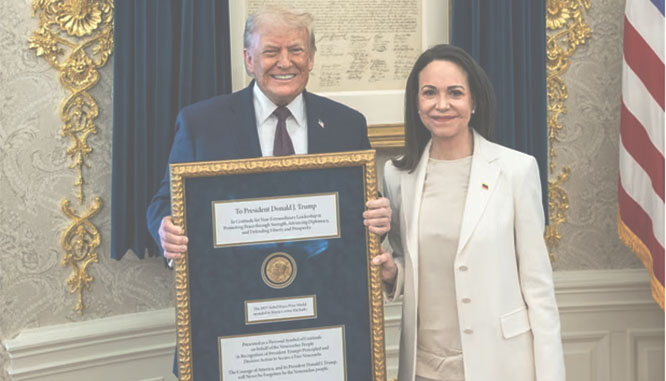
The Nobel Peace Prize is awarded by the independent Norwegian Nobel Committee, not the government. Trump had campaigned for last year’s prize, which went to Venezuelan opposition leader María Corina Machado, who dedicated her award to him.

Støre reiterated that the Nobel Prize decision rests solely with the committee.

Comments

Add new comment

  • Coastaldigest.com reserves the right to delete or block any comments.
  • Coastaldigset.com is not responsible for its readers’ comments.
  • Comments that are abusive, incendiary or irrelevant are strictly prohibited.
  • Please use a genuine email ID and provide your name to avoid reject.
News Network
January 23,2026

Karnataka Governor Thaawarchand Gehlot read only three lines from the 122-paragraph address prepared by the Congress-led state government while addressing the joint session of the Legislature on Thursday, effectively bypassing large sections critical of the BJP-led Union government.

The omitted portions of the customary Governor’s address outlined what the state government described as a “suppressive situation in economic and policy matters” under India’s federal framework. The speech also sharply criticised the Centre’s move to replace the Mahatma Gandhi National Rural Employment Guarantee Act (MGNREGA) with the Viksit Bharat–Guarantee for Rozgar and Ajeevika Mission (Gramin) Act, commonly referred to as the VB-GRAM (G) Act.

Governor Gehlot had earlier conveyed his objection to several paragraphs that were explicitly critical of the Union government. On Thursday, he confined himself to the opening lines — “I extend a warm welcome to all of you to the joint session of the State legislature. I am extremely pleased to address this august House” — before jumping directly to the concluding sentence of the final paragraph.

He ended the address by reading the last line of paragraph 122: “Overall, my government is firmly committed to doubling the pace of the State’s economic, social and physical development. Jai Hind — Jai Karnataka.”

According to the prepared speech, the Karnataka government demanded the scrapping of the VB-GRAM (G) Act, describing it as “contractor-centric” and detrimental to rural livelihoods, and called for the full restoration of MGNREGA. The state government argued that the new law undermines decentralisation, weakens labour protections, and centralises decision-making in violation of constitutional norms.

Key points from the unread sections of the speech:

•    Karnataka facing a “suppressive” economic and policy environment within the federal system

•    Repeal of MGNREGA described as a blow to rural livelihoods

•    VB-GRAM (G) Act accused of protecting corporate and contractor interests

•    New law alleged to weaken decentralised governance

•    Decision-making said to be imposed by the Centre without consulting states

•    Rights of Adivasis, women, backward classes and agrarian communities curtailed

•    Labourers allegedly placed under contractor control

•    States facing mounting fiscal stress due to central policies

•    VB-GRAM (G) Act accused of enabling large-scale corruption

Comments

Add new comment

  • Coastaldigest.com reserves the right to delete or block any comments.
  • Coastaldigset.com is not responsible for its readers’ comments.
  • Comments that are abusive, incendiary or irrelevant are strictly prohibited.
  • Please use a genuine email ID and provide your name to avoid reject.