Karnataka tops states, UTs in providing access to justice: IJR 2022

News Network
April 4, 2023

Bengaluru, Apr 4: Karnataka tops the list of states and Union Territories in providing access to justice and three other southern states figure among the best five, according to the India Justice Report 2022.

The IJR, which was released here on Tuesday, said except for Delhi and Chandigarh, no state or union territory spends more than one per cent of its total annual expenditure on judiciary where the vacancy of judges in high courts stands at 30 per cent.

The IJR, an initiative of the Tata Trusts launched in 2019, said as of December 2022, the country had 19 judges for every 10 lakh people and a backlog of 4.8 crore cases. The Law Commission had suggested, as early as in 1987, that there should be 50 judges for every 10 lakh people in a decade’s time.

The statistics were shared in IJR which ranked states and UTs on various parameters like vacancies in judiciary, budgetary allocations, infrastructure, human resources, legal aid, condition of prisons, functioning of police and state human rights commissions.

The Tata Trusts website describes IJR as a "unique initiative" that "ranks individual Indian states in relation to their capacity to deliver access to justice".

While Karnataka topped the chart among 18 large and mid-size states having a population of over 1 crore each, it was followed by Tamil Nadu, Telangana, Gujarat and Andhra Pradesh.

The list of seven small states, having a population of less than one crore each, was headed by Sikkim, followed by Arunachal Pradesh and Tripura.

“The justice system as a whole remains affected by low budgets. Except for two union territories, Delhi and Chandigarh, no state spends more than 1 per cent of its total annual expenditure on the judiciary.

“Vacancy is an issue across the police, prison staff, legal aid, and judiciary. For 1.4 billion (140 crore) people, India has about 20,076 judges with about 22 per cent sanctioned posts vacant. Vacancy among high court judges is at 30 per cent.

“In the police, women are only about 11.75 per cent, despite their numbers doubling in the last decade. About 29 per cent of the officer positions are vacant. The police to population ratio is 152.8 per lakh. The international standard is 222,” the report said.

It said prisons are over-occupied at over 130 per cent and more than two-thirds of the prisoners (77.1 per cent) are awaiting the completion of investigation or trial.

The IJR said most of the states have not fully utilised funds given to them by the Centre and their own increase in spending on the police, prisons, and judiciary has not kept pace with overall increase in state expenditure.

Retired Supreme Court judge Justice Madan B Lokur said, “The third IJR shows that states are making a substantive improvement over the last two ones in terms of adding new dimensions on diversity, training, and infrastructure. Some states have dramatically improved their performance but there is a lot that needs to be done on the whole.”

“So far as the police is concerned there does appear to be a shortage of women officers in police. Legal aid is doing better but still a lot of people need to be provided quality free legal aid, we need to increase the confidence that people have in our services,” he said.

Maja Daruwala, Chief Editor of IJR 2022, said as a member of the comity of nations and, more importantly, as a commitment to itself, India has promised that by 2030 it will have ensured access to justice for all and built effective, accountable, and inclusive institutions at all levels.

“But the official statistics brought together in the IJR this year show that we still have a long way to go. I would again urge that the provision of affordable, efficient and accessible justice services to each one of us be treated as necessary as food, education, or health.

"For this to happen more resources need to be ploughed into it, much more capacity built and much more attention paid to curing long standing deficiencies,” she said.

The report said Karnataka remains the only state to have consistently met its quota for SC, ST and OBC positions, both among police officers and the constabulary.

“In the judiciary, at the subordinate/ district court level, no state met all the three quotas. Only Gujarat and Chhattisgarh met their respective SC quotas. Arunachal Pradesh, Telangana, and Uttarakhand met their respective ST quotas. Kerala, Sikkim, Andhra Pradesh, Maharashtra, Tamil Nadu, Chhattisgarh, and Telangana met OBC quotas,” it said.

Regarding the share of women in key positions across the justice system, which includes police, prisons, judiciary and legal aid, the report states that one out of 10 is a woman.

“While the overall share of women in the police force is about 11.75 per cent, in the officer ranks it is still lower at 8 per cent. Only 13 per cent of high court judges and 35 per cent of subordinate court judges are women. Among prison staff, they are 13 per cent. A majority of states has increased the share of women panel lawyers. Nationally, the share has increased from 18 per cent to 25 per cent,” it said.

It said one in four police stations does not have a single CCTV and nearly three in 10 police stations do not have women help desks.

The report said about 30 per cent (391) of prisons record occupancy rates of above 150 per cent and 54 per cent (709) run above 100 per cent capacity.

“With the exception of Andaman and Nicobar Islands, Arunachal Pradesh, Mizoram, Tripura, and Madhya Pradesh, the undertrial population of all states and Union Territories exceeds 60 per cent," it said.

On the aspect of workload in judiciary, the report said in 28 states/ Union Territories, one in every four high court cases is pending for more than five years. In district courts of 11 states/UTs, one in every four cases is pending for more than five years,” the report said.

The IJR said the population per subordinate court judge and high court judge is 71,224 persons and 17,65,760 persons respectively.

With regard to budgets, it found the national per capita spend on legal aid, including the expenditure of the National Legal Services Authority (NALSA) and the state/ UT governments themselves, is a meagre Rs 4.57 per annum.

Excluding NALSA, this figure drops to Rs 3.87 and, if only NALSA’s budget (2021-22) is considered, the per capita spend is Rs 1.06 only, it said.

It said the national per capita spend on prisons is Rs 43. Nationally, the annual average spend per prisoner has gone down to Rs 38,028 from Rs 43,062. Andhra Pradesh records the highest annual spend on a prisoner at Rs 2,11,157.

“The national per capita spend on judiciary stands at Rs. 146,” it said, adding the national per capita spend on police is at Rs 1151.

“IJR 2022 has reiterated both immediate and foundational corrections. It has flagged urgent filling of vacancies and increased representation. To effect an irreversible change, it has exhorted that Justice delivery be designated as an essential service,” it concluded.

The third IJR also assessed the capacity of the 25 State Human Rights Commissions (SHRC) and found that there are 33,312 pending cases before these panels in March 2021 and the national average vacancy across 25 SHRCs is at 44 per cent.

The statistics show nine states have been working with 50 per cent or more vacancies among members in SHRCs and only six states have women in their executive staff.

Comments

Add new comment

  • Coastaldigest.com reserves the right to delete or block any comments.
  • Coastaldigset.com is not responsible for its readers’ comments.
  • Comments that are abusive, incendiary or irrelevant are strictly prohibited.
  • Please use a genuine email ID and provide your name to avoid reject.
News Network
November 29,2025

DKSsiddu.jpg

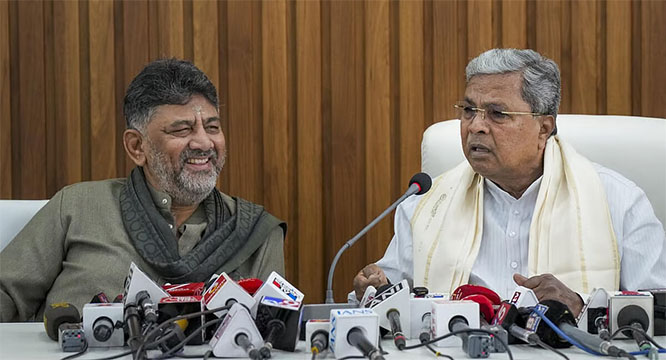
New Delhi: Karnataka chief minister Siddaramaiah and deputy CM DK Shivakumar on Saturday put up a dramatic display of unity at a closely watched joint press briefing, firmly dismissing weeks of speculation about a power-sharing tussle within the Congress. With the high command nudging both leaders to sit together and settle the dust, the meeting became a political spectacle, ending with the duo declaring that there was “no confusion, no differences.”

Calling the reports of a rift “manufactured confusion,” Siddaramaiah said the talks had gone smoothly, even joking about their breakfast. “Breakfast was very good. All three of us enjoyed it,” he said. “We want to end this confusion once and for all. For local elections and for 2028, our mission is clear — Congress must return to power. There is no difference between me and DKS, not now, not before.”

He blamed the media for fuelling rumours and reiterated absolute adherence to the party leadership. “From tomorrow, let there be no confusion. What the high command says, we will follow.”

Siddaramaiah also assured that the Assembly session starting December 8 would run smoothly and vowed that Congress would take on the BJP and JD(S) “together.”

Shivakumar echoed the chief minister word for word, stressing loyalty and discipline. “People have given us a massive mandate. It is our duty to deliver,” he said. “This government was formed under Siddaramaiah’s leadership. We both have complete trust in the high command. If they tell me to wait, I will wait.”

He added that the two leaders had discussed strategy for the 2028 Assembly elections. “Whatever the CM says, I agree. We are loyal soldiers of the party. The party may be facing challenges nationally, but we will keep it strong in Karnataka.”

Shivakumar also said Siddaramaiah would soon visit his home for lunch or dinner — another symbolic gesture meant to underline their unity.

Both leaders later posted on social media describing the breakfast meeting as “productive” and focused on “Karnataka’s priorities.”

The BJP, however, rejected the show of camaraderie as “pure bunkum,” accusing Congress of trying to paper over an internal power struggle. But Siddaramaiah and Shivakumar insisted their united front would continue — and that there was “no confusion” within the state leadership.

Comments

Add new comment

  • Coastaldigest.com reserves the right to delete or block any comments.
  • Coastaldigset.com is not responsible for its readers’ comments.
  • Comments that are abusive, incendiary or irrelevant are strictly prohibited.
  • Please use a genuine email ID and provide your name to avoid reject.
News Network
December 2,2025

DKSsiddu.jpg

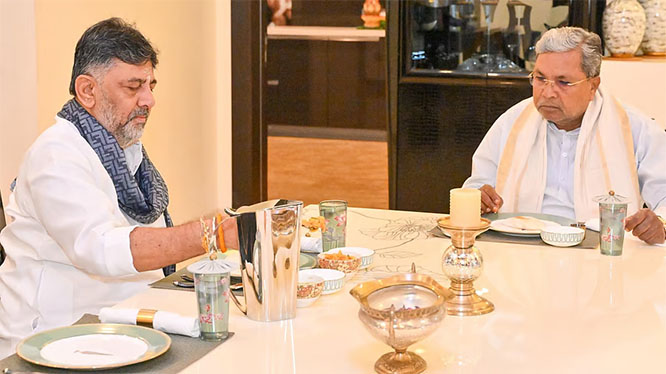
Bengaluru: 'Nati koli saaru' (country chicken curry) considered one of Chief Minister Siddaramaiah’s favourites along with steaming hot idlis was on the breakfast menu at Deputy CM D K Shivakumar’s residence on Tuesday, according to official sources.

The spread also included 'nati koli' fry, vada and pongal, among other items, they said.

In an apparent show of unity, Siddaramaiah visited Shivakumar’s residence for breakfast, just days after the two leaders shared a meal amid a simmering power tussle in the state Congress.

Siddaramaiah drove to the Deputy CM’s residence in Sadashivanagar, where he was received by Shivakumar and his brother D K Suresh, who is a former Congress MP.

Suresh and Kunigal MLA H D Ranganath, a relative of Shivakumar, joined them for breakfast, which featured a mix of vegetarian and non-vegetarian dishes.

Speaking to reporters later, Siddaramaiah said Shivakumar had invited him during his visit to the CM’s residence for breakfast on Saturday.

Asked about the difference between the two meals, the chief minister said, "At his (Shivakumar’s) house it was non-veg, while at my house it was veg. He is a vegetarian, I am a non-vegetarian. I had not prepared non-veg. I told DK to get chicken from the village as you won’t get the original in Bengaluru."

Shivakumar said he had initially invited Siddaramaiah to his residence, but the CM had suggested visiting his place first and reciprocating later. "It was a vegetarian breakfast at the CM’s house on Saturday," he noted.

"Today, I invited him (the CM) to my house. He enjoyed the breakfast, which had his Mysuru taste," Shivakumar added. At this point, Siddaramaiah remarked that Shivakumar’s wife is also from Mysuru.

Saturday’s breakfast at Siddaramaiah’s official residence, held as part of efforts by the Congress high command to ease tensions in the leadership dispute between the two, reportedly included idlis and sambar, according to official sources.

Comments

Add new comment

  • Coastaldigest.com reserves the right to delete or block any comments.
  • Coastaldigset.com is not responsible for its readers’ comments.
  • Comments that are abusive, incendiary or irrelevant are strictly prohibited.
  • Please use a genuine email ID and provide your name to avoid reject.
News Network
November 27,2025

Bengaluru, Nov 27: Karnataka Chief Minister Siddaramaiah’s camp is reportedly on alert as the Congress leadership tussle in the state intensifies, particularly amid speculation over the potential promotion of Deputy Chief Minister D.K. Shivakumar. Siddaramaiah is said to be in a “wait-and-watch” mode after admitting to “confusion” earlier this week and urging the party to “put a full stop” to it.

Sources say his supporters are ready to act if senior leaders — including party chief Mallikarjun Kharge, Sonia Gandhi, and Rahul Gandhi — give any indication of backing Shivakumar. If the party insists on a leadership change, Siddaramaiah’s camp has a list of alternatives, underscoring the deep rift between the two leaders. One possible candidate is Home Minister G. Parameshwara, a Siddaramaiah loyalist and influential Dalit leader.

The strategy was reportedly finalized at a meeting led by PWD Minister Satish Jarkiholi, another Siddaramaiah supporter, who stressed that Delhi leaders need to resolve the issue. Kharge and the Gandhis are expected to meet soon, after which Siddaramaiah and Shivakumar may be summoned to Delhi.

Shivakumar has largely stayed non-confrontational, publicly endorsing Siddaramaiah and downplaying speculation about his own ambitions. However, he has made pointed comments emphasizing the importance of honoring promises, directed at Siddaramaiah.

The feud traces back to the 2023 state election, when Siddaramaiah was chosen as Chief Minister while Shivakumar, who led the party’s campaign, was made Deputy CM and state party chief — a departure from the Congress’ usual “one post per person” rule.

There were also hints of a prior understanding that Siddaramaiah would step down midway through the term. As the halfway mark passed last week, Shivakumar-aligned lawmakers have ramped up pressure on the party for a leadership change, with Shivakumar himself hinting at stepping down as state party chief to pursue the top job.

Comments

Add new comment

  • Coastaldigest.com reserves the right to delete or block any comments.
  • Coastaldigset.com is not responsible for its readers’ comments.
  • Comments that are abusive, incendiary or irrelevant are strictly prohibited.
  • Please use a genuine email ID and provide your name to avoid reject.