



No EC action so far against Modi over blatant hate-speech against Muslims, lie on Manmohan Singh’s 18-year-old speech

News Network
April 22, 2024

modihate.jpg

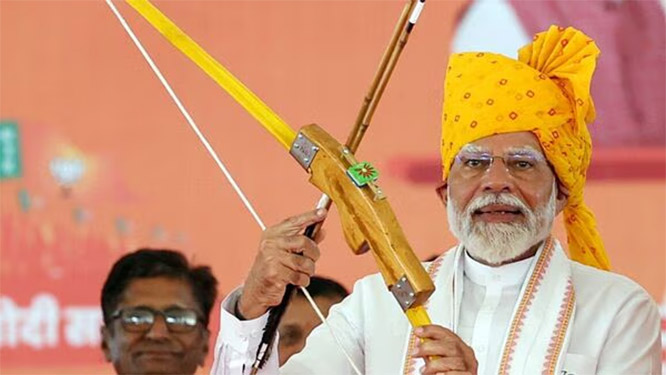
New Delhi: Even though Prime Minister Narendra Modi's nasty election speech in Rajasthan's Banswara has triggered a nationwide controversy, the Election Commission has so far not taken any action. Meanwhile the Opposition bloc INDIA called the speech an attempt to divert attention from "real issues".

Addressing the people Banswara, on April 21, (Sunday) Modi openly attacked India’s Muslims, suggesting they were “infiltrators” and went on to claim that the opposition if elected would give away “mangalsutras” and “land” of those listening to his speech to them (Muslims). 

He referred to his immediate predecessor, Dr Manmohan Singh who was in office for 10 years as prime minister till 2014, and said, “Earlier, when his government was in power, he had said that Muslims have the first right on the country’s property, which means who will they collect this property and distribute it to – those who have more children, will distribute it to the infiltrators. Will the money of your hard work be given to the infiltrators? Do you approve of this?” 

Modi went on to say, “This Congress manifesto is saying that they will calculate the gold of the mothers and sisters, get information about it and then distribute it. Manmohan Singh’s government had said that Muslims have the first right on property. Brothers and sisters, these urban Naxal thoughts will not let even your mangalsutra escape, they will go this far.”

Narendra Modi and the BJP so far in their campaign trail have invoked religious faith, the Ram temple and Lord Ram multiple times, directly using it to call for people to vote for them. The Election Commission has been completely silent on the messaging via videos, tweets and other exhortations. 

Did Manmohan Singh really say that?

Modi’s claim that Dr Singh said that is not new and was refuted in 2006 itself by Singh’s PMO, when Modi had first made the false claim. The PMO had termed such remarks, “a deliberate and mischievous misinterpretation of what the Prime Minister said here yesterday at the meeting of the National Development Council, on fiscal priorities of the government.” It was termed “an avoidable controversy has been generated. The Prime Minister’s observations have also been quoted out of context in some sections of the electronic media, fuelling a baseless controversy.”

The full text of the paragraph in which the Prime Minister referred to the issue of minority empowerment to clarify the matter is as follows:

“I believe our collective priorities are clear: agriculture, irrigation and water resources, health, education, critical investment in rural infrastructure, and the essential public investment needs of general infrastructure, along with programmes for the upliftment of SC/STs, other backward classes, minorities and women and children. The component plans for Scheduled Castes and Scheduled Tribes will need to be revitalized. We will have to devise innovative plans to ensure that minorities, particularly the Muslim minority, are empowered to share equitably in the fruits of development. They must have the first claim on resources. The Centre has a myriad other responsibilities whose demands will have to be fitted within the over-all resource availability.”

The PMO’s clarification said. “it will be seen from the above that the Prime Minister’s reference to “first claim on resources” refers to all the “priority” areas listed above, including programmes for the upliftment of SCs, STs, OBCs, women and children and minorities.

Opposition reacts

Chairman, Media and Publicity department of the Congress, Pawan Khera said in a video message in a post, “We challenge the Prime Minister to show us if the word Hindu or Muslim is written anywhere in our manifesto. This kind of lightness is there in your mentality, in your political values. We have talked about justice for the youth, women, farmers, tribals, middle class and workers. Do you object to this as well?”

Khera was referring to earlier mistruths uttered by Modi about the “Muslim League” having influenced the Congress manifesto.

In Jharkhand’s Ranchi at an opposition rally, Congress president Mallikarjun Kharge is reported to have said by BBC Hindi, “If democracy and the Constitution end in the country, then the people will have nothing left. Babasaheb Ambedkar ji and Jawaharlal Nehru ji gave equal voting rights to everyone, due to which all classes got respect. But Narendra Modi wants to snatch their rights from the poor.”

B.V. Srinivas termed it as unfortunate that “this person is the Prime Minister of this country, and an even bigger tragedy is that the Election Commission of India is no longer alive.” He said that “due to the frustration of impending defeat, the Prime Minister of India is openly sowing the seeds of hatred, he is polarising by misquoting Manmohan Singh’s 18-year-old incomplete statement, But the Election Commission (Modi ka parivar) is bowing down.”

Modi’s past hate-speech

Modi, in his 12-year tenure as chief minister of Gujarat was known to have made speeches targeting the state’s minority Muslim community brazenly, terming camps where Muslims were forced to stay in after communal violence gripped the state in 2002. Frontline covered him on his Gujarat Gaurav Yatra started shortly after the violence, at a rally at Becharaji in Mehsana district in northern Gujarat, when he said, “What should we do? Run relief camps for them? Do we want to open baby-producing centres? But for certain people that means hum paanch, hamare pachees.” 

In 2017 it was time again for direct speech targeting Muslims when in February he spoke of ‘shamshaan versus kabristan’ campaigning for UP and then for Gujarat elections when the BJP had its worst performance this millennium, in a speech at Palanpur on December 10, 2017 Modi invoked a “secret meeting” to get Pakistan to fix Gujarat’s assembly polls. He said that a meeting was held at Congress leader Mani Shankar Aiyar’s residence, attended by former PM Manmohan Singh, former Vice-President Hamid Ansari, former Army Chief Deepak Kapoor and distinguished diplomats to execute the plot. Modi’s PMO faced embarrassment when in response to an RTI filed by the Congress, his office was forced to say that Modi’s campaign speech could have been based on an “informal input”.

In the only question he has answered as part of a press conference with Joe Biden on June 22, 2023, Modi was asked, “India has long prided itself as the world’s largest democracy, but there are many human rights groups who say that your government has discriminated against religious minorities and sought to silence its critics.  As you stand here in the East Room of the White House, where so many world leaders have made commitments to protecting democracy, what steps are you and your government willing to take to improve the rights of Muslims and other minorities in your country and to uphold free speech?”

In response Modi appeared visibly frazzled and denied all charges. “I’m actually really surprised that people say so.  And so, people don’t say it.  Indeed, India is a democracy.” 

The journalist was trolled online by BJP leaders and supporters to such an extent that the White House had to come out and defend her and strongly denounce the trolling and abuse.

Comments

Add new comment

  • Coastaldigest.com reserves the right to delete or block any comments.
  • Coastaldigset.com is not responsible for its readers’ comments.
  • Comments that are abusive, incendiary or irrelevant are strictly prohibited.
  • Please use a genuine email ID and provide your name to avoid reject.
News Network
January 23,2026

oscar.jpg

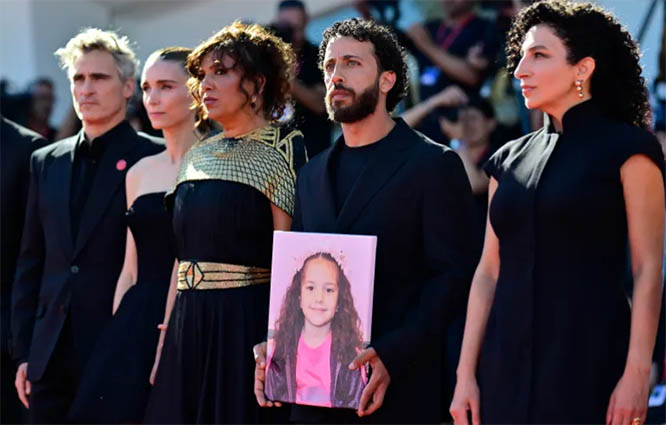
The Voice of Hind Rajab, inspired by the tragic final moments of a young Palestinian girl killed by Israeli fire in Gaza, has been nominated for an Academy Award in the Best International Feature Film category.

Directed by Tunisian filmmaker Kaouther Ben Hania, the film recounts the true story of five-year-old Hind Rajab, who lost her life in January 2024 while fleeing Israeli bombardment with her family.

The film features the real audio of Hind’s desperate call to the Palestinian Red Crescent Society, where she pleaded for help moments before the vehicle she was in was struck by 355 bullets.

The haunting narrative begins with a brief call made from the besieged Tel al-Hawa neighborhood of Gaza, where gunfire and armored vehicles drowned out every sound.

After witnessing the brutal killing of her family, she made a trembling call, her voice reduced to a whisper as she spoke of the massacre and her unbearable loneliness as the sole survivor.

Premiering at the Venice International Film Festival in September 2025, The Voice of Hind Rajab garnered widespread acclaim, receiving a record-setting 23-minute standing ovation and the Silver Lion Grand Jury Prize, the festival’s second-highest honor.

In her acceptance speech, Ben Hania dedicated the film to humanitarian workers and first responders in Gaza, emphasizing that Hind's voice symbolizes countless civilians affected by war.

She aims to give voice to victims often reduced to mere statistics, highlighting the broader suffering of civilians in war zones.

The film’s Oscar nomination underscores its powerful storytelling and ethical approach to depicting real-life tragedy, making it a crucial piece of contemporary cinema.

It serves not only as a narration of individual tragedy but also as an artistic and documentary response to the silence and censorship that often overshadow West Asian struggles and wars.

Using an innovative method she calls docufiction, Ben Hania bridges unvarnished reality and narrative structure, creating a work that is both artistically valuable and socially impactful.

Born in 1977 in Sidi Bouzid—later the epicenter of the Arab revolution—her background profoundly influenced her worldview and artistic approach.

She is a graduate of the Higher School of Audiovisual Arts of Tunis, Pantheon-Sorbonne University, and La Fémis in Paris, where her studies equipped her with the technical and theoretical tools needed to address complex subjects. 

Comments

Add new comment

  • Coastaldigest.com reserves the right to delete or block any comments.
  • Coastaldigset.com is not responsible for its readers’ comments.
  • Comments that are abusive, incendiary or irrelevant are strictly prohibited.
  • Please use a genuine email ID and provide your name to avoid reject.
News Network
February 1,2026

Bengaluru: Karnataka Deputy Chief Minister D K Shivakumar on Sunday criticised the Union Budget presented by Finance Minister Nirmala Sitharaman, claiming it offered no tangible benefit to the state.

Though he said he was yet to study the budget in detail, Shivakumar asserted that Karnataka had gained little from it. “There is no benefit for our state from the central budget. I was observing it. They have now named a programme after Mahatma Gandhi, after repealing the MGNREGA Act that was named after him,” he said.

Speaking to reporters here, the Deputy Chief Minister demanded the restoration of MGNREGA, and made it clear that the newly enacted rural employment scheme — VB-G RAM G — which proposes a 60:40 fund-sharing formula between the Centre and the states, would not be implemented in Karnataka.

“I don’t see any major share for our state in this budget,” he added.

Shivakumar, who also holds charge of Bengaluru development, said there were high expectations for the city from the Union Budget. “The Prime Minister calls Bengaluru a ‘global city’, but what has the Centre done for it?” he asked.

He also drew attention to the problems faced by sugar factories, particularly those in the cooperative sector, alleging a lack of timely decisions and support from the central government.

Noting that the Centre has the authority to fix the minimum support price (MSP) for agricultural produce, Shivakumar said the Union government must take concrete steps to protect farmers’ interests.

Comments

Add new comment

  • Coastaldigest.com reserves the right to delete or block any comments.
  • Coastaldigset.com is not responsible for its readers’ comments.
  • Comments that are abusive, incendiary or irrelevant are strictly prohibited.
  • Please use a genuine email ID and provide your name to avoid reject.
News Network
February 1,2026

Bengaluru, Feb 1: For travelers landing at Kempegowda International Airport (KIA), the sleek, wood-paneled curves of Terminal 2 promise a world-class welcome. But the famed “Garden City” charm quickly withers at the curb. As India’s aviation sector swells to record numbers—handling over 43 million passengers in Bengaluru alone this past year—the “last mile” has turned into a marathon of frustration.

The Bengaluru Logjam: Rules vs Reality

While the city awaits the 2027 completion of the Namma Metro Blue Line, the interim has been chaotic. Recent “decongestion” rules at Terminal 1 have pushed app-based cab pickups to distant parking zones, forcing weary passengers into a 20-minute walk with luggage.

“I landed after ten months away and felt like a stranger in my own city,” says Ruchitha Jain, a Koramangala resident. “My driver couldn’t find me, staff couldn’t guide me, and the so-called ‘Premium’ lane is just a fancy tax on convenience.”

•    The Cost of Distance: A 40-km cab ride can now easily cross ₹1,500, driven by demand pricing and airport surcharges.

•    The Bus Gap: While Vayu Vajra remains a lifeline, its ₹300–₹400 fare is often cited as the most expensive airport bus service in the country.

A National Pattern of Disconnect

The struggle is not unique to Karnataka. From Chennai’s coast to Hyderabad’s plateau, India’s airports tell a familiar story: brilliant runways, broken exits.

City:    Primary Issue   |    Recent Development

Bengaluru:    Cab pickup restrictions & distance  |    App-based taxis shifted to far parking zones; long walks and fare spikes reported

Chennai:    Multi-Level Parking (MLCP) hike  |    Passengers report 40-minute walks to reach cab pickup points

Hyderabad:    “Taxi mafia” & touting  |    Over 440 touting cases reported; security presence intensified

Mumbai:    Fare scams  |     Tourists charged ₹18,000 for just 400 metres, triggering police action

In Hyderabad, travelers continue to battle entrenched local groups that intimidate Uber and Ola drivers, pushing passengers toward overpriced private taxis. Chennai flyers, meanwhile, complain that reaching the designated pickup zones now takes longer than short-haul flights from cities like Coimbatore.

The ‘Budget Day’ Hope

As Finance Minister Nirmala Sitharaman presents the Union Budget 2026 today, the aviation sector is watching closely. With the government’s renewed emphasis on multimodal integration, there is cautious hope for funding toward seamless airport-metro-bus hubs.

The vision is clear: a future where planes, trains, and metros speak the same language. Until then, passengers at KIA—and airports across India—will continue to discover that the hardest part of flying isn’t the thousands of kilometres in the air, but the last few on the ground.

Comments

Add new comment

  • Coastaldigest.com reserves the right to delete or block any comments.
  • Coastaldigset.com is not responsible for its readers’ comments.
  • Comments that are abusive, incendiary or irrelevant are strictly prohibited.
  • Please use a genuine email ID and provide your name to avoid reject.