PM Modi inaugurates Kochi-Mangaluru natural gas pipeline virtually

News Network
January 5, 2021

Mangaluru, Jan 5:  Prime Minister Shri Narendra Modi dedicated Kochi - Mangaluru Natural Gas Pipeline to the Nation through a video conference today. The event marks an important milestone towards the creation of ‘One Nation One Gas Grid'. Governors and Chief Ministers of Karnataka and Kerala, along with Union Minister for Petroleum and Natural Gas were also present on the occasion.

Speaking on the occasion, the Prime Minister termed this day as an important milestone for both the people of Kerala and Karnataka as the two states are being connected by a natural gas pipeline. He said the pipeline will have a positive impact on the economic growth of these two states. He said rapid expansion of Gas based economy is a must to achieve self reliant India and cited this as the reason behind Government’s push for ‘One Nation One Gas Grid’.

While listing the advantages of the pipeline, he said that the pipeline would improve the ease of living in both the states and reduce the expenses of the poor, middle class and entrepreneurs of both the states. He said the pipeline would become the base of the Gas Distribution System in many cities and would form the base of the CNG based transport system in these cities. He said the pipeline would provide clean energy to Mangalore Refinery and would play a major role in reducing the pollution in both the states. He added the reduction of pollution will have a direct impact on the environment akin to planting millions of trees which would help in improving people's health and reducing their health related expenditure. He said that less pollution and clean air would attract more tourists to the city. He added that construction of this pipeline has generated 1.2 million man days of employment and would develop a new ecosystem of employment and self-employment after its commissioning which would help the fertilizer, petrochemical and power sector. It will also help India in saving thousands of crores of Foreign exchange for the country.

The Prime Minister cited that experts around the world say that in the 21st century, whichever country emphasizes the most on connectivity and clean energy would reach new heights. He stressed that the pace of work in the connectivity front in the country happening now is never seen before in earlier decades. He further said in the 27 years before 2014, only a 15 thousand kilometer natural gas pipeline was built. But right now work is underway on more than 16 thousand kilometers of gas pipeline nationwide which will be complete in the next 5-6 years. He also cited examples of increased CNG fuel stations, PNG connections and LPG connections delivered by this Government which was never seen before. He said these increased connections have reduced the shortage of kerosene and many States and Union Territories have declared themselves kerosene free.

The Prime Minister said since 2014, the Government has brought in various reforms across the Oil and Gas sector covering exploration and production, natural gas, marketing and distribution. He announced that the Government plans to achieve 'One Nation One Gas Grid' and to shift to a gas-based economy as this gas has several environmental benefits. He said the Government is taking policy initiatives to increase the share of natural gas in India's energy basket from 6 Percent to 15 Percent. “Dedication of the Kochi-Mangaluru natural gas pipeline of GAIL is part of our journey to move towards One Nation One Gas Grid. Clean energy is important for a better future. This pipeline will help improve clean energy access” said the Prime Minister

The Prime Minister said that efforts are on to prepare for the country’s future energy needs. To achieve this goal, natural gas is being focussed upon on the one hand, energy resources are being diversified on the other hand. He illustrated the point with examples of the proposed world’s biggest renewable energy plant in Gujarat and stress on biofuels. He informed the audience that sincere work is on for getting ethanol from rice and sugarcane. Goal of ethanol blending in petrol upto 20 per cent in 10 years has been set. The Prime Minister said that the Government is committed to provide every citizen affordable, pollution-free fuel and electricity.

As the Prime Minister was speaking to the two coastal states, he laid out his vision of fast and balanced coastal area development. He said that a comprehensive plan for the development of the blue economy in the coastal states like Karnataka, Kerala and other South Indian states is under implementation. He said the Blue Economy is going to be an important source of Aatamnirbhar India. Ports and coastal roads are being connected with a focus on  multi-modal connectivity. We are working with an aim to turn our coastal region into a role model of ease of living and ease of doing business, said the Prime Minister.

The Prime Minister touched upon the fisherman communities in the coastal areas who are not only dependent on the ocean wealth but also are the guardian of the same. For this, the Government has taken many steps to protect and enrich the coastal ecosystem. Steps like helping fishermen with deep sea fishing, separate fisheries department, providing affordable loans and Kisan Credit Cards to the people engaged in aquaculture are helping both entrepreneurs and general fishermen.

The Prime Minister also talked of the recently launched 20 thousand crore Matasya Samapada Yojna which will directly benefit lacs of fishermen in Kerala and Karnataka. India is progressing rapidly in the fishery related exports. All steps are being taken to turn India into a quality processed sea-food hub. India can play a major role in fulfilling the growing demand of seaweed, as farmers are being encouraged for seaweed farming.

Comments

Add new comment

  • Coastaldigest.com reserves the right to delete or block any comments.
  • Coastaldigset.com is not responsible for its readers’ comments.
  • Comments that are abusive, incendiary or irrelevant are strictly prohibited.
  • Please use a genuine email ID and provide your name to avoid reject.
News Network
January 23,2026

modIKERALA.jpg

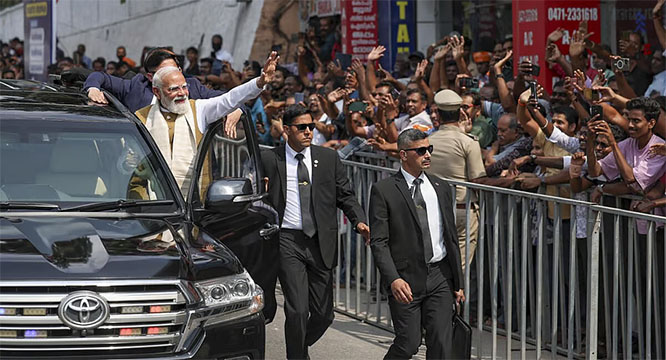
Prime Minister Narendra Modi, during his visit to Thiruvananthapuram on Friday, January 23, indicated that the Bharatiya Janata Party (BJP) is aiming to expand its political footprint in Kerala ahead of the Assembly elections scheduled in the coming months.

Speaking at a BJP-organised public meeting, Modi drew parallels between the party’s early electoral gains in Gujarat and its recent victory in the Thiruvananthapuram Municipal Corporation. The civic body win, which ended decades of Left control, was cited by the Prime Minister as a possible starting point for the party’s broader ambitions in the state.

Recalling BJP’s political trajectory in Gujarat, Modi said the party was largely insignificant before 1987 and received little media attention. He pointed out that the BJP’s first major breakthrough came with its victory in the Ahmedabad Municipal Corporation that year.

“Just as our journey in Gujarat began with one city, Kerala’s journey has also started with a single city,” Modi said, suggesting that the party’s municipal-level success could translate into wider electoral acceptance.

The Prime Minister alleged that successive governments led by the Left Democratic Front (LDF) and the United Democratic Front (UDF) had failed to adequately develop Thiruvananthapuram. He accused both fronts of corruption and neglect, claiming that basic infrastructure and facilities were denied to the capital city for decades.

According to Modi, the BJP’s control of the civic body represents a shift driven by public dissatisfaction with the existing political alternatives. He asserted that the BJP administration in Thiruvananthapuram had begun working towards development, though no specific details or timelines were outlined.

Addressing the gathering at Putharikandam Maidan, Modi said the BJP intended to project Thiruvananthapuram as a “model city,” reiterating his party’s commitment to governance-led change.

The Prime Minister’s visit to Kerala also included the inauguration of several development projects and the flagging off of new train services, as the BJP intensifies its political outreach in the poll-bound state.

Comments

Add new comment

  • Coastaldigest.com reserves the right to delete or block any comments.
  • Coastaldigset.com is not responsible for its readers’ comments.
  • Comments that are abusive, incendiary or irrelevant are strictly prohibited.
  • Please use a genuine email ID and provide your name to avoid reject.
News Network
February 1,2026

Bengaluru, Feb 1: For travelers landing at Kempegowda International Airport (KIA), the sleek, wood-paneled curves of Terminal 2 promise a world-class welcome. But the famed “Garden City” charm quickly withers at the curb. As India’s aviation sector swells to record numbers—handling over 43 million passengers in Bengaluru alone this past year—the “last mile” has turned into a marathon of frustration.

The Bengaluru Logjam: Rules vs Reality

While the city awaits the 2027 completion of the Namma Metro Blue Line, the interim has been chaotic. Recent “decongestion” rules at Terminal 1 have pushed app-based cab pickups to distant parking zones, forcing weary passengers into a 20-minute walk with luggage.

“I landed after ten months away and felt like a stranger in my own city,” says Ruchitha Jain, a Koramangala resident. “My driver couldn’t find me, staff couldn’t guide me, and the so-called ‘Premium’ lane is just a fancy tax on convenience.”

•    The Cost of Distance: A 40-km cab ride can now easily cross ₹1,500, driven by demand pricing and airport surcharges.

•    The Bus Gap: While Vayu Vajra remains a lifeline, its ₹300–₹400 fare is often cited as the most expensive airport bus service in the country.

A National Pattern of Disconnect

The struggle is not unique to Karnataka. From Chennai’s coast to Hyderabad’s plateau, India’s airports tell a familiar story: brilliant runways, broken exits.

City:    Primary Issue   |    Recent Development

Bengaluru:    Cab pickup restrictions & distance  |    App-based taxis shifted to far parking zones; long walks and fare spikes reported

Chennai:    Multi-Level Parking (MLCP) hike  |    Passengers report 40-minute walks to reach cab pickup points

Hyderabad:    “Taxi mafia” & touting  |    Over 440 touting cases reported; security presence intensified

Mumbai:    Fare scams  |     Tourists charged ₹18,000 for just 400 metres, triggering police action

In Hyderabad, travelers continue to battle entrenched local groups that intimidate Uber and Ola drivers, pushing passengers toward overpriced private taxis. Chennai flyers, meanwhile, complain that reaching the designated pickup zones now takes longer than short-haul flights from cities like Coimbatore.

The ‘Budget Day’ Hope

As Finance Minister Nirmala Sitharaman presents the Union Budget 2026 today, the aviation sector is watching closely. With the government’s renewed emphasis on multimodal integration, there is cautious hope for funding toward seamless airport-metro-bus hubs.

The vision is clear: a future where planes, trains, and metros speak the same language. Until then, passengers at KIA—and airports across India—will continue to discover that the hardest part of flying isn’t the thousands of kilometres in the air, but the last few on the ground.

Comments

Add new comment

  • Coastaldigest.com reserves the right to delete or block any comments.
  • Coastaldigset.com is not responsible for its readers’ comments.
  • Comments that are abusive, incendiary or irrelevant are strictly prohibited.
  • Please use a genuine email ID and provide your name to avoid reject.
coastaldigest.com news network
January 19,2026

rizwanzameer.jpg

Bengaluru: As the dust settles on the recent legislative session, the corridors of Vidhana Soudha are buzzing with more than just policy talk. A high-stakes game of political musical chairs has begun, exposing a deepening rift within the Congress party’s Muslim leadership as a major Cabinet reshuffle looms.

With the party hierarchy signaling a "50% refresh" to gear up for the 2028 Assembly elections, the race to fill three projected Muslim ministerial berths has transformed from a strategic discussion into an all-out turf war.

The "Star Son" Spark

The internal friction turned public this week following provocative remarks by Zaid Khan, actor and son of Wakf Minister Zameer Ahmed Khan. Zaid’s claim—that his father "helped" secure a ticket for Shivajinagar MLA Rizwan Arshad in 2023—has acted as a lightning rod for resentment.

Rizwan’s camp was quick to fire back, dismissing the comment as a desperate attempt by Zameer to manufacture seniority. "Rizwan’s political pedigree was forged in the NSUI and Youth Congress long before Zameer even stepped into the party," a supporter noted, highlighting Rizwan’s tenure as an AICC secretary and his two-term presidency of the State Youth Congress.

A Tale of Two Loyalists

While both Zameer Ahmed Khan and Rizwan Arshad are staunch allies of Chief Minister Siddaramaiah and represent Bengaluru strongholds, their political DNA could not be more different:

•    Zameer Ahmed Khan: A four-time MLA who crossed over from JD(S) in 2018. Known for his "overzealous" and often polarizing outreach during communal flashpoints—from the DJ Halli riots to the recent Wakf land notice controversy—his style has frequently left the Congress high command in a state of "discomfort."

•    Rizwan Arshad: A homegrown organizational man. Seen as a "quiet performer," Arshad represents the sophisticated, moderate face of the party, preferred by those who find Zameer’s brand of politics too volatile.

The Outsiders Looking In

The bickering isn't limited to a duo. The "Beary" community, represented by leaders like N A Haris and Saleem Ahmed, is demanding its pound of flesh. Saleem Ahmed, the Chief Whip in the Legislative Council, has dropped the veil of diplomacy, openly declaring his ministerial aspirations.

"I was the only working president not included in the Cabinet last time," Saleem noted pointedly, signaling that the "loyalty quota" is no longer enough to keep the peace.

As Chief Minister Siddaramaiah prepares to finalize the list, he faces a delicate balancing act: rewarding the aggressive grassroots mobilization of Zameer’s camp without alienating the organizational stalwarts and minority sub-sects who feel increasingly sidelined by the "Chamarajpet-Shivajinagar" binary.

Comments

Add new comment

  • Coastaldigest.com reserves the right to delete or block any comments.
  • Coastaldigset.com is not responsible for its readers’ comments.
  • Comments that are abusive, incendiary or irrelevant are strictly prohibited.
  • Please use a genuine email ID and provide your name to avoid reject.