Replacing sitting MPs with new candidates helps BJP retain its coastal Karnataka bastions amid public discontent

News Network
June 5, 2024

kotasrinvas.jpg

Riding on the Hindutva wave and replacing sitting MPs with new candidates, the Bharatiya Janata Party (BJP) has succeeded in retaining its strongholds in coastal Karnataka — Uttara Kannada, Dakshina Kannada, and Udupi-Chikmagalur Lok Sabha constituencies.

Although the victory margins have decreased in all constituencies, a strong organizational network and the Hindutva factor seem to have helped the BJP overcome anti-incumbency sentiment. All three elected MPs will enter the Lok Sabha for the first time.

The Congress appears to have failed in mobilizing its grassroots volunteers and strengthening its organizational networks in these regions. Even the party's guarantee schemes did not seem to significantly influence the election outcomes.

Dakshina Kannada

In Dakshina Kannada, which faced a notable anti-incumbency sentiment, BJP’s Brijesh Chowta defeated Congress’ Padmaraj R. Poojary. Brijesh’s efforts to placate discontented BJP and RSS workers, his focus on the Hindutva factor, development, and local leaders’ efforts to unite various factions within the BJP contributed to his victory with a margin of 1,49,208 votes. In 2019, the BJP had won by a margin of 2,74,621.

Prime Minister Modi held a roadshow in Mangaluru to bolster support for the Dakshina Kannada and Udupi-Chikmagalur candidates, particularly after dissatisfaction with three-time MP Nalin Kumar Kateel’s unfulfilled promises became apparent.

Udupi-Chikmagalur

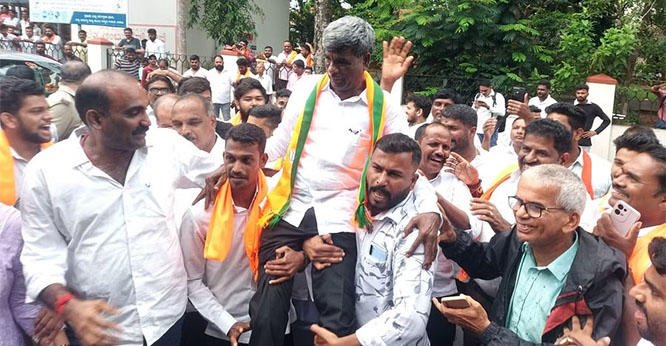
In Udupi-Chikmagalur, the BJP responded to the 'Go Back, Shobha' campaign by fielding former minister Kota Srinivas Poojary, who won with a margin of 2,59,175 votes against Congress candidate Jayaprakash Hegde. In 2019, the BJP’s margin was 3,49,599 votes. Poojary’s clean image, emphasis on Hindutva politics, the Modi wave, and support from majority communities were likely key factors in his victory.

The BJP appeared to be more effective than the Congress in strategizing to win over the Billavas and Bunts, two major communities in Dakshina Kannada and Udupi-Chikmagalur constituencies. Modi’s gesture of garlanding the statue of social reformer Narayana Guru, revered by the Billava community in Mangaluru, also resonated with voters.

Uttara Kannada

In Uttara Kannada, BJP’s Vishweshwar Hegde Kageri defeated Congress’ Anjali Nimbalkar by 3,37,428 votes. In 2019, the BJP’s victory margin was 4,79,649 votes. Despite local leaders’ demands to field a younger candidate, the party chose the six-time MLA and former state minister. The Modi appeal and Hindutva politics were significant factors, along with the outsider tag of the Congress candidate.

The Congress had won five out of eight Assembly segments in Uttara Kannada in last year’s elections, indicating potential for a competitive race. However, a rally by Modi in Sirsi shifted the momentum in favor of Kageri, who campaigned heavily on Modi's popularity rather than his own track record.

Public discontent

Udupi-based political analyst Rajaram Tallur noted that the reduced victory margins signal public discontent with the BJP. However, the Congress failed to capitalize on this sentiment due to a lack of charismatic leaders, insufficient organizational efforts, and a defeatist attitude regarding their chances in these seats.

Yellapur-based political analyst Sriranga Katti highlighted that Kageri’s reliance on Modi's appeal rather than his own achievements was a decisive factor in Uttara Kannada.

Overall, the BJP's combination of new candidates, a strong organizational framework, and leveraging the Hindutva narrative helped it retain its coastal Karnataka strongholds, while the Congress struggled to make significant inroads.

Comments

Add new comment

  • Coastaldigest.com reserves the right to delete or block any comments.
  • Coastaldigset.com is not responsible for its readers’ comments.
  • Comments that are abusive, incendiary or irrelevant are strictly prohibited.
  • Please use a genuine email ID and provide your name to avoid reject.
News Network
November 28,2025

ministerPM.jpg

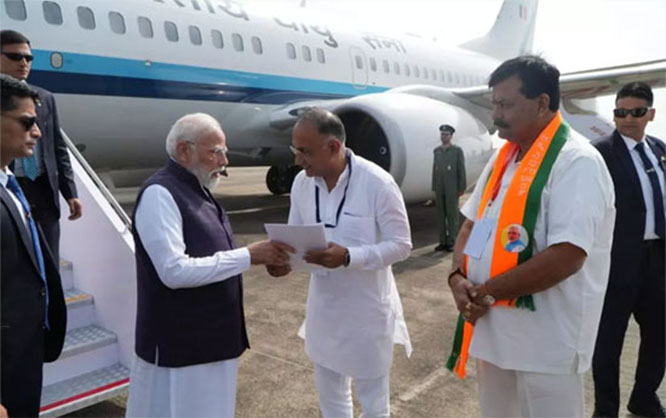
Mangaluru, Nov 28: Karnataka Health Minister and Dakshina Kannada district in-charge minister Dinesh Gundu Rao on Friday handed over Chief Minister Siddaramaiah’s letter to Prime Minister Narendra Modi, highlighting the severe distress faced by farmers due to crashing crop prices.

PM Modi arrived at the Mangaluru International Airport en route to Udupi, where Gundu Rao welcomed him and submitted the letter. The chief minister’s message stressed that farmers are suffering heavy losses because maize and green gram are being bought far below the Minimum Support Price (MSP). The state urged the Centre to immediately begin procurement at MSP.

According to the letter, Karnataka has a bumper harvest this year—over 54.74 lakh metric tons of maize and 1.98 lakh metric tons of green gram—yet farmers are unable to secure fair prices. Against the MSP of ₹2,400/MT for maize and ₹8,768/MT for green gram, market rates have plunged to ₹1,600–₹1,800 and ₹5,400 respectively.

The chief minister has requested the Centre to:

• Direct NAFED, FCI and NCCF to start MSP procurement immediately.
• Ensure ethanol units purchase maize directly from farmers or FPOs.
• Increase Karnataka’s ethanol allocation, citing high production capacity.
• Stop maize imports, which have depressed domestic prices.
• Relax quality norms for green gram, allowing up to 10% discoloration due to rains.

The letter stresses that MSP is crucial for farmer dignity and income stability and calls for swift central intervention to prevent a deepening crisis.

Comments

Add new comment

  • Coastaldigest.com reserves the right to delete or block any comments.
  • Coastaldigset.com is not responsible for its readers’ comments.
  • Comments that are abusive, incendiary or irrelevant are strictly prohibited.
  • Please use a genuine email ID and provide your name to avoid reject.
News Network
December 2,2025

DKSsiddu.jpg

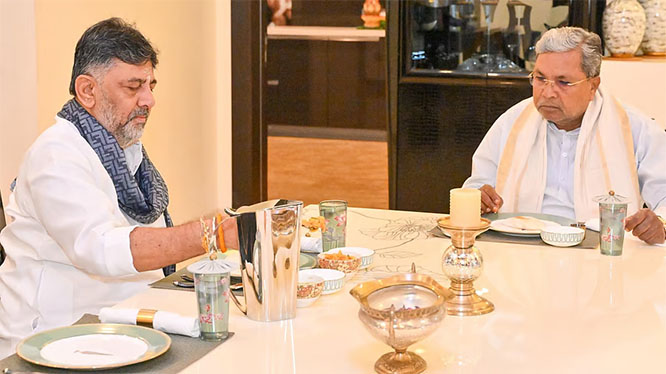
Bengaluru: 'Nati koli saaru' (country chicken curry) considered one of Chief Minister Siddaramaiah’s favourites along with steaming hot idlis was on the breakfast menu at Deputy CM D K Shivakumar’s residence on Tuesday, according to official sources.

The spread also included 'nati koli' fry, vada and pongal, among other items, they said.

In an apparent show of unity, Siddaramaiah visited Shivakumar’s residence for breakfast, just days after the two leaders shared a meal amid a simmering power tussle in the state Congress.

Siddaramaiah drove to the Deputy CM’s residence in Sadashivanagar, where he was received by Shivakumar and his brother D K Suresh, who is a former Congress MP.

Suresh and Kunigal MLA H D Ranganath, a relative of Shivakumar, joined them for breakfast, which featured a mix of vegetarian and non-vegetarian dishes.

Speaking to reporters later, Siddaramaiah said Shivakumar had invited him during his visit to the CM’s residence for breakfast on Saturday.

Asked about the difference between the two meals, the chief minister said, "At his (Shivakumar’s) house it was non-veg, while at my house it was veg. He is a vegetarian, I am a non-vegetarian. I had not prepared non-veg. I told DK to get chicken from the village as you won’t get the original in Bengaluru."

Shivakumar said he had initially invited Siddaramaiah to his residence, but the CM had suggested visiting his place first and reciprocating later. "It was a vegetarian breakfast at the CM’s house on Saturday," he noted.

"Today, I invited him (the CM) to my house. He enjoyed the breakfast, which had his Mysuru taste," Shivakumar added. At this point, Siddaramaiah remarked that Shivakumar’s wife is also from Mysuru.

Saturday’s breakfast at Siddaramaiah’s official residence, held as part of efforts by the Congress high command to ease tensions in the leadership dispute between the two, reportedly included idlis and sambar, according to official sources.

Comments

Add new comment

  • Coastaldigest.com reserves the right to delete or block any comments.
  • Coastaldigset.com is not responsible for its readers’ comments.
  • Comments that are abusive, incendiary or irrelevant are strictly prohibited.
  • Please use a genuine email ID and provide your name to avoid reject.
News Network
November 26,2025

students.jpg

Bengaluru, Nov 26: Karnataka is taking its first concrete steps towards lifting a three-decade-old ban on student elections in colleges and universities. Deputy Chief Minister D.K. Shivakumar announced Wednesday that the state government will form a small committee to study the reintroduction of campus polls, a practice halted in 1989 following incidents of violence.

Speaking at a 'Constitution Day' event organised by the Karnataka Congress, Mr. Shivakumar underscored the move's aim: nurturing new political leadership from the grassroots.

"Recently, (Leader of the Opposition in Lok Sabha) Rahul Gandhi wrote a letter to me and Chief Minister (Siddaramaiah) asking us to think about restarting student elections," Shivakumar stated. "I'm announcing today that we'll form a small committee and seek a report on this."

Student elections were banned in Karnataka in 1989, largely due to concerns over violence and the infiltration of political party affiliates into campus life. The ban effectively extinguished vibrant student bodies and the pipeline of young leaders they often produced.

Mr. Shivakumar, who also serves as the Karnataka Congress president, said that former student leaders will be consulted to "study the pros and cons" of the re-introduction.

Acknowledging the history of the ban, he added, "There were many criminal activities taking place back then. We’ll see how we can conduct (student) elections by regulating such criminal activities."

The Deputy CM reminisced about his own journey, which began on campus. He recalled his political activism at Sri Jagadguru Renukacharya College leading to his first Assembly ticket in 1985 at the age of 23. "That's how student leadership was at the time. Such leadership has gone today. College elections have stopped," he lamented, adding that for many, college elections were "like a big movement" where leaders were forged.

The move, driven by the Congress high command's push to cultivate young talent, will face scrutiny from academics and university authorities who have, in the past, expressed concern that the return of polls could disrupt the peaceful academic environment and turn campuses into political battlegrounds.

Comments

Add new comment

  • Coastaldigest.com reserves the right to delete or block any comments.
  • Coastaldigset.com is not responsible for its readers’ comments.
  • Comments that are abusive, incendiary or irrelevant are strictly prohibited.
  • Please use a genuine email ID and provide your name to avoid reject.