Siddaramaiah objects to lesser share of central funds, says ‘Karnataka stood against divide & rule policy’

News Network
August 15, 2023

siddmodi.jpg

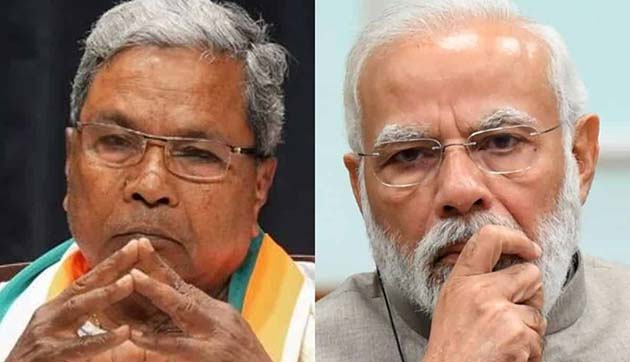
Bengaluru, Aug 15: In the occasion of the 77th Independence Day, Karnataka Chief Minister Siddaramaiah during his speech objected to the lesser share of returns to the state in terms of GST tax, and underlined that Karnataka has stood against the divide and rule policy.

Siddaramaiah hoisted the national flag at the Field Marshal Manekshaw Parade Ground here, and also delivered his first Independence Day speech as Karnataka’s chief minister during his second stint in the seat.

He said that Karnataka is the second highest tax paying state in the country.

“We are paying over Rs 4 lakh crore in form of taxes and duties to the Centre. However, we are just getting Rs 50,000 crore in return from the Centre. Karnataka will be the richest state if we get what actually we deserve naturally,” he stated.

Siddaramaiah maintained that, “despite this challenging situation, we are complying with fiscal discipline. We are committed to a comprehensive development of the state. True patriots are aware of our efforts.”

“People of Karnataka have stood against the efforts of divide and rule policy. ‘All inclusive’ is our policy and hence people have chosen us for power. This promise of strengthening the new Karnataka Development Model which ensures inclusive growth and yearns for development of everyone, is the most important promise that I make on the occasion of the Independence Day.

“The country has been facing a crisis in the last few years. Hatred, violence, suspicion, revenge and intolerance are growing. Rather, there are efforts to fuel these traits. Some sections of the society are producing these traits and are projecting that these have acceptance too.

“There is a need to defeat these efforts as they are aimed to create negativity. As a civilised society we will doom if such efforts are not thwarted. Only peace and harmony can ensure development. Any society marred by violence, chaos, lack of law and order situation nurtures poverty. Lakhs of young talented and skilled youths are leaving the country and its citizenship. Our institutions of higher learning and universities should create highly talented and skilled students with a scientific bent of mind,” he said.

Invoking Jawaharlal Nehru in his speech, CM Siddaramaiah said, “As Pandit Nehru remarked, let us work with unity. Let us herald a new dawn of development. Let peace, happiness and harmony thrive in our land. Let us be grateful to our army who are protecting us, to youth who are increasing the land’s wealth; to the farmers who are producing food for us.

“Citizens of Karnataka are convinced that peace in society is inevitable for development and hence have rejected deliberate efforts of negative forces.

“In our society, only about 10 per cent of people have established their ownership over 78 per cent of resources. The British administration looted the country’s resources during the colonial era. However, today only a few people have accumulated wealth. Does this situation lead us to development?

“In this background, we are implementing policies that are aimed at ensuring social justice in terms of accumulation of resources and their redistribution. This is the idea behind the introduction of five guarantee schemes such as Shakti, Gruha Jyothi, Anna Bhagya, Gruha Lakshmi and Yuva Nidhi. We strongly believe in the premise of economist Amartya Sen that ‘development is real freedom’ and hence have introduced the five guarantee schemes,” he said.

“We are working under the guidance of ‘Gandhiji’s Talisman’. Whenever implementing a scheme, whether it benefits the last person and whether social justice has been achieved are the guiding principles of our administration.

“People were in distress due to price rise, unemployment, corruption and discrimination due to caste and religion. Per capita income in several districts has not increased when compared to our previous tenure and there has been an increase in poverty. Considering this, our government followed Universal Basic Income policy and introduced the five guarantee schemes to boost the economic and social energy of the people.

“We are mooting the ‘Brand Bengaluru’ initiative. The objective is to transform Bengaluru to international standards. Much focus has been laid to ensure smooth traffic flow, management of solid wastes, proper utilisation of public places, proper health of livestock and citizens, introduction of citizen-friendly e-administration, water security and management of challenges arising out of natural calamities.

“We dream of transforming Karnataka into the number one state in Asia in terms of modern technology. We want the state to be the number one manufacturing hub in Asia too. In the last 10 years, the industrial sector of the state has registered a 9.3 per cent growth rate. We have set a goal of achieving 15 per cent and 16 per cent growth rate in the coming days. This requires an investment of about Rs 1.4 lakh crore every year and generation of 14 lakh new jobs,” CM Siddaramaiah stated.

Comments

Add new comment

  • Coastaldigest.com reserves the right to delete or block any comments.
  • Coastaldigset.com is not responsible for its readers’ comments.
  • Comments that are abusive, incendiary or irrelevant are strictly prohibited.
  • Please use a genuine email ID and provide your name to avoid reject.
News Network
January 23,2026

modIKERALA.jpg

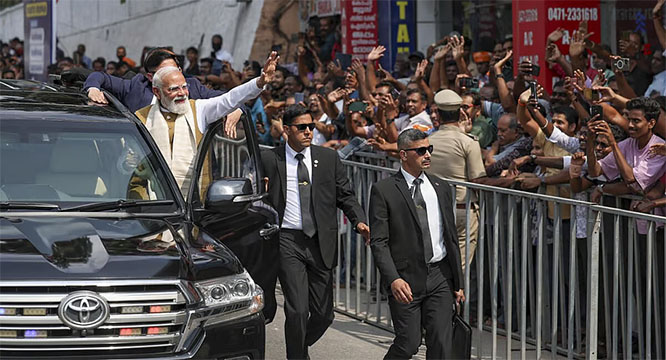
Prime Minister Narendra Modi, during his visit to Thiruvananthapuram on Friday, January 23, indicated that the Bharatiya Janata Party (BJP) is aiming to expand its political footprint in Kerala ahead of the Assembly elections scheduled in the coming months.

Speaking at a BJP-organised public meeting, Modi drew parallels between the party’s early electoral gains in Gujarat and its recent victory in the Thiruvananthapuram Municipal Corporation. The civic body win, which ended decades of Left control, was cited by the Prime Minister as a possible starting point for the party’s broader ambitions in the state.

Recalling BJP’s political trajectory in Gujarat, Modi said the party was largely insignificant before 1987 and received little media attention. He pointed out that the BJP’s first major breakthrough came with its victory in the Ahmedabad Municipal Corporation that year.

“Just as our journey in Gujarat began with one city, Kerala’s journey has also started with a single city,” Modi said, suggesting that the party’s municipal-level success could translate into wider electoral acceptance.

The Prime Minister alleged that successive governments led by the Left Democratic Front (LDF) and the United Democratic Front (UDF) had failed to adequately develop Thiruvananthapuram. He accused both fronts of corruption and neglect, claiming that basic infrastructure and facilities were denied to the capital city for decades.

According to Modi, the BJP’s control of the civic body represents a shift driven by public dissatisfaction with the existing political alternatives. He asserted that the BJP administration in Thiruvananthapuram had begun working towards development, though no specific details or timelines were outlined.

Addressing the gathering at Putharikandam Maidan, Modi said the BJP intended to project Thiruvananthapuram as a “model city,” reiterating his party’s commitment to governance-led change.

The Prime Minister’s visit to Kerala also included the inauguration of several development projects and the flagging off of new train services, as the BJP intensifies its political outreach in the poll-bound state.

Comments

Add new comment

  • Coastaldigest.com reserves the right to delete or block any comments.
  • Coastaldigset.com is not responsible for its readers’ comments.
  • Comments that are abusive, incendiary or irrelevant are strictly prohibited.
  • Please use a genuine email ID and provide your name to avoid reject.
News Network
January 23,2026

Karnataka Governor Thaawarchand Gehlot read only three lines from the 122-paragraph address prepared by the Congress-led state government while addressing the joint session of the Legislature on Thursday, effectively bypassing large sections critical of the BJP-led Union government.

The omitted portions of the customary Governor’s address outlined what the state government described as a “suppressive situation in economic and policy matters” under India’s federal framework. The speech also sharply criticised the Centre’s move to replace the Mahatma Gandhi National Rural Employment Guarantee Act (MGNREGA) with the Viksit Bharat–Guarantee for Rozgar and Ajeevika Mission (Gramin) Act, commonly referred to as the VB-GRAM (G) Act.

Governor Gehlot had earlier conveyed his objection to several paragraphs that were explicitly critical of the Union government. On Thursday, he confined himself to the opening lines — “I extend a warm welcome to all of you to the joint session of the State legislature. I am extremely pleased to address this august House” — before jumping directly to the concluding sentence of the final paragraph.

He ended the address by reading the last line of paragraph 122: “Overall, my government is firmly committed to doubling the pace of the State’s economic, social and physical development. Jai Hind — Jai Karnataka.”

According to the prepared speech, the Karnataka government demanded the scrapping of the VB-GRAM (G) Act, describing it as “contractor-centric” and detrimental to rural livelihoods, and called for the full restoration of MGNREGA. The state government argued that the new law undermines decentralisation, weakens labour protections, and centralises decision-making in violation of constitutional norms.

Key points from the unread sections of the speech:

•    Karnataka facing a “suppressive” economic and policy environment within the federal system

•    Repeal of MGNREGA described as a blow to rural livelihoods

•    VB-GRAM (G) Act accused of protecting corporate and contractor interests

•    New law alleged to weaken decentralised governance

•    Decision-making said to be imposed by the Centre without consulting states

•    Rights of Adivasis, women, backward classes and agrarian communities curtailed

•    Labourers allegedly placed under contractor control

•    States facing mounting fiscal stress due to central policies

•    VB-GRAM (G) Act accused of enabling large-scale corruption

Comments

Add new comment

  • Coastaldigest.com reserves the right to delete or block any comments.
  • Coastaldigset.com is not responsible for its readers’ comments.
  • Comments that are abusive, incendiary or irrelevant are strictly prohibited.
  • Please use a genuine email ID and provide your name to avoid reject.
coastaldigest.com news network
January 19,2026

rizwanzameer.jpg

Bengaluru: As the dust settles on the recent legislative session, the corridors of Vidhana Soudha are buzzing with more than just policy talk. A high-stakes game of political musical chairs has begun, exposing a deepening rift within the Congress party’s Muslim leadership as a major Cabinet reshuffle looms.

With the party hierarchy signaling a "50% refresh" to gear up for the 2028 Assembly elections, the race to fill three projected Muslim ministerial berths has transformed from a strategic discussion into an all-out turf war.

The "Star Son" Spark

The internal friction turned public this week following provocative remarks by Zaid Khan, actor and son of Wakf Minister Zameer Ahmed Khan. Zaid’s claim—that his father "helped" secure a ticket for Shivajinagar MLA Rizwan Arshad in 2023—has acted as a lightning rod for resentment.

Rizwan’s camp was quick to fire back, dismissing the comment as a desperate attempt by Zameer to manufacture seniority. "Rizwan’s political pedigree was forged in the NSUI and Youth Congress long before Zameer even stepped into the party," a supporter noted, highlighting Rizwan’s tenure as an AICC secretary and his two-term presidency of the State Youth Congress.

A Tale of Two Loyalists

While both Zameer Ahmed Khan and Rizwan Arshad are staunch allies of Chief Minister Siddaramaiah and represent Bengaluru strongholds, their political DNA could not be more different:

•    Zameer Ahmed Khan: A four-time MLA who crossed over from JD(S) in 2018. Known for his "overzealous" and often polarizing outreach during communal flashpoints—from the DJ Halli riots to the recent Wakf land notice controversy—his style has frequently left the Congress high command in a state of "discomfort."

•    Rizwan Arshad: A homegrown organizational man. Seen as a "quiet performer," Arshad represents the sophisticated, moderate face of the party, preferred by those who find Zameer’s brand of politics too volatile.

The Outsiders Looking In

The bickering isn't limited to a duo. The "Beary" community, represented by leaders like N A Haris and Saleem Ahmed, is demanding its pound of flesh. Saleem Ahmed, the Chief Whip in the Legislative Council, has dropped the veil of diplomacy, openly declaring his ministerial aspirations.

"I was the only working president not included in the Cabinet last time," Saleem noted pointedly, signaling that the "loyalty quota" is no longer enough to keep the peace.

As Chief Minister Siddaramaiah prepares to finalize the list, he faces a delicate balancing act: rewarding the aggressive grassroots mobilization of Zameer’s camp without alienating the organizational stalwarts and minority sub-sects who feel increasingly sidelined by the "Chamarajpet-Shivajinagar" binary.

Comments

Add new comment

  • Coastaldigest.com reserves the right to delete or block any comments.
  • Coastaldigset.com is not responsible for its readers’ comments.
  • Comments that are abusive, incendiary or irrelevant are strictly prohibited.
  • Please use a genuine email ID and provide your name to avoid reject.