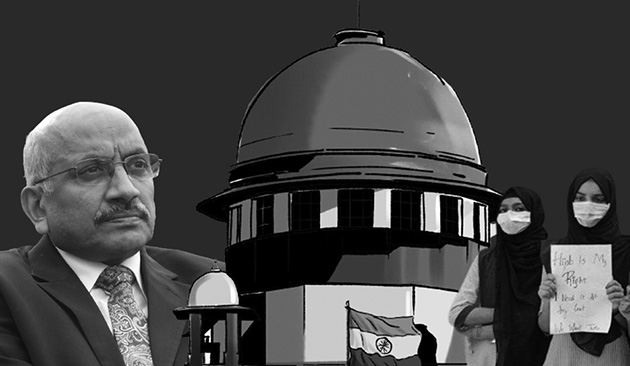
‘Sikhism engrained in India, can't compare with Islamic practices’: SC on Karnataka hijab row

News Network
September 8, 2022

gupta.jpg

New Delhi, Sept 8: It is "not very fair" to compare the practices in Sikhism as they are well engrained in the culture of the country, the Supreme Court said on Thursday while asking the petitioners in the Karnataka Hijab ban matter not to draw a parallel between Muslim and Sikh religious practices.

Hearing arguments on a batch of pleas challenging the Karnataka High Court verdict refusing to lift the ban on hijab in educational institutions of the state, the apex court observed the five Ks in Sikhism -- Kesh, Kara, Kanga, Kaccha and Kirpan -- are well established.

A bench of Justices Hemant Gupta and Sudhanshu Dhulia observed this after an advocate, appearing for one of the petitioners in the case, gave an example of Sikhism and turban.

"It is not very fair to compare the rights or the practices in Sikhism. The five Ks are well established," the bench observed.

The top court referred to Article 25 of the Constitution and said it provides for the carrying of Kirpan by Sikhs.

Article 25 of the Constitution deals with freedom of conscience and free profession, practice and propagation of religion.

"Don't compare these practices because they have been recognised for over 100 years," the bench said.

Advocate Nizam Pasha, arguing for one of the petitioners, said Article 25 mentions only Kirpan and not the other Ks.

"What we are saying is, please do not draw any parity with Sikhism. That is all. That is what we are saying," the bench said.

Observing that arguments were advanced about Kara and turban, the bench said the practices in Sikhism are well established and well engrained in the culture of the country.

During the arguments, Pasha said the high court verdict had referred to certain verses of the Holy Quran as well as some commentaries.

He said the Holy Quran, as it stands, is perfect for all times to come and to say that verses of the Quran have become obsolete, is "bordering on blasphemy".

Senior advocate Devadatt Kamat, who appeared for one of the petitioners, told the bench that the state of Karnataka has said if the students would come in a head scarf, other people will get offended but this cannot be the reason for banning it.

Kamat argued that Article 25 has three restrictions -- public order, morality and health.

"Wearing a head scarf is a part of the religious belief apart from it being a part of (Articles) 19 and 21 rights," he said.

Kamat argued that every religious practice or religious observance is not essential to the religion but that does not mean that the State will keep on restricting it because it is not essential.

"As long as I do not violate public order, I do not fall foul of morality and I do not affect the health of others, I am entitled," he said.

Giving an example that one of the senior advocates wears a 'namam' (a divine mark put on the forehead), Kamat said it may not be an integral part of the religion of the Hindu faith.

"How does it harm discipline in the court? Does it harm public order?" he asked.

The bench observed there is a particular uniform for the lawyers to appear in court.

Justice Gupta said people in Rajasthan wear Pagdi as a matter of routine because of the climatic condition and in Gujarat also people wear it.

On the arguments about public order, the bench said this issue may arise when one is on the street.

The bench observed that wearing Hijab on the street does not affect anybody.

"But once you are talking about a school building, school premises, then the question is what kind of a public order the school want to be maintained there," it said.

Kamat said public order is the responsibility of the state and the school has nothing to do with it.

He asked, "In our constitutional scheme, is heckler's veto permitted?" (Heckler's veto is suppression of speech by the government when necessary to prevent possible violent reactions).

The senior advocate said it is the duty of the State to create an atmosphere where people can exercise their rights in accordance with Article 25.

"If I wear a head scarf, whose fundamental rights am I violating?" he said.

The bench observed it is not a question of violating others' fundamental rights.

"The question is what kind of fundamental right do you have which you want to exercise," it observed during the arguments which would continue on September 12.

Kamat said the state's argument is that if it will permit the wearing of a head scarf, which the petitioners regard as a part of their faith, some other students will wear an orange shawl.

"Wearing of an orange shawl, I do not think it is an innocent display of faith. It is a belligerent display of religious jingoism," he said, adding, "Article 25 only protects an innocent display of faith".

Kamat had earlier referred to the state government's order of February 5, 2022, by which it had banned wearing clothes that disturb equality, integrity, and public order in schools and colleges which some Muslim girls had challenged in the high court.

Several pleas have been filed in the top court against the March 15 verdict of the high court holding that wearing of hijab is not a part of the essential religious practice which can be protected under Article 25 of the Constitution.

The high court had dismissed the pleas filed by a section of Muslim students from the Government Pre-University Girls College in Udupi, seeking permission to wear hijab inside the classroom.

Challenging the February 5 order of the government, the petitioners had argued before the high court that wearing the Islamic headscarf was an innocent practice of faith and an essential religious practice and not a display of religious jingoism.


Comments

Add new comment

  • Coastaldigest.com reserves the right to delete or block any comments.
  • Coastaldigset.com is not responsible for its readers’ comments.
  • Comments that are abusive, incendiary or irrelevant are strictly prohibited.
  • Please use a genuine email ID and provide your name to avoid reject.
News Network
January 31,2026

Roy.jpg

Bengaluru: The shooting incident involving CJ Roy, founder of the Confident Group, has once again put the spotlight on a businessman whose life has swung between flamboyant global success and persistent controversy at home.

Though Roy’s business interests extended across continents, his roots lay firmly in Karnataka. An alumnus of Christ School in Bengaluru, he later moved to Tumakuru to pursue an engineering degree. Those familiar with his early years describe him as intensely ambitious, beginning his career as a salesman at a small electronics firm dealing in computers.

Roy’s entry into large-scale real estate came through the Crystal Group, where he worked closely with Latha Namboothiri and rose from manager to director. However, the launch of the Confident Group in 2005 was clouded by industry speculation. Insiders speak of a fallout involving alleged “benami” properties and claims of deception that ultimately led to his independent venture—an episode Roy spent years trying to distance himself from, according to associates.

A tale of two cities

Roy’s professional trajectory diverged sharply across geographies.

In Dubai, he built a reputation as a bold and efficient developer, completing massive luxury residential projects in record time—some reportedly within 11 months. His rapid project delivery and lavish lifestyle in the Emirates earned him admiration and visibility in the real estate sector.

In Bengaluru, however, his image remained far more fractured. Sources say Roy stayed away from the city for several years amid disputes over unpaid dues to vendors and suppliers. Several projects were allegedly stalled, with accusations of unfulfilled commitments to cement and steel suppliers continuing to follow him.

Roy’s return to Bengaluru’s business and social circles began around 2018, marked by a conscious attempt at rebranding. His appointment as Honorary Consul of the Slovak Republic added diplomatic legitimacy, which he complemented with visible CSR initiatives, including ambulance donations and high-profile charity events.

Heavy police presence in Langford Town

Following the incident, police personnel from the Central division were deployed outside the Confident Group building in Langford Town, which also houses the Slovak Honorary Consulate in Bengaluru.

The otherwise busy premises near Hosur Road wore a deserted look on Friday, reflecting the shock and uncertainty that followed the tragedy.

Comments

Add new comment

  • Coastaldigest.com reserves the right to delete or block any comments.
  • Coastaldigset.com is not responsible for its readers’ comments.
  • Comments that are abusive, incendiary or irrelevant are strictly prohibited.
  • Please use a genuine email ID and provide your name to avoid reject.
News Network
January 19,2026

New Delhi: Setting speculation to the rest, the CPI(M) has made it clear that it is open to have an electoral understanding with the Congress “to defeat” the Trinamool Congress and the BJP in West Bengal Assembly election even as it is all set to take on the grand old party in Kerala accusing it of “found wanting” in fighting the Hindutva forces.

The CPI(M) also said that it will contest the Tamil Nadu election “with DMK and its allies to defeat the BJP and its allies”, amid a section in the Congress triggering confusion about its participation in the M K Stalin-led coalition over demand over power-sharing and more seats. It is also willing to join hands with Congress and others in Assam and Puducherry to defeat the BJP.

The decisions came at a three-day meeting of the CPI(M) Central Committee in Thiruvananthapuram, which ended on Sunday after reviewing the poll preparations in the poll-bound states.

The CPI(M)'s decision came even as a section led by West Bengal Congress president Subhankar Sarkar is averse to tying up with the Left Front, claiming that their party is not benefitted by the electoral understanding. Both Congress and CPI(M)-led Left Front had electoral understanding in 2016 and 2021 Assembly elections and 2024 Lok Sabha polls.

Congress and the Left Front fought together for the first time in 2016 when Congress won 44 seats and the CPI(M) got 26. In 2021, the Left Front and the Congress drew a blank. In the 2024 Lok Sabha polls, Congress managed to win one seat while the Left did not win any. In the 2019 Lok Sabha polls, both fought against each other with Congress winning two and the Left none.

“In Bengal, the party will work for the defeat of both the TMC and the BJP, which are trying to polarise the society. We will try to rally all the forces that are ready to work against them,” the CPI(M) said in a statement without naming Congress by name. Senior leaders said there is no change in its strategy of pooling all non-BJP, non-TMC votes.

However, the party was critical of the Congress in Kerala where both will fight against each other.

The CPI(M) said it would "expose the BJP-led Union government’s denial of rightful dues to Kerala, the fiscal constraints imposed and the overall attack on federalism" as also "expose the failure of the Congress to effectively counter this attack on federalism, as the largest opposition party in the Parliament".

"The Congress, especially in Kerala, was found wanting in the fight against communal RSS-BJP, ideologically and this will also be exposed before the people," it added.

In Assam, it said, the CPI(M) will work for the mobilisation of all the anti-BJP parties and forces and defeat the rabidly communal and divisive BJP government. The Left parties are cooperating with Congress in the north-eastern state. In Puducherry, it said it will work for the defeat of the BJP alliance government.

Comments

Add new comment

  • Coastaldigest.com reserves the right to delete or block any comments.
  • Coastaldigset.com is not responsible for its readers’ comments.
  • Comments that are abusive, incendiary or irrelevant are strictly prohibited.
  • Please use a genuine email ID and provide your name to avoid reject.
News Network
January 23,2026

oscar.jpg

The Voice of Hind Rajab, inspired by the tragic final moments of a young Palestinian girl killed by Israeli fire in Gaza, has been nominated for an Academy Award in the Best International Feature Film category.

Directed by Tunisian filmmaker Kaouther Ben Hania, the film recounts the true story of five-year-old Hind Rajab, who lost her life in January 2024 while fleeing Israeli bombardment with her family.

The film features the real audio of Hind’s desperate call to the Palestinian Red Crescent Society, where she pleaded for help moments before the vehicle she was in was struck by 355 bullets.

The haunting narrative begins with a brief call made from the besieged Tel al-Hawa neighborhood of Gaza, where gunfire and armored vehicles drowned out every sound.

After witnessing the brutal killing of her family, she made a trembling call, her voice reduced to a whisper as she spoke of the massacre and her unbearable loneliness as the sole survivor.

Premiering at the Venice International Film Festival in September 2025, The Voice of Hind Rajab garnered widespread acclaim, receiving a record-setting 23-minute standing ovation and the Silver Lion Grand Jury Prize, the festival’s second-highest honor.

In her acceptance speech, Ben Hania dedicated the film to humanitarian workers and first responders in Gaza, emphasizing that Hind's voice symbolizes countless civilians affected by war.

She aims to give voice to victims often reduced to mere statistics, highlighting the broader suffering of civilians in war zones.

The film’s Oscar nomination underscores its powerful storytelling and ethical approach to depicting real-life tragedy, making it a crucial piece of contemporary cinema.

It serves not only as a narration of individual tragedy but also as an artistic and documentary response to the silence and censorship that often overshadow West Asian struggles and wars.

Using an innovative method she calls docufiction, Ben Hania bridges unvarnished reality and narrative structure, creating a work that is both artistically valuable and socially impactful.

Born in 1977 in Sidi Bouzid—later the epicenter of the Arab revolution—her background profoundly influenced her worldview and artistic approach.

She is a graduate of the Higher School of Audiovisual Arts of Tunis, Pantheon-Sorbonne University, and La Fémis in Paris, where her studies equipped her with the technical and theoretical tools needed to address complex subjects. 

Comments

Add new comment

  • Coastaldigest.com reserves the right to delete or block any comments.
  • Coastaldigset.com is not responsible for its readers’ comments.
  • Comments that are abusive, incendiary or irrelevant are strictly prohibited.
  • Please use a genuine email ID and provide your name to avoid reject.