‘Sikhism engrained in India, can't compare with Islamic practices’: SC on Karnataka hijab row

News Network
September 8, 2022

gupta.jpg

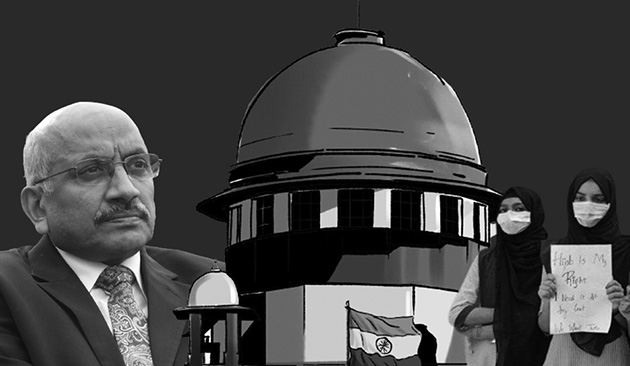
New Delhi, Sept 8: It is "not very fair" to compare the practices in Sikhism as they are well engrained in the culture of the country, the Supreme Court said on Thursday while asking the petitioners in the Karnataka Hijab ban matter not to draw a parallel between Muslim and Sikh religious practices.

Hearing arguments on a batch of pleas challenging the Karnataka High Court verdict refusing to lift the ban on hijab in educational institutions of the state, the apex court observed the five Ks in Sikhism -- Kesh, Kara, Kanga, Kaccha and Kirpan -- are well established.

A bench of Justices Hemant Gupta and Sudhanshu Dhulia observed this after an advocate, appearing for one of the petitioners in the case, gave an example of Sikhism and turban.

"It is not very fair to compare the rights or the practices in Sikhism. The five Ks are well established," the bench observed.

The top court referred to Article 25 of the Constitution and said it provides for the carrying of Kirpan by Sikhs.

Article 25 of the Constitution deals with freedom of conscience and free profession, practice and propagation of religion.

"Don't compare these practices because they have been recognised for over 100 years," the bench said.

Advocate Nizam Pasha, arguing for one of the petitioners, said Article 25 mentions only Kirpan and not the other Ks.

"What we are saying is, please do not draw any parity with Sikhism. That is all. That is what we are saying," the bench said.

Observing that arguments were advanced about Kara and turban, the bench said the practices in Sikhism are well established and well engrained in the culture of the country.

During the arguments, Pasha said the high court verdict had referred to certain verses of the Holy Quran as well as some commentaries.

He said the Holy Quran, as it stands, is perfect for all times to come and to say that verses of the Quran have become obsolete, is "bordering on blasphemy".

Senior advocate Devadatt Kamat, who appeared for one of the petitioners, told the bench that the state of Karnataka has said if the students would come in a head scarf, other people will get offended but this cannot be the reason for banning it.

Kamat argued that Article 25 has three restrictions -- public order, morality and health.

"Wearing a head scarf is a part of the religious belief apart from it being a part of (Articles) 19 and 21 rights," he said.

Kamat argued that every religious practice or religious observance is not essential to the religion but that does not mean that the State will keep on restricting it because it is not essential.

"As long as I do not violate public order, I do not fall foul of morality and I do not affect the health of others, I am entitled," he said.

Giving an example that one of the senior advocates wears a 'namam' (a divine mark put on the forehead), Kamat said it may not be an integral part of the religion of the Hindu faith.

"How does it harm discipline in the court? Does it harm public order?" he asked.

The bench observed there is a particular uniform for the lawyers to appear in court.

Justice Gupta said people in Rajasthan wear Pagdi as a matter of routine because of the climatic condition and in Gujarat also people wear it.

On the arguments about public order, the bench said this issue may arise when one is on the street.

The bench observed that wearing Hijab on the street does not affect anybody.

"But once you are talking about a school building, school premises, then the question is what kind of a public order the school want to be maintained there," it said.

Kamat said public order is the responsibility of the state and the school has nothing to do with it.

He asked, "In our constitutional scheme, is heckler's veto permitted?" (Heckler's veto is suppression of speech by the government when necessary to prevent possible violent reactions).

The senior advocate said it is the duty of the State to create an atmosphere where people can exercise their rights in accordance with Article 25.

"If I wear a head scarf, whose fundamental rights am I violating?" he said.

The bench observed it is not a question of violating others' fundamental rights.

"The question is what kind of fundamental right do you have which you want to exercise," it observed during the arguments which would continue on September 12.

Kamat said the state's argument is that if it will permit the wearing of a head scarf, which the petitioners regard as a part of their faith, some other students will wear an orange shawl.

"Wearing of an orange shawl, I do not think it is an innocent display of faith. It is a belligerent display of religious jingoism," he said, adding, "Article 25 only protects an innocent display of faith".

Kamat had earlier referred to the state government's order of February 5, 2022, by which it had banned wearing clothes that disturb equality, integrity, and public order in schools and colleges which some Muslim girls had challenged in the high court.

Several pleas have been filed in the top court against the March 15 verdict of the high court holding that wearing of hijab is not a part of the essential religious practice which can be protected under Article 25 of the Constitution.

The high court had dismissed the pleas filed by a section of Muslim students from the Government Pre-University Girls College in Udupi, seeking permission to wear hijab inside the classroom.

Challenging the February 5 order of the government, the petitioners had argued before the high court that wearing the Islamic headscarf was an innocent practice of faith and an essential religious practice and not a display of religious jingoism.

Comments

Add new comment

  • Coastaldigest.com reserves the right to delete or block any comments.
  • Coastaldigset.com is not responsible for its readers’ comments.
  • Comments that are abusive, incendiary or irrelevant are strictly prohibited.
  • Please use a genuine email ID and provide your name to avoid reject.
News Network
February 1,2026

US President Donald Trump on Saturday claimed that the government of India led by Prime Minister Narendra Modi has made a deal to buy Venezuelan oil, as opposed to purchasing it from Iran.

"We've already made that deal, the concept of the deal," he told reporters on Air Force One.

Trump had imposed 25% tariffs on countries buying Venezuelan oil, including India, in March 2025. He had also hit India with tariffs for buying Russian oil, saying it was "funding" President Vladimir Putin's war against Ukraine.

Trump has said that the US has taken control of the oil-rich Venezuela after capturing former President Nicolas Maduro in January.

A fleet of 18 ships loaded with crude oil bound for refineries in Texas, Louisiana, and Mississippi in January, the most since December 2024, according to a report by the news agency Bloomberg.

Combined crude deliveries to the US will reach about 2,75,000 barrels a day, more than doubling volumes seen in December last year. Shipments to China, which averaged 4,00,000 barrels a day last year, fell to zero in January.

PM Modi, Venezuelan President Agree To Expand Ties

Prime Minister Narendra Modi and Venezuela's acting President Delcy Rodriguez spoke on Friday and agreed to take the bilateral relations to "new heights" in the years ahead.

It was the first phone call between the two leaders since the capture of Maduro and his wife by the US on January 3.

"Spoke with Acting President of Venezuela, Ms. Delcy Rodriguez. We agreed to further deepen and expand our bilateral partnership in all areas, with a shared vision of taking India-Venezuela relations to new heights in the years ahead," PM Modi said in a post on X.

A statement from Prime Minister Modi's office said the two leaders agreed to further expand and deepen the India-Venezuela partnership in all areas, including trade and investment, energy, digital technology, health, agriculture, and people-to-people ties.

They exchanged views on various regional and global issues of mutual interest and underscored the importance of their close cooperation for the Global South, the statement said.

Rodriguez also said that they discussed partnerships in the fields of agriculture, science and technology, mining, and tourism, as well as the pharmaceutical and automotive industries.

Comments

Add new comment

  • Coastaldigest.com reserves the right to delete or block any comments.
  • Coastaldigset.com is not responsible for its readers’ comments.
  • Comments that are abusive, incendiary or irrelevant are strictly prohibited.
  • Please use a genuine email ID and provide your name to avoid reject.
News Network
January 20,2026

iran.jpg

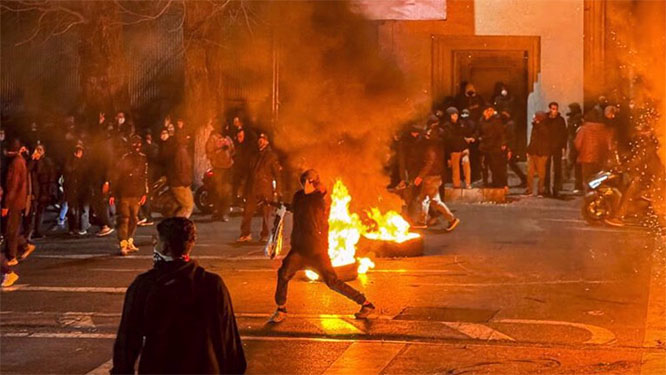
Iranian security and intelligence forces have captured more than 470 individuals in three provinces, identified as key figures behind the recent wave of violent unrest and terrorist activities linked to foreign-backed networks.

The Intelligence Ministry's provincial office in Khorasan Razavi announced on Monday the arrest of 192 armed terrorists, identified as the main agents behind recent riots in the region. 

According to an official statement, the detainees were involved in the killing of several security personnel and civilians, setting fire to mosques, public service facilities, and buses, as well as attacks on military and law enforcement centers.

The seized items from the group include several bulletproof vests, Kalashnikov rifles, hunting weapons, Winchester rifles, and various cold weapons such as daggers, swords, brass knuckles, tactical knives, crossbows, and chains.

Evidence indicates that some of the individuals were tied to hostile movements and terrorist organizations, with links overseas. Others were identified as members of violent criminal gangs, actively taking part in the unrest alongside their associates.

Simultaneously, in the western province of Lorestan, the IRGC announced the arrest of 134 individuals as the main leaders and influential field agents of a US-Israeli terrorist network.

The IRGC statement stated that these individuals formed terrorist cells during the recent unrest, committing "Daesh-like" acts.

They wounded security forces with firearms and cold weapons, and burned and destroyed public and private properties, including mosques, shops, banks, and private and public vehicles.

In the northwestern province of Zanjan, the police reported detaining 150 people identified as principal leaders and agents behind recent riots.

Authorities noted that these individuals were responsible for destroying public and private property and intentionally setting fire to vehicles in the province's squares.

Their crimes include shedding the blood of innocent people, destroying public and private property, attempting to enter military sites, disrupting public order, and spreading terror among citizens.

A variety of cold weapons were reportedly seized from the detainees.

What began late last month as peaceful protests over economic hardship across Iran turned violent after public statements by US and Israeli regime figures encouraged vandalism and disorder.

During the unrest, foreign-backed mercenaries rampaged through cities, killing security forces and civilians and damaging public property.

Comments

Add new comment

  • Coastaldigest.com reserves the right to delete or block any comments.
  • Coastaldigset.com is not responsible for its readers’ comments.
  • Comments that are abusive, incendiary or irrelevant are strictly prohibited.
  • Please use a genuine email ID and provide your name to avoid reject.
News Network
January 28,2026

ajit.jpg

Mumbai: The sudden death of Maharashtra Deputy Chief Minister Ajit Pawar in a plane crash in his hometown of Baramati has plunged the state into political uncertainty, raising a pressing question for both the Nationalist Congress Party (NCP) and its rival faction, the Nationalist Congress Party (Sharadchandra Pawar): what next?

For the two factions that emerged after the dramatic split of June–July 2023, the moment marks their gravest challenge yet. Many believe the answer now rests with party founder Sharad Pawar.

Sharad Pawar, who founded the NCP in 1999 after parting ways with the Congress over Sonia Gandhi’s foreign origin, has already indicated his intention to step away from electoral politics once his Rajya Sabha term ends in April 2026.

Speaking at a public event in Baramati ahead of his 85th birthday on December 12, 2025, Pawar said he would not contest any further elections. “I have contested 14 elections. The younger generation needs to be given an opportunity,” he said, adding that he would decide later whether to seek another Rajya Sabha term.

Often described as the Bhishma Pitamah of Indian politics, Pawar also spoke of his gradual withdrawal from active leadership. “For the first 30 years, I handled everything. For the next 25–30 years, Ajit Dada handled responsibilities. Now, arrangements must be made for new leadership,” he said.

Ajit Pawar’s death has dramatically altered that transition, especially as he was working towards reunifying the two NCP factions.

“After the developments of June–July 2023 and the 2024 Lok Sabha and Vidhan Sabha elections, there were deep changes within the family and the party. In the last six months, serious efforts were made to reunite. Even workers from both sides wanted unity. This is a massive blow,” a Pawar family insider told DH over phone from Baramati.

Electoral outcomes over the past year reflected the split. In the 2024 Lok Sabha elections, NCP (SP) recorded the best strike rate in Maharashtra, winning eight of the 10 seats it contested. The NCP, by contrast, won just one seat out of four.

However, the trend reversed in the subsequent Vidhan Sabha elections, where the NCP emerged stronger, securing 41 of the 288 seats, while NCP (SP) managed only 10.

Within NCP (SP), Sharad Pawar’s daughter Supriya Sule serves as Working President, followed by leaders such as Rohit Pawar, state president Shashikant Shinde and former state chief Jayant Patil.

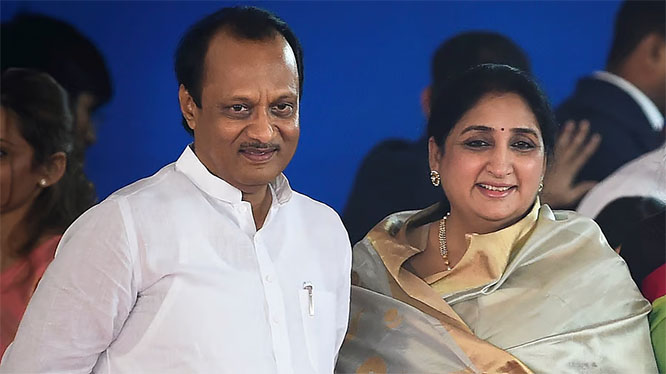
In the NCP, Praful Patel is the Working President and Raigad MP Sunil Tatkare heads the state unit. Ajit Pawar’s wife, Sunetra Pawar, is a Rajya Sabha MP, while their sons Parth and Jay are not actively involved in day-to-day politics. Parth Pawar briefly entered electoral politics in 2019 but lost the Lok Sabha election from Maval. Jay Pawar’s political debut was under consideration.

With Ajit Pawar gone, speculation has intensified that a member of the family may be asked to assume a larger role. For now, Sunetra Pawar is expected to play a key coordinating role in party affairs, alongside Patel and Tatkare.

The NCP continues to have several heavyweight leaders, including Chhagan Bhujbal, Hasan Mushrif, Dattatreya Bharne, Manikrao Kokate and Dhananjay Munde.

Ajit Pawar had already begun steps towards reconciliation between the two factions. While they contested the Pune and Pimpri-Chinchwad municipal elections separately, they later decided to fight the zilla parishad elections together under the ‘clock’ symbol—seen as the first formal step towards reunification.

Nagpur meet and party roadmap

Both NCP factions claim adherence to the ideology of ‘Shiv–Shahu–Phule–Ambedkar’. At the Rashtravadi Chintan Shivir held in Nagpur on September 19, 2025, the NCP reaffirmed its commitment to sarva dharma sambhav and discussed strengthening ties with the BJP “for the welfare and development of Maharashtra”.

In recent days, reports had suggested Ajit Pawar might return to the Maha Vikas Aghadi following the party’s poor performance in Pune municipal elections, but these claims were denied.

Big question for Maha Yuti

Ajit Pawar’s death also presents an immediate challenge for the Devendra Fadnavis-led Maha Yuti government. Pawar held crucial portfolios, including Finance, Planning and Excise. With the Budget Session approaching, appointing a new Finance Minister has become urgent.

Beyond numbers and portfolios, Maha Yuti has lost a swift decision-maker known for his administrative grip and political finesse—leaving a vacuum that will not be easy to fill.

Comments

Add new comment

  • Coastaldigest.com reserves the right to delete or block any comments.
  • Coastaldigset.com is not responsible for its readers’ comments.
  • Comments that are abusive, incendiary or irrelevant are strictly prohibited.
  • Please use a genuine email ID and provide your name to avoid reject.