



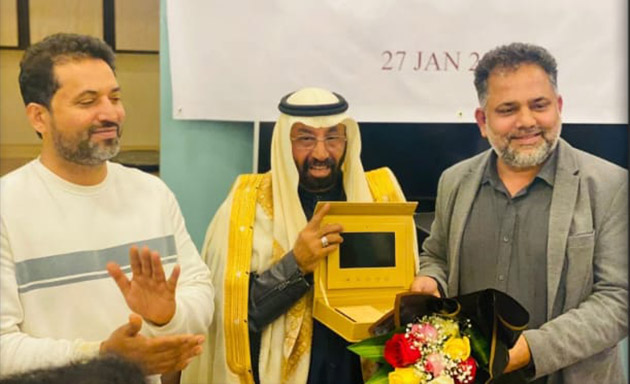
Two brothers from Udupi’s Padubidri receive Saudi Green Card

P A Hameed Padubidri, KSA
February 1, 2023

Padubidri.jpg

Al Khober: Two brothers, Ibrahim Meera Hussain and Abdul Salam Meera Hussain from RAQWANI Co Ltd. Al-Khobar, Kingdom of Saudi Arabia, have received Saudi permanent ‘premium residency’, which is casually known as a Saudi Green Card. Ibrahim is a Managing Director and Abdul Salam is a General Manager of RAQWANI Co. Ltd. based in Al-Khober, eastern province of the KSA. It's one of the prestigious recognitions granted by the Saudi Arabian Government for foreigners in the KSA. 

The duo are sons of late Haji Meera Hussain, who hails from Padubidri in Udupi district. They are not only businessmen, but also involved in various philanthropic, socio-humanitarian -educational activities that benefited a lot of needy & underprivileged people. Also, they built a positive image of India in KSA, which is friendly country of India. 

The duo are only the third from the undivided Dakshina Kannada to receive the Premium Residency while Mr. Shaikh, head of Expertise Company in Al-Jubail, and Zaheer from Al-Muzain being the first and second to receive it. 

This scheme (Saudi Premium Residency) is in line with the Saudi Arabia's Vision-2030 designed by Crown Prince H.H. Mohammed Bin Salman to boost up the country's economy. It's applied through the Premium Residency Center and Unified National Platform. 

There are two kinds of grant of Premium Residencies such as Permanent Premium Residency under SP1 & yearly renewable Premium Residency under SP2. The former is granted for life-time to Iqama (Residence Permit) holders with one time payment of SR. 800,000, whereas the latter is granted on yearly renewable basis with the payment of SR. 100,000. 

The holders of the Premium Residency are provided with  many benefits & privileges, which other ordinary Iqama holders are not given like without sponsor, buying & selling properties, building house, owning business, trading etc. 

Sometpimes an opportunity comes to the threshold of one's door, but most of the times he creates an opportunity where he endeavor to get positive results & benefits out of it. The latter one needs hard work, determination & dedication to reach its success. 

These brothers opted for dedication & hardwork to create an opportunity that resulted in the establishment of RAQWANI Est.,in 2006. They started a humble begining of their business. Initially it was a small Establishment with only 3 employees, gradually increasing the business set up to a Limited Company. Presently, there are more than 400 employees actively working in the Company. 

RAQWANI Co. engaged in business of heavy equipments renting, trading, medical supply and other diversified business. It's now one of the recognized companies of the KSA. 

Comments

Add new comment

  • Coastaldigest.com reserves the right to delete or block any comments.
  • Coastaldigset.com is not responsible for its readers’ comments.
  • Comments that are abusive, incendiary or irrelevant are strictly prohibited.
  • Please use a genuine email ID and provide your name to avoid reject.
News Network
February 1,2026

Bengaluru: Karnataka Deputy Chief Minister D K Shivakumar on Sunday criticised the Union Budget presented by Finance Minister Nirmala Sitharaman, claiming it offered no tangible benefit to the state.

Though he said he was yet to study the budget in detail, Shivakumar asserted that Karnataka had gained little from it. “There is no benefit for our state from the central budget. I was observing it. They have now named a programme after Mahatma Gandhi, after repealing the MGNREGA Act that was named after him,” he said.

Speaking to reporters here, the Deputy Chief Minister demanded the restoration of MGNREGA, and made it clear that the newly enacted rural employment scheme — VB-G RAM G — which proposes a 60:40 fund-sharing formula between the Centre and the states, would not be implemented in Karnataka.

“I don’t see any major share for our state in this budget,” he added.

Shivakumar, who also holds charge of Bengaluru development, said there were high expectations for the city from the Union Budget. “The Prime Minister calls Bengaluru a ‘global city’, but what has the Centre done for it?” he asked.

He also drew attention to the problems faced by sugar factories, particularly those in the cooperative sector, alleging a lack of timely decisions and support from the central government.

Noting that the Centre has the authority to fix the minimum support price (MSP) for agricultural produce, Shivakumar said the Union government must take concrete steps to protect farmers’ interests.

Comments

Add new comment

  • Coastaldigest.com reserves the right to delete or block any comments.
  • Coastaldigset.com is not responsible for its readers’ comments.
  • Comments that are abusive, incendiary or irrelevant are strictly prohibited.
  • Please use a genuine email ID and provide your name to avoid reject.
News Network
February 1,2026

Bengaluru: Karnataka Deputy Chief Minister D K Shivakumar on Sunday criticised the Union Budget presented by Finance Minister Nirmala Sitharaman, claiming it offered no tangible benefit to the state.

Though he said he was yet to study the budget in detail, Shivakumar asserted that Karnataka had gained little from it. “There is no benefit for our state from the central budget. I was observing it. They have now named a programme after Mahatma Gandhi, after repealing the MGNREGA Act that was named after him,” he said.

Speaking to reporters here, the Deputy Chief Minister demanded the restoration of MGNREGA, and made it clear that the newly enacted rural employment scheme — VB-G RAM G — which proposes a 60:40 fund-sharing formula between the Centre and the states, would not be implemented in Karnataka.

“I don’t see any major share for our state in this budget,” he added.

Shivakumar, who also holds charge of Bengaluru development, said there were high expectations for the city from the Union Budget. “The Prime Minister calls Bengaluru a ‘global city’, but what has the Centre done for it?” he asked.

He also drew attention to the problems faced by sugar factories, particularly those in the cooperative sector, alleging a lack of timely decisions and support from the central government.

Noting that the Centre has the authority to fix the minimum support price (MSP) for agricultural produce, Shivakumar said the Union government must take concrete steps to protect farmers’ interests.

Comments

Add new comment

  • Coastaldigest.com reserves the right to delete or block any comments.
  • Coastaldigset.com is not responsible for its readers’ comments.
  • Comments that are abusive, incendiary or irrelevant are strictly prohibited.
  • Please use a genuine email ID and provide your name to avoid reject.
News Network
January 23,2026

Mangaluru: The Karnataka Government Polytechnic (KPT), Mangaluru, has achieved autonomous status from the All India Council for Technical Education (AICTE), becoming the first government polytechnic in the country to receive such recognition in its 78-year history. The status was granted by AICTE, New Delhi, and subsequently approved by the Karnataka Board of Technical Education in October last year.

Officials said the autonomy was conferred a few months ago. Until recently, AICTE extended autonomous status only to engineering colleges, excluding diploma institutions. However, with a renewed national focus on skill development, several government polytechnics across India have now been granted autonomy.

KPT, the second-largest polytechnic in Karnataka, was established in 1946 with four branches and has since expanded to offer eight diploma programmes, including computer science and polymer technology. The institution is spread across a 19-acre campus.

Ravindra M Keni, the first dean of the institution, told The Times of India that AICTE had proposed autonomous status for polytechnic institutions that are over 25 years old. “Many colleges applied. In the first round, 100 institutions were shortlisted, which was further narrowed down to 15 in the second round. We have already completed one semester after becoming an autonomous institution,” he said. He added that nearly 500 students are admitted annually across eight three-year diploma courses.

Explaining the factors that helped KPT secure autonomy, Keni said the institution has consistently recorded 100 per cent admissions and placements for its graduates. He also noted its strong performance in sports, with the college emerging champions for 12 consecutive years, along with active student participation in NCC and NSS activities.

Autonomous status allows KPT to design industry-oriented curricula, conduct examinations, prepare question papers, and manage academic documentation independently. The institution can also directly collaborate with industries and receive priority funding from AICTE or the Ministry of Education. While academic autonomy has been granted, financial control will continue to rest with the state government.

“There will be separate committees for examinations, question paper setting, boards of studies, and boards of examiners. The institution will now have the freedom to conduct admissions without government notifications and issue its own marks cards,” Keni said, adding that new academic initiatives would be planned after a year of functioning under the autonomous framework.

Comments

Add new comment

  • Coastaldigest.com reserves the right to delete or block any comments.
  • Coastaldigset.com is not responsible for its readers’ comments.
  • Comments that are abusive, incendiary or irrelevant are strictly prohibited.
  • Please use a genuine email ID and provide your name to avoid reject.