



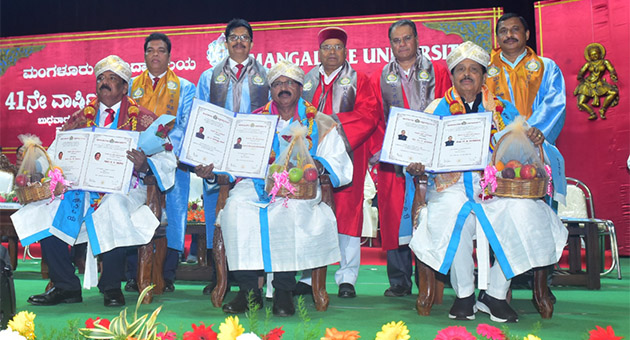
Mangaluru, Mar 15: Mangalore University during its 41st convocation on Wednesday, March 15, conferred honorary doctorate degrees were awarded to three achievers who achieved unparalleled achievements in various fields.
Haji U.K. Monu, founder and managing director of Kanachur Group of Industries, Mangaluru for his achievements in education and social service, businessman G Ramakrishna Achar for his contribution to agriculture, education and social service and Rajyotsava awardee Prof. M.B. Puranik for education and social service received honorary doctorate degree from the Governor.
Haji U K Monu
Haji U. K. Monu is the founder and managing director of Kanachur Group of Industries in Mangalore. Under his leadership, the Kanachur Academy of General Education was established in 2002 to provide quality education to the people of the locality, especially women and the underprivileged. The Academy includes a range of institutions, including the Kanachur Public School, Kanachur Pre-University College for Women, Kanachur Institute of Management and Science, Kanachur Institute of Medical Science, Kanachur College of Physiotherapy, Kanachur College of Nursing Science, Kanachur Institute of Allied Health Science, and Kanachur Hospital and Research Centre.
In addition to his outstanding achievements in the educational field, Haji U.K Monu has made significant contributions in the social and religious fields. He has served as the President and Vice President of the Syed Madani Charitable Trust and Dargah Association Ullal, Mangalore, and as the President of the Mohidin Jumma Masjid, Panjala, Mangaluru for the past 25 years. He has also served as the Vice President of the South Indian Plywood Manufacturers Association and the Karnataka Timber Importers Association.
Haji U.K Monu's business ventures have provided direct and indirect employment opportunities to many people, and his efforts have extended globally through his association with Global Business Associates in Singapore, Dubai, Myanmar, Africa, and Europe. He has been recognized for his outstanding contributions in the field of Education and Social Service by the Newspaper Association of Karnataka and by the Mangalore University on 43rd Foundation day.
Haji U. K. Monu is Self-taught and self-made entrepreneur and educationist with an undying passion for constant learning and amelioration. He is universally compassionate, empathetic and involved in social service, helping many poor families who are economically backward, facilitating fee concessions and free education for
deserving students, and conducting free mass marriages for poor couples. He has covered a vast sphere of business interests and diverse social ventures, providing both direct and indirect employment to many people. He has faced numerous difficulties and challenges during his initial days towards the path of achievement. His dedication, hard work, and commitment to excellence made him a role model for the younger generation. His contributions to society are truly commendable.
Ramakrishna Achar
G Ramakrishna Achar was born in a financially backward family from Gangolli in Kundapur taluk in Udupi district and due to the fact that he had to support his family he quickly took up work at a fabrication workshop and dropped out of the school early in his childhood. All the time his heart yearned for more academic education, but learnt skills from his work at an impressionable age. The self-learning desire in him took him deep into mechanics and fabrication field and made him master craftsman, when he had just reached his teenage. He upgraded his technical knowledge by working as a trainee in the Central Food Technology and Research Institute (CFTRI) in Mysuru.
From then on, he did not look back or paused on the road to his horizons. Though he started his professional life in a shed with only Rs. 25,000 capital, he ploughed hard and today he owns a fabrication company that is making waves in the field of agriculture, water management, sewage treatment having a turnover of Rs. 250 crores per annum and employed over 3000 people in skilled, semi-skilled and unskilled segments. He has built infrastructure close to Rs. 100 crores. His clientele is spread over the globe- even in the developed world.
His line up of products began in 1990 with paddy processing unit which he quickly upgraded into a modern range of machinery with inbuilt dryer that played a major role in controlling the moisture and retaining the quality of rice for a long time. This was a world innovation and many paddy growing countries around the world have subscribed to his idea and started using his machinery. As a result in India alone, the wastage of cured rice was arrested and the country gained Rs. 100 crore every season by way of stopping the rice going waste due to moisture retention.
This process also had another advantage of retaining the composition of rice that made it suitable for the modern day rice-based fastfood recipes. Today if the common rice smells and tastes better all over the country, it was due to the deep research product of Ramarkishna Achar’s ingenuity, imagination, creativity and innovative outlook.
Clean and pure water to the last person in society- Elixir of life
Ramakrishna Achar’s quest for research took another turn which was towards providing safe drinking water to the masses. His ‘Elixir’ brand of water purifier with different configuration is now a standard equipment for water dispensing in public places all over the country and in the neighbhouring countries. Heeding to the call of honourable Prime Minister Narendra Modiji for clean and safe water for every citizen under ‘Sujala’ programme, Ramarkishna Achar upgraded his range of water purification plants and made it more affordable to install them in more places where people can fill up one litre of purified water at Rs. 1 per litre. This worked like a charm in rural areas where the drinking water supply quality was always wanting for improvement. Thanks to the efforts now thousands of villages, temple complexes, public offices, schools, colleges or wherever there is a good number of visitors the ‘Elixir’ machines were installed providing safe drinking water.
The Elixir machines also minimised the use of pet bottles being littered after the use that led to plastic pollution. This innovative product also gave jobs to many urban and rural youths by installing the Elixir water dispenser machines and earned their livelihood. In fact, the Elixir Machines have taken care of three objectives together, namely stand-up India, Skill India and clean water programme which the honourable Prime Minister of India had envisaged.
Effluent treatment plant -micro and macro operations.
Another area of vital importance where Ramkrishna Achar concentrated is the treatment of effluent water or what we call municipal waste. There are a number of scientific findings and research papers that indicate untreated sewage discharge from towns and cities polluting the surface water resources and gradually turning the surface water and the sub-terranean water sources unusable, especially in the highly urban areas and cities.
To deal with this problem, he has designed sewage water treatment plants of various configurations that can cater to individual households, medium and large housing colonies, industrial houses, high-rise apartment blocks. Since space is always a constraint in housing complexes, the design of these new-generation effluent treatment plants can fit in a corner of any independent house and what is more? The system does not need any civil work and is fully automated and requires no or minimal human intervention for maintenance purposes. This model also has been widely accepted in many parts of the globe including some developed countries. To put it simply it is a ‘plug and play’ system.
Industrial Training Institute- a ray of hope for the rural youth.
His deep understanding of the social system around the youth was instrumental in promoting an Industrial Institute at Bannadka near Moodbidri. He has developed thousands of skilled youth who have populated Industrial set-up in various countries in the world and are gainfully employed in ancillaries and mainline industrial houses in fabrication, technology integration and adoption, and mechanical automation. The National Council for Vocational Training has recognised the Institute. Many of them already own SMEs in the rural engineering and fabrication in small towns and cities. Even here, the Skill India programme of our honourable Prime Minister Narendra Modi ji has been a motivating factor.
Go Dhama - a passion and a mission
In another initiative towards making the farmers self-sufficient, Ramakrishna Achar has launched a ‘Go Dhama’ in a remote village - Muniyal in Karkala taluk about 25 kilometers from Moodbidri on a 35 acres of land. His idea was to create a model, micro self-sufficient village led by the cow-rearing and value- addition to the milk and milk products. It started as a passion and later became a mission of his life.
The Go Dhama has 37 Indian breed cows from different parts of the country. A fully machinised production unit, in-house veterinary service, composting, fodder development, training programmes for the farmer in integrated farming and intercropping and developing nutrition programme for the cows for better milk-yield and healthy progeny. The Go Dhama also has plans for development of the hyper local variety of cows and cattle.
The wider vision of Go Dhama is to have a SME level Dairy development based on modernisation and Technology based on PLC norms.
Social service
His heart and mind fill with joy when he talks about the social work aspect in his life so far. The Sri Kalikamba temple in Moodbidri of which he is a trustee has climbed from strength to strength over the last few years. The managing committee and devotees acknowledge the growth with high degree of confidence.
The Bala Samskara Kendra is an institution he launched with help from his own community. The basic objective of the institution is to impart traditional knowledge and Indian ethos along with the school curriculum tapping into the forgotten traditions of our society.
The SKF has also laid out substantial funds for taking up Corporate Social Responsibility projects. It participates in water conservation, water body revivals, Human Resources Development and holding regular medical camps.
Prof. M. B. Puranik
RajyotsavaPuraskar Recipient, Prof. M. B. Puranik is a visionary, a philanthropist, an educationalist, an entrepreneur, a social worker and a politician committed to the nationalist idea that is India.
Prof. M. B. Puranik has a rich 34 years of experience in teaching as the Professor and Head, Dept. of Botany. He was initially associated with St. Mary’s Junior College, Shirva and later on with Canara College, Mangalore. Education is his passion and he realised that a lot of problems in the society could be solved by empowering the youth with education and employment. Over the past thirty years he has been successful in building 10 institutions in four different campuses. He is currently the President of Tulunad Educational Trust and Sharada Group of Institutions. He is a noted alumnus of Sri. Rama Higher Elementary School, Majur; Sri. Vishnumurthy Hayavadana Swamy High School, Innanje; Poorna Prajna College Udupi, Regional College of Education Mysore, and Sardar Patel University, Anand Gujarat. All his alma maters have known him for his leadership skills and diligence. He was the Union President in College, and Senior Under Officer in NCC (Army) having C-certificate with distinctions. As a Professor, he was also the Associate NCC Officer (ANO) in the Air Wing branch, Student Welfare Officer, and Fine Arts Association Convener.
Prof. M. B. Puranik has always been interested in social welfare – he believes that one should be able to give back to the society at least a small portion of what one has taken from the society. His interests apart from education and social work are animal husbandry and agriculture. He is a President of an orphanage called Mangala Seva Samiti Trust (Bala Samrakshana Kendra, Kuttarpadav) and started the Gowvanithashraya Trust in Pajeer which shelters 400 cows and a few destitute women. He is also the president of RCPHD Trust, which runs a school for the economically deprived as well as physically handicapped children. Due to his philanthropic leadership, every year nearly 100 students receive free education, and so far 21 orphan girls have entered into wedlock.
From a Karyakartha in Udupi, he was raised to the level of the Working President of VHP (Karnataka state),a responsibility of a very grave nature, which he is very proud of, till date. His association with the RSS starts from his early youthful days, and though he was elevated to the position of the Vibhag Sangha Chalak, Mangaluru, he had to renounce it later to take
up larger roles. Prof. M.B Puranik was also appointed as State Committee Member of Rajya Dharmik Parishat and the Chairman of Gau-SevaAayog in 2013 by the then BJP Government under Sri. B. S. Yediyurappa.
Philanthropist, Prof. M. B. Puranik born in 1945 in Majuru, a small village of undivided Dakshina Kannada, as the 7th son of Late Sri. Ramkrishna Puranik and Smt. Jalajakshi Ammais thus a doyen of education, empowerment, and social upliftment which sums up to patriotism.
Institutions under Prof. M.B. Puranik’s Leadership:
Sharada Vidyalaya - 1992
Sharada PU College - 1998
Shubhodaya Vidyalaya - 2003
Sharada Vidyanikethana Public School - Residential - 2005
Sharada Vidyanikethana Public School - Day Boarding - 2005
Sharada Vidyanikethana P.U. College - 2010
Sharada First Grade College - 2010
Sharada Ayurdhama Medical College & Hospital - 2016
Sharada Shishu Vihara - 2017
Sharada Yoga & Naturopathy Hospital & Research Centre - 2019
Awards & Honours:
Best NCC Officer - Karnataka State Government - 1984
Rajyothsava Puraskar - Karnataka State Government - 2010
Ahara Rathna - Hotel Owners Association - 2011
Seva Rathna - by Swarnavalli Mutt, Sonda - 2015
Krishnanugraha - by Pejavara Mutt - 2018
Hari Bhaktha Netha - by Paryaya Sri.Adamaru Mutt - 2021
Ananda Samaja Bhushana - Ananda Balaga Bengaluru - 2022
Shivalli Shikshana Ratna - Shivalli Spandana, Mangaluru– 2022
Vidyanidhi Shilpi – Shanbhog Dasappa Datti – 2023 (100th Silver Crown)
Prof. M. B. Puranik has been a member of many other organisations and associations in various capacities and has been honoured with multiple recognitions. However, only a few have been listed above.


Comments
Add new comment