



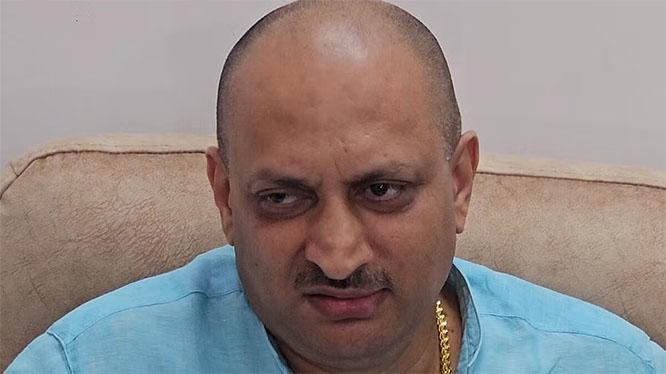
Will you take action against Anantkumar Hegde to demonstrate commitment to Constitution?: Congress to PM Modi

News Network
March 12, 2024

AK.jpg

The Congress on Tuesday attacked Prime Minister Narendra Modi over Anantkumar Hegde's remark about amending the Constitution, asking whether he would take action against the BJP MP to demonstrate his commitment to the Constitution.

Congress general secretary Jairam Ramesh hit out at the prime minister who is on a visit to Gujarat and Rajasthan and posed five questions to Modi.

"The prime minister is in Ahmedabad for the Sabarmati Ashram Memorial Project. While the prime minister is embracing the Mahatma for his political gains, will he commit to Mahatma Gandhi's ideals of non-violence, inclusivity, and equality?" he said in a post on X.

The Congress leader also asked whether PM Modi would take action against Anantkumar Hegde, the BJP MP from Karnataka, to demonstrate his personal commitment to the Constitution that he swore an oath to bear true faith and allegiance to.

Hegde, at a gathering at Karwar in Karnataka on Saturday, had said the BJP needed a two-third majority in both Houses of Parliament to amend the Constitution and 'set right the distortions and unnecessary additions made to it by the Congress'.

In his posers to the prime minister, Ramesh also asked whether PM Modi would explain the 14 paper leaks that have occurred in Gujarat over the last seven years.

'The Congress has announced a comprehensive plan, 'Paper Leak se Mukti' under its Yuva Nyay guarantees to tackle the issue. How does the Prime Minister plan to address it?' he said.

Ramesh said on crucial indicators of development, Gujarat fares poorly compared to other states.

'Gujarat does worse on retention of students in higher secondary education and spends less on public education than poorer states like Rajasthan and Chhattisgarh. Gujarat currently ranks 10th among 20 major states in terms of its population living Below Poverty Line,' he said.

'Despite the prime minister's public posturing on 'Beti Bachao, Beti Padhao', Gujarat ranks 15th out of 20 states in sex ratio. How does PM Modi reconcile the reality of Gujarat's socio-economic backwardness with the 'Gujarat Model' that he publicised in 2014 or the 'Double Engine' Sarkar model that he espouses today? the Congress leader said.

Ramesh said Prime Minister Modi will also visit Pokhran in Rajasthan, made famous exactly 50 years ago by Indira Gandhi as the site of India's first 'peaceful nuclear explosion', to celebrate India's indigenous defence capabilities which have incidentally been developed despite his best efforts.

'The share of expenditure on defence has fallen from 17.43 per cent of the Union Budget in FY19 to 13 per cent for FY25. As percentage of GDP, it has fallen from 2.13 per cent to 1.9 per cent between 2014 and 2024 - below the global standard of at least 2 per cent,' he said.

How does the prime minister intend to safeguard India's border or show China his 'Lal aankh' (red eye) without adequate expenditure on the armed forces, Ramesh asked.

'In the same vein, the prime minister has set up two committees in the last three years to investigate ways in which he can privatise or shut down the DRDO. The K VijayRaghavan committee has reportedly suggested that the DRDO's role be limited to research and development without being involved in developing prototypes or technology demonstrations,' he said.

'Instead, any production and further development would be done by selected private players. What is the prime minister's motivation in privatising defence research and development? Is it an attempt to bring his favoured industrialist friends into the industry through the backdoor?' Ramesh asked.

Comments

Add new comment

  • Coastaldigest.com reserves the right to delete or block any comments.
  • Coastaldigset.com is not responsible for its readers’ comments.
  • Comments that are abusive, incendiary or irrelevant are strictly prohibited.
  • Please use a genuine email ID and provide your name to avoid reject.
News Network
January 23,2026

Karnataka Governor Thaawarchand Gehlot read only three lines from the 122-paragraph address prepared by the Congress-led state government while addressing the joint session of the Legislature on Thursday, effectively bypassing large sections critical of the BJP-led Union government.

The omitted portions of the customary Governor’s address outlined what the state government described as a “suppressive situation in economic and policy matters” under India’s federal framework. The speech also sharply criticised the Centre’s move to replace the Mahatma Gandhi National Rural Employment Guarantee Act (MGNREGA) with the Viksit Bharat–Guarantee for Rozgar and Ajeevika Mission (Gramin) Act, commonly referred to as the VB-GRAM (G) Act.

Governor Gehlot had earlier conveyed his objection to several paragraphs that were explicitly critical of the Union government. On Thursday, he confined himself to the opening lines — “I extend a warm welcome to all of you to the joint session of the State legislature. I am extremely pleased to address this august House” — before jumping directly to the concluding sentence of the final paragraph.

He ended the address by reading the last line of paragraph 122: “Overall, my government is firmly committed to doubling the pace of the State’s economic, social and physical development. Jai Hind — Jai Karnataka.”

According to the prepared speech, the Karnataka government demanded the scrapping of the VB-GRAM (G) Act, describing it as “contractor-centric” and detrimental to rural livelihoods, and called for the full restoration of MGNREGA. The state government argued that the new law undermines decentralisation, weakens labour protections, and centralises decision-making in violation of constitutional norms.

Key points from the unread sections of the speech:

•    Karnataka facing a “suppressive” economic and policy environment within the federal system

•    Repeal of MGNREGA described as a blow to rural livelihoods

•    VB-GRAM (G) Act accused of protecting corporate and contractor interests

•    New law alleged to weaken decentralised governance

•    Decision-making said to be imposed by the Centre without consulting states

•    Rights of Adivasis, women, backward classes and agrarian communities curtailed

•    Labourers allegedly placed under contractor control

•    States facing mounting fiscal stress due to central policies

•    VB-GRAM (G) Act accused of enabling large-scale corruption

Comments

Add new comment

  • Coastaldigest.com reserves the right to delete or block any comments.
  • Coastaldigset.com is not responsible for its readers’ comments.
  • Comments that are abusive, incendiary or irrelevant are strictly prohibited.
  • Please use a genuine email ID and provide your name to avoid reject.
News Network
February 1,2026

Bengaluru: Karnataka Deputy Chief Minister D K Shivakumar on Sunday criticised the Union Budget presented by Finance Minister Nirmala Sitharaman, claiming it offered no tangible benefit to the state.

Though he said he was yet to study the budget in detail, Shivakumar asserted that Karnataka had gained little from it. “There is no benefit for our state from the central budget. I was observing it. They have now named a programme after Mahatma Gandhi, after repealing the MGNREGA Act that was named after him,” he said.

Speaking to reporters here, the Deputy Chief Minister demanded the restoration of MGNREGA, and made it clear that the newly enacted rural employment scheme — VB-G RAM G — which proposes a 60:40 fund-sharing formula between the Centre and the states, would not be implemented in Karnataka.

“I don’t see any major share for our state in this budget,” he added.

Shivakumar, who also holds charge of Bengaluru development, said there were high expectations for the city from the Union Budget. “The Prime Minister calls Bengaluru a ‘global city’, but what has the Centre done for it?” he asked.

He also drew attention to the problems faced by sugar factories, particularly those in the cooperative sector, alleging a lack of timely decisions and support from the central government.

Noting that the Centre has the authority to fix the minimum support price (MSP) for agricultural produce, Shivakumar said the Union government must take concrete steps to protect farmers’ interests.

Comments

Add new comment

  • Coastaldigest.com reserves the right to delete or block any comments.
  • Coastaldigset.com is not responsible for its readers’ comments.
  • Comments that are abusive, incendiary or irrelevant are strictly prohibited.
  • Please use a genuine email ID and provide your name to avoid reject.
News Network
January 20,2026

Mangaluru: In a major step towards strengthening rural innovation, the Office of the Principal Scientific Adviser (PSA) to the Government of India is supporting the establishment of RuTAGe Smart Village Centres (RSVCs) across the country through collaborations with academic institutions, civil society organisations and philanthropic partners.

As part of this national initiative, Nitte (Deemed to be University) will set up the first RSVCs in the region at Nitte GP in Udupi district and at the Nitte Health Centre, Sevanjali Trust, Farangipete, in Dakshina Kannada district. The centres will be inaugurated on January 21. In South India, the programme is being implemented by the Section Infin-8 Foundation (SI-8).

Speaking to reporters on Monday, SI-8 founder-director Vishwas US said experts from Nitte University and SI-8 would work closely with farmers, students, youth and local entrepreneurs to adapt and deploy technologies tailored to local needs.

Project head Prof Iddya Karunasagar, representing Nitte DU, said the RSVCs at Nitte and Farangipete would serve as demonstration hubs for a wide range of agriculture, energy, skill-development and assistive technologies. These include solar dryers for fruits, vegetables and crops; soil-testing solutions; power weeders and women-friendly farm tools; wind-powered devices for rural artisans; grain storage systems; grass-cutting and tree-climbing equipment; and liquid fertiliser production using cowshed waste.

SI-8 CEO Aravind C Kumar said the centres would also provide access to digital and knowledge-based platforms such as ISRO applications, government scheme portals, market linkage tools and gamified learning resources, along with assistive technologies for persons with visual impairments.

Highlighting the broader impact of the initiative, Principal Scientific Adviser Prof Ajay Kumar Sood said it demonstrated how applied research could bridge the rural–urban divide and help create self-reliant, technology-enabled villages.

The initiative has been made possible through philanthropic support from Dr NC Murthy of ACM Business Solutions, LLC, USA. Dr Sapna Poti, Director (Strategic Alliances) at the Office of the Principal Scientific Adviser, said the long-term objective is to build self-sufficient, technology-driven communities capable of generating sustainable livelihoods on their own.

Comments

Add new comment

  • Coastaldigest.com reserves the right to delete or block any comments.
  • Coastaldigset.com is not responsible for its readers’ comments.
  • Comments that are abusive, incendiary or irrelevant are strictly prohibited.
  • Please use a genuine email ID and provide your name to avoid reject.