Separation of KSRTC BC Road depot from Mangalore division opposed

July 5, 2011
Mangalore, July 5: Karnataka Dalit Sangharsha Samiti (Bheemavada) has expressed its sever opposition to the separation of B C Road depot of KSRTC from Mangalore division.

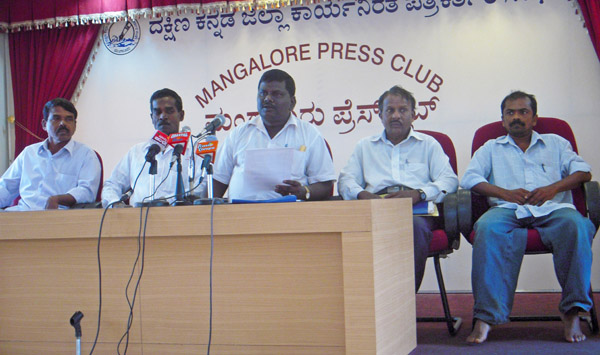
P Keshava, State Committee Member of Samithi, said at a press meet here on Tuesday that BC Road depot, which is 24km away from Mangalore city, should not be bring under the jurisdiction of proposed Puttur sub-division as people from BC Road depend more on Mangalore for administrative purposes. The BC Road depot should be attached to the Mangalore division of the KSRTC at any cost, he added.

People in the region will not be benefited through the formation of a new sub-division at Puttur. Hence, KSRTC authorities should think of forming a new division based in Madikeri or Udupi, he suggested.

Further, he demanded that KSRTC authorities should give priority to candidates from Dakshina Kannada district while appointing staff for Mangalore division. The division faces severe staff shortage, as employees from other districts manage to get transfer to their native places immediately after they are posted in Mangalore, he pointed out.

He said 50% of reservation should be given to local people during recruitment.

Acquire Ambedkar Bhavan

Mr Keshava also urged the government to acquire Ambedkar Bhavan, which was constructed during time of then Chief Minister of Karnataka Ramakrishna Hegde on the premises of Uppinangady Pre-University College. He said the college is using the Bhavan as library.

“Uppinangady Gram Panchayat should acquire the Bhavan and allow people to utilize it to conduct programmes and functions,” he said.

Action against MCC official

Samithi also demanded stringent action against a Junior Engineer in the Development Cell of Mangalore City Corporation, who allegedly misbehaved with Dalit Mayor Pravin Anchan during a review meeting.

Mr Keshava said if the Junior Engineer was a Dalit, they would have not turned back to suspend him immediately. “This is the 'disrespect' shown by the bureaucrats to the post of Mayor,” he said.

Mayor had advised twice to the concerned officials to hold a review meeting on the effective utilization SC/ST Development Fund. However, officials did not pay attention to the Mayor. He urged the MCC to hold the meeting before monthly meeting.

Vishwanatha Bolloor, Chandra Kumar, Somanath and Dinakar Mulky were present.
DLT1

Comments

Add new comment

  • Coastaldigest.com reserves the right to delete or block any comments.
  • Coastaldigset.com is not responsible for its readers’ comments.
  • Comments that are abusive, incendiary or irrelevant are strictly prohibited.
  • Please use a genuine email ID and provide your name to avoid reject.
News Network
January 23,2026

Karnataka Governor Thaawarchand Gehlot read only three lines from the 122-paragraph address prepared by the Congress-led state government while addressing the joint session of the Legislature on Thursday, effectively bypassing large sections critical of the BJP-led Union government.

The omitted portions of the customary Governor’s address outlined what the state government described as a “suppressive situation in economic and policy matters” under India’s federal framework. The speech also sharply criticised the Centre’s move to replace the Mahatma Gandhi National Rural Employment Guarantee Act (MGNREGA) with the Viksit Bharat–Guarantee for Rozgar and Ajeevika Mission (Gramin) Act, commonly referred to as the VB-GRAM (G) Act.

Governor Gehlot had earlier conveyed his objection to several paragraphs that were explicitly critical of the Union government. On Thursday, he confined himself to the opening lines — “I extend a warm welcome to all of you to the joint session of the State legislature. I am extremely pleased to address this august House” — before jumping directly to the concluding sentence of the final paragraph.

He ended the address by reading the last line of paragraph 122: “Overall, my government is firmly committed to doubling the pace of the State’s economic, social and physical development. Jai Hind — Jai Karnataka.”

According to the prepared speech, the Karnataka government demanded the scrapping of the VB-GRAM (G) Act, describing it as “contractor-centric” and detrimental to rural livelihoods, and called for the full restoration of MGNREGA. The state government argued that the new law undermines decentralisation, weakens labour protections, and centralises decision-making in violation of constitutional norms.

Key points from the unread sections of the speech:

•    Karnataka facing a “suppressive” economic and policy environment within the federal system

•    Repeal of MGNREGA described as a blow to rural livelihoods

•    VB-GRAM (G) Act accused of protecting corporate and contractor interests

•    New law alleged to weaken decentralised governance

•    Decision-making said to be imposed by the Centre without consulting states

•    Rights of Adivasis, women, backward classes and agrarian communities curtailed

•    Labourers allegedly placed under contractor control

•    States facing mounting fiscal stress due to central policies

•    VB-GRAM (G) Act accused of enabling large-scale corruption

Comments

Add new comment

  • Coastaldigest.com reserves the right to delete or block any comments.
  • Coastaldigset.com is not responsible for its readers’ comments.
  • Comments that are abusive, incendiary or irrelevant are strictly prohibited.
  • Please use a genuine email ID and provide your name to avoid reject.
coastaldigest.com news network
January 19,2026

rizwanzameer.jpg

Bengaluru: As the dust settles on the recent legislative session, the corridors of Vidhana Soudha are buzzing with more than just policy talk. A high-stakes game of political musical chairs has begun, exposing a deepening rift within the Congress party’s Muslim leadership as a major Cabinet reshuffle looms.

With the party hierarchy signaling a "50% refresh" to gear up for the 2028 Assembly elections, the race to fill three projected Muslim ministerial berths has transformed from a strategic discussion into an all-out turf war.

The "Star Son" Spark

The internal friction turned public this week following provocative remarks by Zaid Khan, actor and son of Wakf Minister Zameer Ahmed Khan. Zaid’s claim—that his father "helped" secure a ticket for Shivajinagar MLA Rizwan Arshad in 2023—has acted as a lightning rod for resentment.

Rizwan’s camp was quick to fire back, dismissing the comment as a desperate attempt by Zameer to manufacture seniority. "Rizwan’s political pedigree was forged in the NSUI and Youth Congress long before Zameer even stepped into the party," a supporter noted, highlighting Rizwan’s tenure as an AICC secretary and his two-term presidency of the State Youth Congress.

A Tale of Two Loyalists

While both Zameer Ahmed Khan and Rizwan Arshad are staunch allies of Chief Minister Siddaramaiah and represent Bengaluru strongholds, their political DNA could not be more different:

•    Zameer Ahmed Khan: A four-time MLA who crossed over from JD(S) in 2018. Known for his "overzealous" and often polarizing outreach during communal flashpoints—from the DJ Halli riots to the recent Wakf land notice controversy—his style has frequently left the Congress high command in a state of "discomfort."

•    Rizwan Arshad: A homegrown organizational man. Seen as a "quiet performer," Arshad represents the sophisticated, moderate face of the party, preferred by those who find Zameer’s brand of politics too volatile.

The Outsiders Looking In

The bickering isn't limited to a duo. The "Beary" community, represented by leaders like N A Haris and Saleem Ahmed, is demanding its pound of flesh. Saleem Ahmed, the Chief Whip in the Legislative Council, has dropped the veil of diplomacy, openly declaring his ministerial aspirations.

"I was the only working president not included in the Cabinet last time," Saleem noted pointedly, signaling that the "loyalty quota" is no longer enough to keep the peace.

As Chief Minister Siddaramaiah prepares to finalize the list, he faces a delicate balancing act: rewarding the aggressive grassroots mobilization of Zameer’s camp without alienating the organizational stalwarts and minority sub-sects who feel increasingly sidelined by the "Chamarajpet-Shivajinagar" binary.

Comments

Add new comment

  • Coastaldigest.com reserves the right to delete or block any comments.
  • Coastaldigset.com is not responsible for its readers’ comments.
  • Comments that are abusive, incendiary or irrelevant are strictly prohibited.
  • Please use a genuine email ID and provide your name to avoid reject.
News Network
January 20,2026

Mangaluru: In a major step towards strengthening rural innovation, the Office of the Principal Scientific Adviser (PSA) to the Government of India is supporting the establishment of RuTAGe Smart Village Centres (RSVCs) across the country through collaborations with academic institutions, civil society organisations and philanthropic partners.

As part of this national initiative, Nitte (Deemed to be University) will set up the first RSVCs in the region at Nitte GP in Udupi district and at the Nitte Health Centre, Sevanjali Trust, Farangipete, in Dakshina Kannada district. The centres will be inaugurated on January 21. In South India, the programme is being implemented by the Section Infin-8 Foundation (SI-8).

Speaking to reporters on Monday, SI-8 founder-director Vishwas US said experts from Nitte University and SI-8 would work closely with farmers, students, youth and local entrepreneurs to adapt and deploy technologies tailored to local needs.

Project head Prof Iddya Karunasagar, representing Nitte DU, said the RSVCs at Nitte and Farangipete would serve as demonstration hubs for a wide range of agriculture, energy, skill-development and assistive technologies. These include solar dryers for fruits, vegetables and crops; soil-testing solutions; power weeders and women-friendly farm tools; wind-powered devices for rural artisans; grain storage systems; grass-cutting and tree-climbing equipment; and liquid fertiliser production using cowshed waste.

SI-8 CEO Aravind C Kumar said the centres would also provide access to digital and knowledge-based platforms such as ISRO applications, government scheme portals, market linkage tools and gamified learning resources, along with assistive technologies for persons with visual impairments.

Highlighting the broader impact of the initiative, Principal Scientific Adviser Prof Ajay Kumar Sood said it demonstrated how applied research could bridge the rural–urban divide and help create self-reliant, technology-enabled villages.

The initiative has been made possible through philanthropic support from Dr NC Murthy of ACM Business Solutions, LLC, USA. Dr Sapna Poti, Director (Strategic Alliances) at the Office of the Principal Scientific Adviser, said the long-term objective is to build self-sufficient, technology-driven communities capable of generating sustainable livelihoods on their own.

Comments

Add new comment

  • Coastaldigest.com reserves the right to delete or block any comments.
  • Coastaldigset.com is not responsible for its readers’ comments.
  • Comments that are abusive, incendiary or irrelevant are strictly prohibited.
  • Please use a genuine email ID and provide your name to avoid reject.