Computer Navigation Knee-Replacement Surgery sets inroad into Mangalore

[email protected] (CD Network, Photos by Savitha B R)
July 14, 2011

aj14

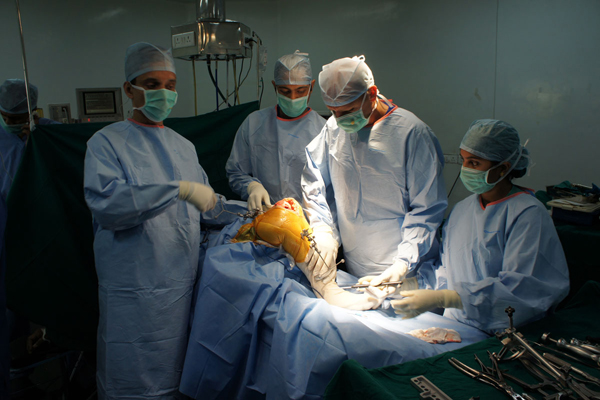
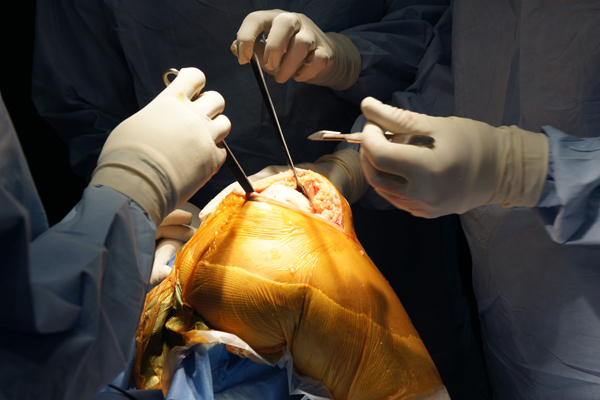
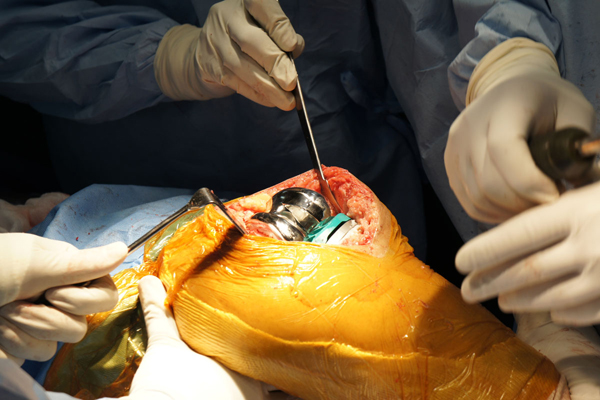
Mangalore, July 14: Pioneering the first-ever Computer Navigated joint-replacement surgery in the medical history of Mangalore, a team of senior orthopaedic surgeons successfully performed a Knee-Replacement prosthesis on Vasanthi Shetty, a 62-year old homemaker suffering from Osteoarthritis since the past five years.

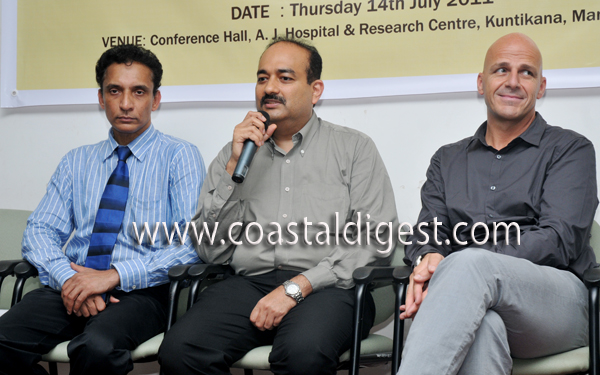
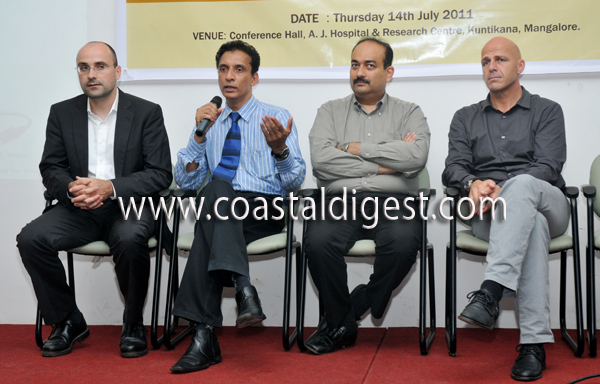
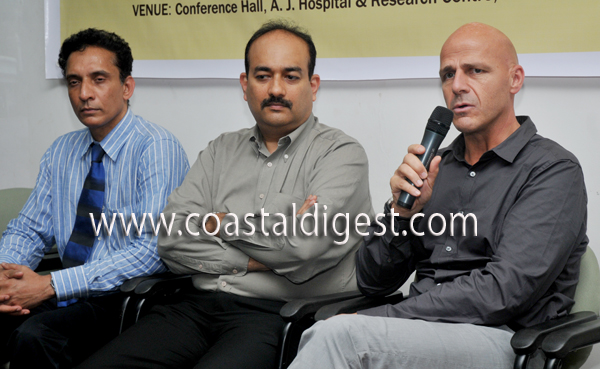
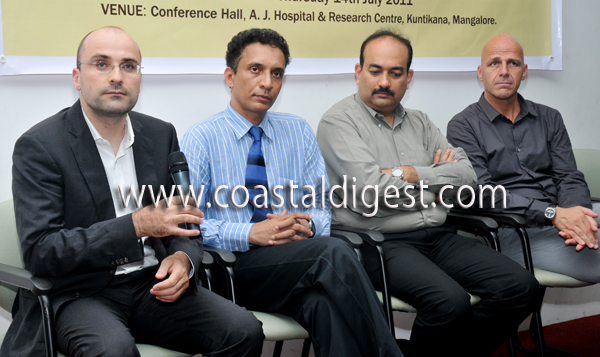
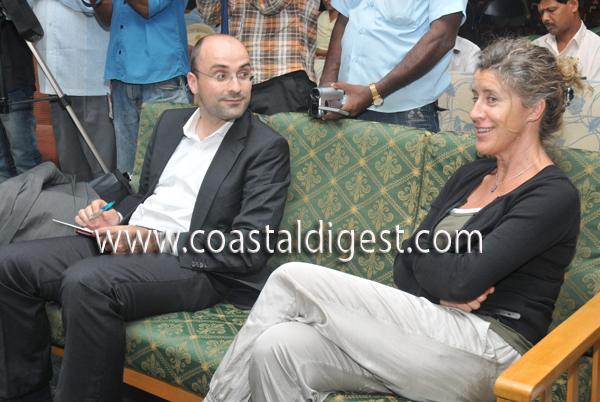
The surgery was, led by world renowned surgeon Dr. Christoph Saager, who has travelled from Switzerland for the surgery and veteran Dr. Sudarshan Bhandary, Professor and Head of Department, Arthroscopic and joint- replacement specialty, A. J. Hospital & Research Centre, Mangalore.

Focusing on the benefits of this surgical technique which has a successful clinical history of 10 years in orthopaedics, Dr. Christoph Saager, who has been personally employing Computer Navigation technique for the past five years in Switzerland said that, “Severe knee-joint condition, advanced surgical techniques such as Computer Navigation in Knee-Replacement surgeries have excellent results and also enhance the life span of the implant.

He further highlighted the edge of the technology and said “The Computer Navigation system aligns the patient's bones and joint implants with a degree of accuracy not possible with the naked eye.”

Focusing on the benefits of this surgical technique which has a successful clinical history of 10 years in orthopaedics, Dr. Christoph Saager who has been personally employing Computer Navigation technique for the past five years in Switzerland, mentioned that, “However severe the knee-joint condition may be, advanced surgical techniques such as Computer Navigation in Knee-Replacement surgeries have excellent results and also enhance the life span of the implant. He further highlighted the edge of the technology by stating, “The Computer Navigation system aligns the patient's bones and joint implants with a degree of accuracy not possible with the naked eye.”

The Computer Navigation System functions by capturing the patient's unique anatomy and translates it to a computer screen, providing an unobstructed view of the patient's knee-joint aiding visual mapping and thus supports decision-making and enhances the surgeon's flexibility. The cameras take data via infrared signals from reflectors placed on the patient's body and on specially designed surgical instruments. The computer uses the data to track the exact position of the patient and the instruments on a monitor. The key of this technology is to combine the precision and accuracy of computer technology with the surgeon's skill to perform surgery.

Commenting on this medical advancement at Mangalore, Dr. Sudarshan Bhandary, said, “The introduction of Computer Navigation technique in Mangalore will serve as a boon to future patients opting for Knee Replacement Surgeries as the new procedure is less painful and heals faster. Further, with the growing advancement in Mangalore's medical offerings, the city's population will have easier access to a medically fit, healthier and happier way of life.”

Further, the surgery was telecasted live in the in-house auditorium of A. J. Hospital and was viewed by approximately 35 doctors who had specifically come from in and around Mangalore, thus introducing the new technique to other medical practitioners in the community and also benefitting the entire medical fraternity at large.

Post this surgery, the patient will now begin rehabilitation therapy either at home or if needed at a rehabilitation centre, depending upon the doctor's advice, in order to help improve muscle strength and resume normal activities. Functionally, Ms. Shetty's condition will improve drastically and she will live a much improved life in the future as she will be mobile.
aj11

aj12
aj1

aj2

aj3

aj4

aj5

aj6

aj7

aj8

aj9

aj10

Comments

Add new comment

  • Coastaldigest.com reserves the right to delete or block any comments.
  • Coastaldigset.com is not responsible for its readers’ comments.
  • Comments that are abusive, incendiary or irrelevant are strictly prohibited.
  • Please use a genuine email ID and provide your name to avoid reject.
News Network
February 1,2026

Golf.jpg

The coastal city of Mangaluru is gearing up for a major sporting milestone with the launch of a Golf Excellence Academy at the Pilikula Golf Club (PGC), scheduled to open on May 31. The initiative aims to position Mangaluru firmly on India’s national golfing map.

Speaking to reporters on Saturday during PGC’s first-ever floodlit Pro-Am tournament, club captain Manoj Kumar Shetty said the project is being funded by UAE-based philanthropist Michael D’Souza and is currently in the design phase. Experts from leading golf academies across the country are expected to visit Mangaluru to help shape the training programme and infrastructure.

The academy will train 20 young golfers at a time, with a long-term vision of producing national-level players from the region. Until now, PGC relied on an in-house coach, but the recent renovation of the course and the introduction of floodlights have opened new possibilities for expanding the sport.

Shetty said discussions are underway with two reputed coaching academies, whose heads are expected to visit PGC shortly. “A dormitory for trainers is already under construction. We are inviting academies to assess the facilities and suggest changes so we can build a truly world-class Golf Excellence Academy,” he said.

Professional golfer Aryan Roopa Anand noted that the floodlit course would be a game-changer for young players. “Students can now practise after school hours, even up to 8 or 9 pm, without compromising on academics,” he said.

Comments

Add new comment

  • Coastaldigest.com reserves the right to delete or block any comments.
  • Coastaldigset.com is not responsible for its readers’ comments.
  • Comments that are abusive, incendiary or irrelevant are strictly prohibited.
  • Please use a genuine email ID and provide your name to avoid reject.
News Network
February 1,2026

Bengaluru: Karnataka Deputy Chief Minister D K Shivakumar on Sunday criticised the Union Budget presented by Finance Minister Nirmala Sitharaman, claiming it offered no tangible benefit to the state.

Though he said he was yet to study the budget in detail, Shivakumar asserted that Karnataka had gained little from it. “There is no benefit for our state from the central budget. I was observing it. They have now named a programme after Mahatma Gandhi, after repealing the MGNREGA Act that was named after him,” he said.

Speaking to reporters here, the Deputy Chief Minister demanded the restoration of MGNREGA, and made it clear that the newly enacted rural employment scheme — VB-G RAM G — which proposes a 60:40 fund-sharing formula between the Centre and the states, would not be implemented in Karnataka.

“I don’t see any major share for our state in this budget,” he added.

Shivakumar, who also holds charge of Bengaluru development, said there were high expectations for the city from the Union Budget. “The Prime Minister calls Bengaluru a ‘global city’, but what has the Centre done for it?” he asked.

He also drew attention to the problems faced by sugar factories, particularly those in the cooperative sector, alleging a lack of timely decisions and support from the central government.

Noting that the Centre has the authority to fix the minimum support price (MSP) for agricultural produce, Shivakumar said the Union government must take concrete steps to protect farmers’ interests.

Comments

Add new comment

  • Coastaldigest.com reserves the right to delete or block any comments.
  • Coastaldigset.com is not responsible for its readers’ comments.
  • Comments that are abusive, incendiary or irrelevant are strictly prohibited.
  • Please use a genuine email ID and provide your name to avoid reject.
News Network
January 23,2026

Mangaluru: The Karnataka Government Polytechnic (KPT), Mangaluru, has achieved autonomous status from the All India Council for Technical Education (AICTE), becoming the first government polytechnic in the country to receive such recognition in its 78-year history. The status was granted by AICTE, New Delhi, and subsequently approved by the Karnataka Board of Technical Education in October last year.

Officials said the autonomy was conferred a few months ago. Until recently, AICTE extended autonomous status only to engineering colleges, excluding diploma institutions. However, with a renewed national focus on skill development, several government polytechnics across India have now been granted autonomy.

KPT, the second-largest polytechnic in Karnataka, was established in 1946 with four branches and has since expanded to offer eight diploma programmes, including computer science and polymer technology. The institution is spread across a 19-acre campus.

Ravindra M Keni, the first dean of the institution, told The Times of India that AICTE had proposed autonomous status for polytechnic institutions that are over 25 years old. “Many colleges applied. In the first round, 100 institutions were shortlisted, which was further narrowed down to 15 in the second round. We have already completed one semester after becoming an autonomous institution,” he said. He added that nearly 500 students are admitted annually across eight three-year diploma courses.

Explaining the factors that helped KPT secure autonomy, Keni said the institution has consistently recorded 100 per cent admissions and placements for its graduates. He also noted its strong performance in sports, with the college emerging champions for 12 consecutive years, along with active student participation in NCC and NSS activities.

Autonomous status allows KPT to design industry-oriented curricula, conduct examinations, prepare question papers, and manage academic documentation independently. The institution can also directly collaborate with industries and receive priority funding from AICTE or the Ministry of Education. While academic autonomy has been granted, financial control will continue to rest with the state government.

“There will be separate committees for examinations, question paper setting, boards of studies, and boards of examiners. The institution will now have the freedom to conduct admissions without government notifications and issue its own marks cards,” Keni said, adding that new academic initiatives would be planned after a year of functioning under the autonomous framework.

Comments

Add new comment

  • Coastaldigest.com reserves the right to delete or block any comments.
  • Coastaldigset.com is not responsible for its readers’ comments.
  • Comments that are abusive, incendiary or irrelevant are strictly prohibited.
  • Please use a genuine email ID and provide your name to avoid reject.