Backward classes, minorities deserve reservation in private sector'

[email protected] (CD Network, Photos by Suresh Vamanjoor )
December 11, 2012

sdpi1


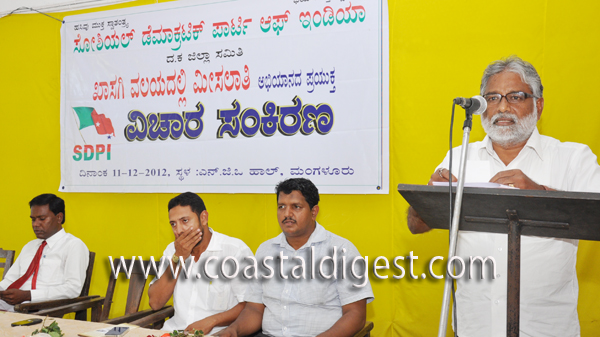
Mangalore, December 11: The embracing of Liberalisation, Privatisation and Globalisation (LPG) economic policy in 1991 was an attempt to spoil the chances of backward classes in obtaining reservations in employment. Backward classes and minorities must be given reservation in private sector, said N Mahesh, State Convenor, Bahujan Samaj Party (BSP), Karnataka.


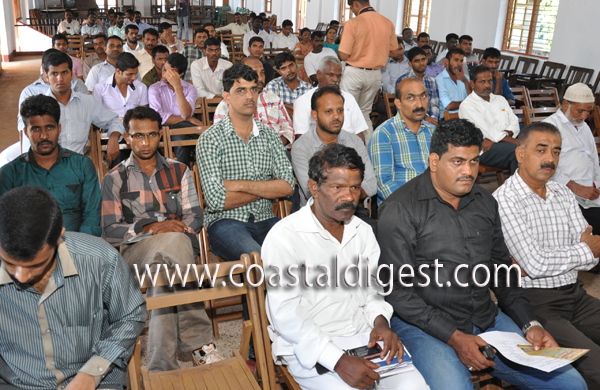
He was speaking at a seminar on reservation in private sector organized by Social Democratic Party of India (SDPI) in Mangalore on Tuesday.


Reservation is always opposed with the argument of merit. By putting forth the argument of merit, it is being implied that the backward classes are useless and unfit for the job, which is wrong. Bill Gates provided 15% reservation to blacks in his company and from his own admission, he found them to be more effecientand honest than the whites, said Mr. Mahesh. He also put forth the 30% reservation in private sector reform brought about by Mayavati in her tenure as Uttar Pradesh Chief Minister according to which she made companies enter into a PPP agreement wherein 10% of reservation would be provided for SC/STs, 10% for OBCs and minorities and the oter 10% for poor people from other castes, he said, and urged that it be implemented by the central government too.  “Reservation is not for charity, but for parity”, he said.


Although there is a lot of private sector activity happening in the country, the backward classes are not benefiting enough, Mr. Mahesh said. “The Karnataka government talks about Global Investors Meet and providing 12 lakh jobs. Who are the people who benefit here? Examples of Wipro and Infosys are in front of us. 90% of them who get in there are Brahmins. What do we get? The private companies are provided land, water and electricity by the government and the government is elected by us. We need our share in the private sector”, Mr. Mahesh said.


The concept of reservation in India has existed in the past too, he said. “Way back in 185 B.C, there was reservation provided by the 'Manusmriti' or the code of Manu. According to it, there was 100% reservation for Brahmins in education, 100% reservation for Kshatriyas in administration, 100% reservation for Vaishyas in properties and 100% reservations for Shudras in jobs meant to serve these three classes”, he said.


Briefing about the attempts made in the past to introduce reservation for backward classes, Mr. Mahesh said that Chatrapathi Sahu Maharaj of Kohlapur and Nalvadi Krishnaraja Wodeyar had carved out reservations in jobs for non-Brahmin and backward classes in their tenures which were opposed by Lokamanya Tilak and Sir M Vishweshwarayya respectively.


'Mandal Commission report and Babri issue connected'


Stating that after independence the Congress never really bothered to give reservations to backward classes a serious thought, Mr. Mahesh said that it took Kanshiram's BSP to come into force to start a movement demanding the implementation of the Mandal Commission report. “Sensing the SC/STs in UP taking side of the BSP, the Congress wanted to attract the Hindu vote bank and hence the lock was opened at Babri Masjid during Rajiv Gandhi's time. To give momentum to Ram Mandir sentiment, the programme Ramayana was aired on TV. All this was a grand plan of the Congress”, he said.


HT Srinivas, State President, Sir M Vishweshwarayya Technical Graduates' Association, Abdul Jaleel K, President, SDPI, DK, Akbar Ali, Chief Secretary, SDPI, DK, were present.

sdpi2


Comments

Add new comment

  • Coastaldigest.com reserves the right to delete or block any comments.
  • Coastaldigset.com is not responsible for its readers’ comments.
  • Comments that are abusive, incendiary or irrelevant are strictly prohibited.
  • Please use a genuine email ID and provide your name to avoid reject.
News Network
December 7,2025

SHRIMP.jpg

Mangaluru, Dec 7: A rare bamboo shrimp has been rediscovered on mainland India more than 70 years after it was last reported, confirming for the first time the presence of Atyopsis spinipes in the country. The find was made by researchers from the Centre for Climate Change Studies at Sathyabama Institute of Science and Technology, Chennai, during surveys in Karnataka and Odisha.

The team — shrimp expert Dr S Prakash, PhD scholar K Kunjulakshmi, and Mangaluru-based researcher Maclean Antony Santos — combined field surveys, ecological assessments and DNA analysis to identify the elusive species. Their findings, published in Zootaxa, resolve decades of taxonomic confusion stemming from a 1951 report that misidentified the species as Atyopsis moluccensis without strong evidence.

The shrimp has now been confirmed at two locations: the Mulki–Pavanje estuary near Mangaluru and the Kuakhai River in Bhubaneswar. Historical specimens from the Andaman Islands, previously labelled as A. moluccensis, were also found to be misidentified and actually belong to A. spinipes.

The rediscovery began after an aquarium hobbyist in Odisha spotted a shrimp in 2022, prompting systematic surveys across Udupi, Karwar and Mangaluru. Four female specimens were collected in Mulki and one in Odisha, all genetically matching.

Researchers warn the species may exist in very small, vulnerable populations as freshwater habitats face increasing pressure from pollution, sand mining and infrastructure development. All verified specimens have been deposited with the Zoological Survey of India for future reference.

Comments

Add new comment

  • Coastaldigest.com reserves the right to delete or block any comments.
  • Coastaldigset.com is not responsible for its readers’ comments.
  • Comments that are abusive, incendiary or irrelevant are strictly prohibited.
  • Please use a genuine email ID and provide your name to avoid reject.
News Network
December 2,2025

Mangaluru, Dec 2: Mangaluru International Airport responded to a medical emergency late on Monday night. Air India Express flight IX 522, travelling from Riyadh to Thiruvananthapuram, was diverted to Mangaluru Airport after a passenger in his late 30s experienced a medical emergency on board.

The Airport’s Operations Control Centre received an alert regarding the passenger’s health condition. The airport activated its emergency response protocol, mobilising the airport medical team and coordinating with stakeholders including CISF, immigration, and customs. 

Upon landing, airport medical personnel attended to the passenger, assessed his condition, and arranged to shift him to a local tertiary-care hospital for further treatment. The passenger’s relatives accompanied the passenger, who incidentally received necessary medical care on board, which helped stabilise the situation.

Following the handling of the emergency, the flight departed for Thiruvananthapuram at 2:05 am on Tuesday.

"We appreciate the cooperation of all parties involved, and this incident reaffirms our ongoing commitment to prioritising passenger safety and readiness to respond to unforeseen emergencies with professionalism and care," the Airport spokesperson said. 

Comments

Add new comment

  • Coastaldigest.com reserves the right to delete or block any comments.
  • Coastaldigset.com is not responsible for its readers’ comments.
  • Comments that are abusive, incendiary or irrelevant are strictly prohibited.
  • Please use a genuine email ID and provide your name to avoid reject.
News Network
December 4,2025

Mangaluru: Chaos erupted at Mangaluru International Airport (MIA) after IndiGo flight 6E 5150, bound for Mumbai, was repeatedly delayed and ultimately cancelled, leaving around 100 passengers stranded overnight. The incident highlights the ongoing country-wide operational disruptions affecting the airline, largely due to the implementation of new Flight Duty Time Limitations (FDTL) norms for crew.

The flight was initially scheduled for 9:25 PM on Tuesday but was first postponed to 11:40 PM, then midnight, before being cancelled around 3:00 AM. Passengers expressed frustration over last-minute communication and the lack of clarity, with elderly and ailing travellers particularly affected. “Though the airline arranged food, there was no proper communication, leaving us confused,” said one family member.

An IndiGo executive at MIA cited the FDTL rules, designed to prevent pilot fatigue by limiting crew working hours, as the cause of the cancellation. While alternative arrangements, including hotel stays, were offered, about 100 passengers chose to remain at the airport, creating tension. A replacement flight was arranged but also faced delays due to the same constraints, finally departing for Mumbai around 1:45 PM on Wednesday. Passengers either flew, requested refunds, or postponed their travel.

The Mangaluru delay is part of a broader crisis for IndiGo. The airline has been forced to make “calibrated schedule adjustments”—a euphemism for widespread cancellations and delays—after stricter FDTL norms came into effect on November 1.

While an IndiGo spokesperson acknowledged unavoidable flight disruptions due to technology issues, operational requirements, and the updated crew rostering rules, the DGCA has intervened, summoning senior airline officials to explain the chaos and outline corrective measures.

The ripple effect has been felt across the country, with major hubs like Bengaluru and Mumbai reporting numerous cancellations. The Mangaluru incident underscores the systemic operational strain currently confronting India’s largest carrier, leaving passengers nationwide grappling with uncertainty and delays.

Comments

Add new comment

  • Coastaldigest.com reserves the right to delete or block any comments.
  • Coastaldigset.com is not responsible for its readers’ comments.
  • Comments that are abusive, incendiary or irrelevant are strictly prohibited.
  • Please use a genuine email ID and provide your name to avoid reject.