Media losing its credibility: Resul Pookutty

[email protected] (CD Network, Photos by Ahmed Anwar )
December 13, 2012
Mangalore, December 13: People who have been running media as part of their business activities have lost a sense of credibility that it held years ago, said Oscar Award winner and film sound designer Dr Resul Pookutty.


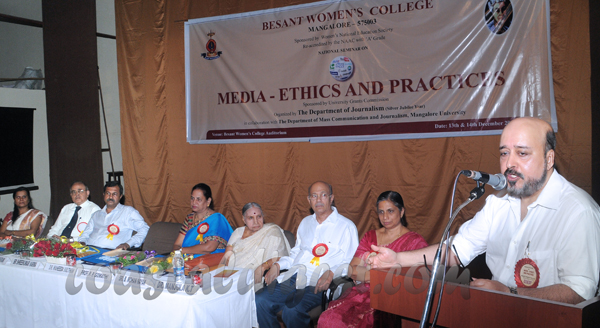
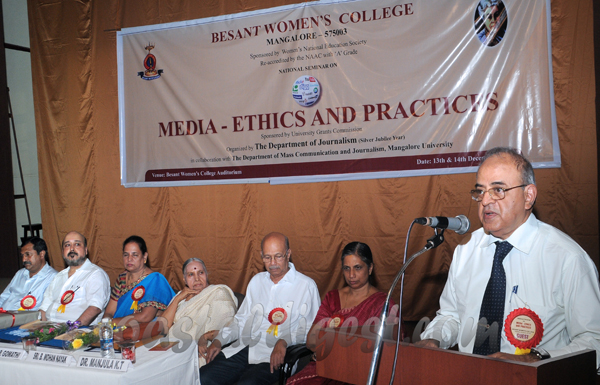
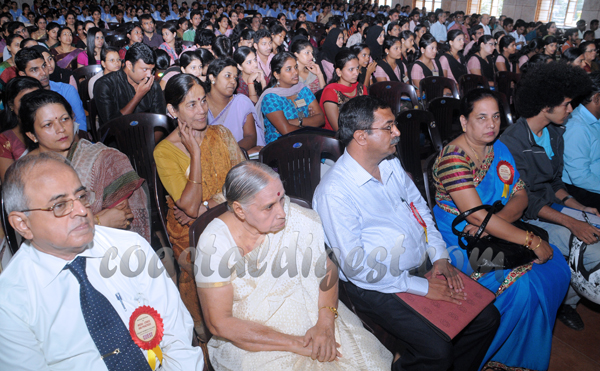
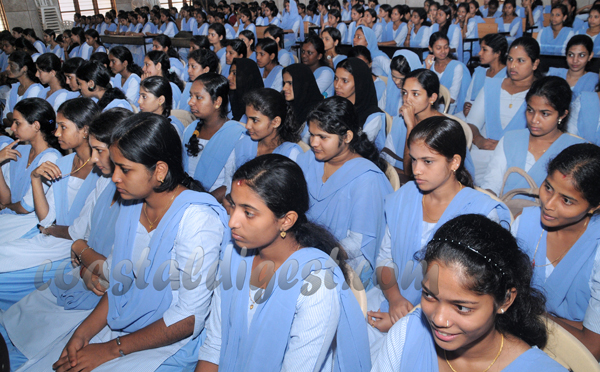
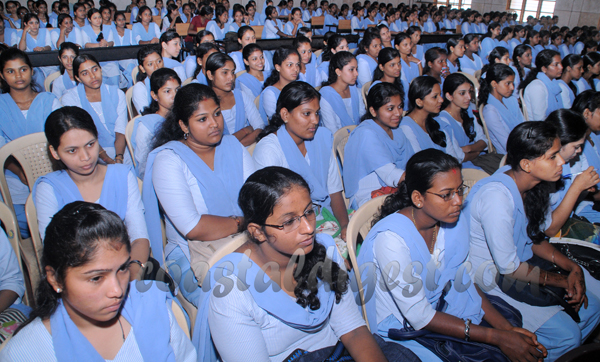
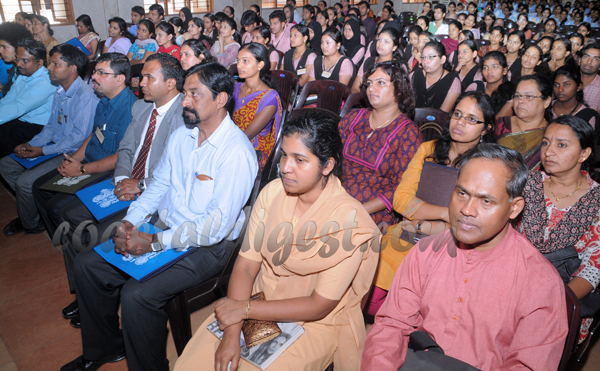
He was delivering the inaugural address at a two-day national seminar on 'Media Ethics and Practices' organised by the Department of Journalism at Besant Women's College (BWC), in collaboration with Department of Mass Communication and Journalism (DMCJ) at Mangalore University, in the college auditorium on Thursday.


Although he was unable to attend the programme, he spoke over a pre-recorded video clipping from Mumbai.


Narrating his first brush with media after he won the Oscar Award in 2009, he said that in spite of having ethics, the pressure on media persons to get exclusive footages was so bad that they were forced to do things they normally wouldn't want to.


“News today is a huge business, and media has arrived at a point where news has to be created, if it is not available. It has become a commodity where small things are blown out of proportion to create it. All of us as media persons have to take a personal stand on these practices to retain the value of news, ignoring which, we will be left with a society which is on the decline,” he said.


Delivering the keynote address, creative writer, playwright and newspaper columnist Shreekumar Varma said that in India, newspapers did not depend on its readers or circulation. Only 3 per cent of the revenue of a newspaper house comes from its circulation, while the rest comes from advertising. Newspapers heavily depend on corporate bodies and organisations, and these bodies, along with politics, have been influencing journalism, he said.


Recalling the time when the news of Mahatma Gandhi's death had not been carried on the front page of a newspaper as it was filled with advertisements, he said, “it is the same thing now, in a different scenario.”


Talking about the way newspapers in India functioned over the years, he said that till the 1950's, there were five major newspapers which dictated policy. They created and moulded public opinion, and had great vibrancy. But during the days of Emergency, journalism took a dip and grew weak, where editors were put down even if they protested against the repression. Journalism was never the same after that. When India started looking outward a couple of decades ago, journalism took a turn. It now started being backed by corporate bodies, and began losing its independence purely because of financial and investment reasons. In the 1990's, newspapers started going beyond the headlines and behind the news. Reporters discovered stories and horrific crimes hidden behind a curtain of secrecy. Journalism started taking a turn, towards social activism. However, media was at its strongest when it communicated and brought awareness among the people about corruption in recent times. People poured from all corners of the country in support of Anna Hazare and the Lokpal bill. This was mainly because of media such as television, blogs, and social networking sites like Facebook and Twitter, he said.


Giving a message to the students, he said that the real education in the field of journalism came when one worked. “Media is very fast, and you have to grasp everything on your own. If you want to get into the field, learn about it now,” he stressed.


Principal of BWC Dr Manjula K T welcomed the gathering and introduced the guests. Speaking on the rights and responsibilities of media, she said that fake news had become rampant and sensationalism had become the order of the day. “Although we have the right to Freedom of Speech and Expression, this freedom cannot be at the cost of damaging the society,” she said.


President of Women's National Education Society (WNES), Mangalore, Kudpi Jagadish Shenoy, Chairman of DMCJ Dr Waheeda Sulthana and Dr G P Shivram, spoke on the occasion.


Secretary of WNES P P Gomathi made the presidential remarks.


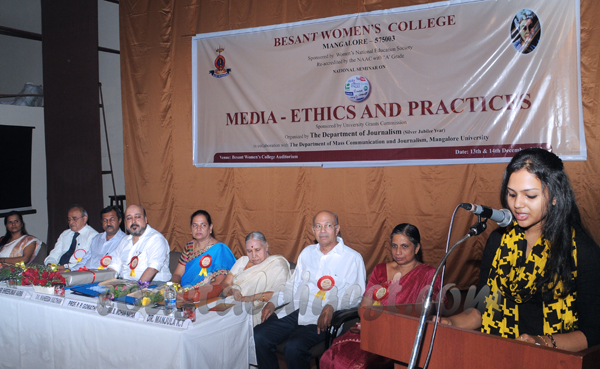
Aima Sherin compered the programme, and Sushma proposed a vote of thanks.
Agn_1

Agn_2

Agn_3

Agn_4

Agn_5

Agn_6

Agn_7

Agn_8

Comments

Add new comment

  • Coastaldigest.com reserves the right to delete or block any comments.
  • Coastaldigset.com is not responsible for its readers’ comments.
  • Comments that are abusive, incendiary or irrelevant are strictly prohibited.
  • Please use a genuine email ID and provide your name to avoid reject.
News Network
December 4,2025

Udupi: A 40-year-old NRI from Udupi has reportedly lost more than Rs 12.25 lakh in an online investment scam operated through Telegram.

According to a complaint filed at the CEN police station, Leo Jerome Mendonsa, who has been working in Dubai for the past 15 years in computer accessories sales, maintains NRI accounts in Karkala and Nitte.

On November 12, 2025, Mendonsa was added to a Telegram group called Instaflow Earnings by unknown individuals. Users identified as Priya and Dipannita persuaded him to invest in “Revenue Tasks.” Initially, Mendonsa transferred Rs 1,100 multiple times and received the promised returns, encouraging him to continue.

On November 14, another user, Nishmitha Shetty, directed him to register on a website, digitvisionuoce.cc, and invest Rs 4 lakh in various shares. Over the next few days, he made multiple transfers totaling Rs 12,25,000, including Rs 50,000 via Google Pay, believing the scheme was legitimate.

After receiving the money, the alleged handlers stopped responding, and neither the invested amount nor the promised profits were returned.

The CEN police have registered a case under Sections 66(C) and 66(D) of the IT Act and Section 318(4) of the Bharatiya Nyaya Sanhita (BNS), and investigations are ongoing.

Comments

Add new comment

  • Coastaldigest.com reserves the right to delete or block any comments.
  • Coastaldigset.com is not responsible for its readers’ comments.
  • Comments that are abusive, incendiary or irrelevant are strictly prohibited.
  • Please use a genuine email ID and provide your name to avoid reject.
News Network
December 15,2025

Mangaluru, Dec 15: Air India Express has announced that it will resume direct flight services between Mangaluru and Muscat from March 2026, restoring an important international air link for passengers from the coastal region.

Airport authorities said the service will operate twice a week—on Sundays and Tuesdays—from March 1. The initial flights are scheduled on March 3, 8 and 10, followed by March 15 and 17, with the same operating pattern to continue thereafter. The flight duration is approximately three hours and 25 minutes.

The Mangaluru–Muscat route was earlier operated under the 2025 summer schedule, with services beginning on July 14. At that time, Air India Express had operated four flights a week before suspending the service.

Officials said the summer schedule will come into effect from March 29, after which changes in flight timings and departure schedules from Mangaluru are expected. Passengers have been advised to check the latest schedules while planning their travel.

The resumption of direct flights to Muscat is expected to significantly benefit expatriates, business travellers and others, further strengthening Mangaluru’s air connectivity with the Gulf region.

Comments

Add new comment

  • Coastaldigest.com reserves the right to delete or block any comments.
  • Coastaldigset.com is not responsible for its readers’ comments.
  • Comments that are abusive, incendiary or irrelevant are strictly prohibited.
  • Please use a genuine email ID and provide your name to avoid reject.
News Network
December 7,2025

SHRIMP.jpg

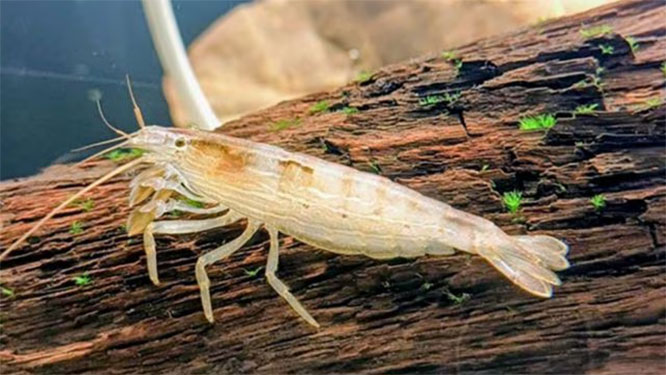
Mangaluru, Dec 7: A rare bamboo shrimp has been rediscovered on mainland India more than 70 years after it was last reported, confirming for the first time the presence of Atyopsis spinipes in the country. The find was made by researchers from the Centre for Climate Change Studies at Sathyabama Institute of Science and Technology, Chennai, during surveys in Karnataka and Odisha.

The team — shrimp expert Dr S Prakash, PhD scholar K Kunjulakshmi, and Mangaluru-based researcher Maclean Antony Santos — combined field surveys, ecological assessments and DNA analysis to identify the elusive species. Their findings, published in Zootaxa, resolve decades of taxonomic confusion stemming from a 1951 report that misidentified the species as Atyopsis moluccensis without strong evidence.

The shrimp has now been confirmed at two locations: the Mulki–Pavanje estuary near Mangaluru and the Kuakhai River in Bhubaneswar. Historical specimens from the Andaman Islands, previously labelled as A. moluccensis, were also found to be misidentified and actually belong to A. spinipes.

The rediscovery began after an aquarium hobbyist in Odisha spotted a shrimp in 2022, prompting systematic surveys across Udupi, Karwar and Mangaluru. Four female specimens were collected in Mulki and one in Odisha, all genetically matching.

Researchers warn the species may exist in very small, vulnerable populations as freshwater habitats face increasing pressure from pollution, sand mining and infrastructure development. All verified specimens have been deposited with the Zoological Survey of India for future reference.

Comments

Add new comment

  • Coastaldigest.com reserves the right to delete or block any comments.
  • Coastaldigset.com is not responsible for its readers’ comments.
  • Comments that are abusive, incendiary or irrelevant are strictly prohibited.
  • Please use a genuine email ID and provide your name to avoid reject.