Dying rivers can be saved without diverting other rivers, says expert

[email protected] (CD Network, Photos by Ahmed Anwar)
October 29, 2013
ZP_1

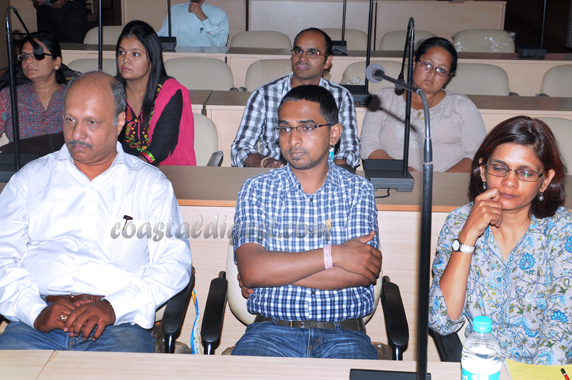
Mangalore, Oct 29: After few days of in-depth study of water management systems in and around Mangalore, which receives about 100 days of rainfall on an average every year and yet experiences mild water shortage in summer, a team of members from India Water Portal (IWP), set up by Arghyam Foundation in 2007, recounted their experiences on rain-harvesting techniques and well rejuvenation methods adopted by people living in western Rajasthan, which experiences acute shortage of water around the year.

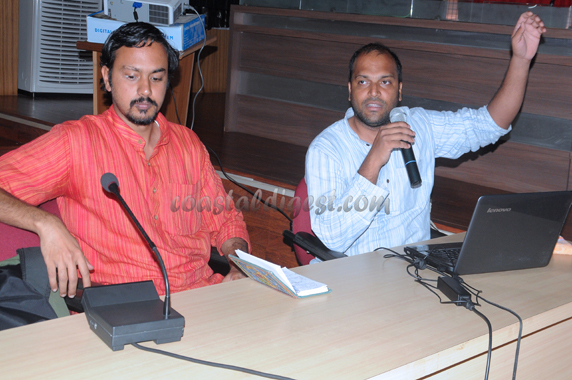
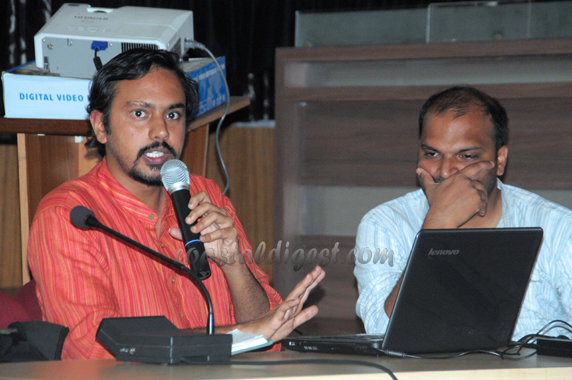
During an interaction with journalists at Nethravathi auditorium in Zilla Panchayat office here on Monday, IWP consultant manager Ashish Panda spoke about survival in the Thar desert in Western Rajasthan, a region where the average rainfall in a year is 100 mm. This year, there was merely two hours of rainfall in Rajasthan in the entire year. Despite this constraint, people survive and thrive in the dry state with the help of conservation of water in storage tanks through catchment areas. Through rain-water harvesting and water management system, there is water available for daily use in few areas of Rajasthan for the next 4-5 years. With this water, the people of Rajasthan manage even irrigation for crops such as wheat and mustard in those areas, he said.

The harvesting is done with the help of roofs as catchment areas in houses, and even water channels in Jaisalmer Fort, from which collection of upto 3 crore litres of water is done. In the city of Jodhpur, almost 90 per cent of homes harvest water, as they need water for their survival, he said, going on to brief about the two-tier system of lakes and water storage tank, because of which survival was possible in the dry land.

He further briefed on how the local communities in the region next to the Aravallis got together to rejuvenate a river in Alwar district that had been dried up from over 30 years, because of which around 285 wells had also dried up. Through forests, ponds, farm bunds and the continuous effort of the local communities, an entire river was revived in a span of five years and the water table rose across 17 villages. This in turn, rejuvenated forests and the soil moisture grew enough for crops to be cultivated, he said.

In contrast, the Indira Gandhi Canal Project implemented by the government spending crores of rupees, which proposed water to be brought from the Himalayas to the districts of Rajasthan, was futile, with only 2 percent of the irrigation being achieved, he added.

Rain-water harvesting in coastal Karnataka

IWP team member Shrikanta Prasanna from Bangalore, briefed on the success stories of rainwater harvesting in coastal Karnataka such as in Farangipete Church, Yenepoya Medical College, Manipal University and others.

Rejuvenation of rivers and wells

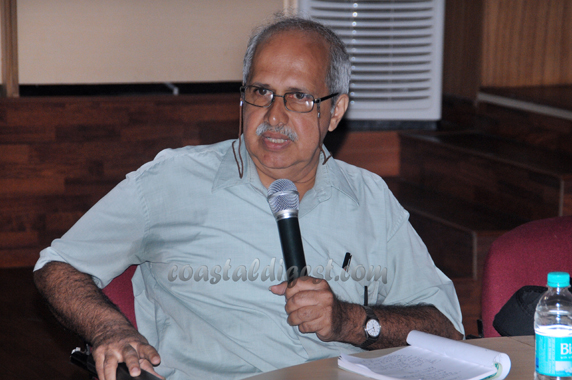
Interacting with journalists, Mr Panda said that dried or drying rivers could be rejuvenated without diversion of other rivers by ensuring proper rainwater harvesting and water management. With reference to the Nethravati Diversion or Yettinahole Project, he said that akin to rejuvenation of the river in Alwar district, Rajasthan which a budget of Rs 30 lakhs, smaller investments were better than spending huge sums of money on a single water project. The government should enable the role of a facilitator than implementing projects of higher budgets, he said.
ZP_2
ZP_3
ZP_4

Comments

Add new comment

  • Coastaldigest.com reserves the right to delete or block any comments.
  • Coastaldigset.com is not responsible for its readers’ comments.
  • Comments that are abusive, incendiary or irrelevant are strictly prohibited.
  • Please use a genuine email ID and provide your name to avoid reject.
News Network
December 15,2025

Udupi, Dec 15: What was meant to be a post-pilgrimage gathering turned tragic in Padukere village of Brahmavar taluk, Udupi district, late Sunday night, when a clash among youths escalated into a fatal assault, leaving one man dead.

The victim has been identified as 30-year-old Santosh Mogaveera, a resident of Padukere.

According to preliminary information, the incident took place during a late-night drinking party involving a group of local youths who had recently returned after completing their pilgrimage to the Sabarimala shrine. An argument reportedly broke out among the group and soon escalated into a violent confrontation.

During the ensuing brawl, Santosh Mogaveera was allegedly assaulted and collapsed at the spot after sustaining serious injuries. He was rushed by local residents to a private hospital in Brahmavar, where doctors declared him dead.

On receiving information, senior police officials, including Brahmavar Circle Inspector Gopikrishna, Kota Police Sub-Inspector Praveen Kumar T, Station ASI Manthesh Jabagoudar, and head constables Pradeep and Ashok, visited the spot and conducted an inspection.

Police have taken four youths into custody in connection with the incident. A case has been registered at the Kota police station, and further investigation is underway to ascertain the exact sequence of events leading to the death.

Comments

Add new comment

  • Coastaldigest.com reserves the right to delete or block any comments.
  • Coastaldigset.com is not responsible for its readers’ comments.
  • Comments that are abusive, incendiary or irrelevant are strictly prohibited.
  • Please use a genuine email ID and provide your name to avoid reject.
News Network
December 4,2025

Mangaluru: Chaos erupted at Mangaluru International Airport (MIA) after IndiGo flight 6E 5150, bound for Mumbai, was repeatedly delayed and ultimately cancelled, leaving around 100 passengers stranded overnight. The incident highlights the ongoing country-wide operational disruptions affecting the airline, largely due to the implementation of new Flight Duty Time Limitations (FDTL) norms for crew.

The flight was initially scheduled for 9:25 PM on Tuesday but was first postponed to 11:40 PM, then midnight, before being cancelled around 3:00 AM. Passengers expressed frustration over last-minute communication and the lack of clarity, with elderly and ailing travellers particularly affected. “Though the airline arranged food, there was no proper communication, leaving us confused,” said one family member.

An IndiGo executive at MIA cited the FDTL rules, designed to prevent pilot fatigue by limiting crew working hours, as the cause of the cancellation. While alternative arrangements, including hotel stays, were offered, about 100 passengers chose to remain at the airport, creating tension. A replacement flight was arranged but also faced delays due to the same constraints, finally departing for Mumbai around 1:45 PM on Wednesday. Passengers either flew, requested refunds, or postponed their travel.

The Mangaluru delay is part of a broader crisis for IndiGo. The airline has been forced to make “calibrated schedule adjustments”—a euphemism for widespread cancellations and delays—after stricter FDTL norms came into effect on November 1.

While an IndiGo spokesperson acknowledged unavoidable flight disruptions due to technology issues, operational requirements, and the updated crew rostering rules, the DGCA has intervened, summoning senior airline officials to explain the chaos and outline corrective measures.

The ripple effect has been felt across the country, with major hubs like Bengaluru and Mumbai reporting numerous cancellations. The Mangaluru incident underscores the systemic operational strain currently confronting India’s largest carrier, leaving passengers nationwide grappling with uncertainty and delays.

Comments

Add new comment

  • Coastaldigest.com reserves the right to delete or block any comments.
  • Coastaldigset.com is not responsible for its readers’ comments.
  • Comments that are abusive, incendiary or irrelevant are strictly prohibited.
  • Please use a genuine email ID and provide your name to avoid reject.
News Network
December 7,2025

SHRIMP.jpg

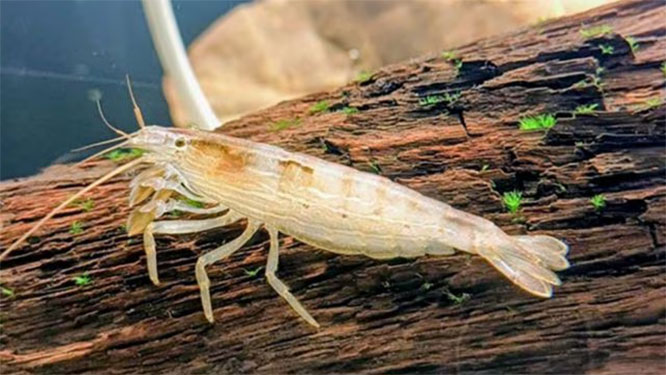
Mangaluru, Dec 7: A rare bamboo shrimp has been rediscovered on mainland India more than 70 years after it was last reported, confirming for the first time the presence of Atyopsis spinipes in the country. The find was made by researchers from the Centre for Climate Change Studies at Sathyabama Institute of Science and Technology, Chennai, during surveys in Karnataka and Odisha.

The team — shrimp expert Dr S Prakash, PhD scholar K Kunjulakshmi, and Mangaluru-based researcher Maclean Antony Santos — combined field surveys, ecological assessments and DNA analysis to identify the elusive species. Their findings, published in Zootaxa, resolve decades of taxonomic confusion stemming from a 1951 report that misidentified the species as Atyopsis moluccensis without strong evidence.

The shrimp has now been confirmed at two locations: the Mulki–Pavanje estuary near Mangaluru and the Kuakhai River in Bhubaneswar. Historical specimens from the Andaman Islands, previously labelled as A. moluccensis, were also found to be misidentified and actually belong to A. spinipes.

The rediscovery began after an aquarium hobbyist in Odisha spotted a shrimp in 2022, prompting systematic surveys across Udupi, Karwar and Mangaluru. Four female specimens were collected in Mulki and one in Odisha, all genetically matching.

Researchers warn the species may exist in very small, vulnerable populations as freshwater habitats face increasing pressure from pollution, sand mining and infrastructure development. All verified specimens have been deposited with the Zoological Survey of India for future reference.

Comments

Add new comment

  • Coastaldigest.com reserves the right to delete or block any comments.
  • Coastaldigset.com is not responsible for its readers’ comments.
  • Comments that are abusive, incendiary or irrelevant are strictly prohibited.
  • Please use a genuine email ID and provide your name to avoid reject.