



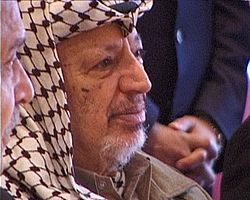
Paris, Nov 7: Palestinian leader Yasser Arafat was poisoned to death in 2004 with radioactive polonium, his widow Suha said on Wednesday after receiving the results of Swiss forensic tests on her husband's corpse.
"We are revealing a real crime, a political assassination," she told Reuters in Paris.
A team of experts, including from Lausanne University Hospital's Institute of Radiation Physics, opened Arafat's grave in the West Bank city of Ramallah last November, and took samples from his body to seek evidence of alleged poisoning.
"This has confirmed all our doubts," said Suha Arafat, who met members of the Swiss forensic team in Geneva on Tuesday. "It is scientifically proved that he didn't die a natural death and we have scientific proof that this man was killed."
She did not accuse any country or person, and acknowledged that the historic leader of the Palestine Liberation Organization had many enemies.
Arafat signed the 1993 Oslo interim peace accords with Israel and led a subsequent uprising after the failure of talks in 2000 on a comprehensive agreement.
Allegations of foul play surfaced immediately. Arafat had foes among his own people, but many Palestinians pointed the finger at Israel, which had besieged him in his Ramallah headquarters for the final two and a half years of his life.
The Israeli government has denied any role in his death, noting that he was 75 years old and had an unhealthy lifestyle.
An investigation by the Qatar-based Al Jazeera television news channel first reported last year that traces of polonium-210 were found on personal effects of Arafat given to his widow by the French military hospital where he died.
That led French prosecutors to open an investigation for suspected murder in August 2012 at the request of Suha Arafat. Forensic experts from Switzerland, Russia and France all took samples from his corpse for testing after the Palestinian Authority agreed to open his mausoleum.
"SMOKING GUN"
The head of the Russian forensics institute, Vladimir Uiba, was quoted by the Interfax news agency last month as saying no trace of polonium had been found on the body specimens examined in Moscow, but his Federal Medico-Biological Agency later denied he had made any official comment on its findings.
The French pathologists have not reported their conclusions publicly, nor have their findings been shared with Suha Arafat's legal team. A spokeswoman for the French prosecutor's office said the investigating magistrats had received no expert reports so far.
One of her lawyers said the Swiss institute's report, commissioned by Al Jazeera, would be translated from English into French and handed over to the three magistrates in the Paris suburb of Nanterre who are investigating the case.
Professor David Barclay, a British forensic scientist retained by Al Jazeera to interpret the results of the Swiss tests, said the findings from Arafat's body confirmed the earlier results from traces of bodily fluids on his underwear, toothbrush and clothing.
"In my opinion, it is absolutely certain that the cause of his illness was polonium poisoning," Barclay told Reuters. "The levels present in him are sufficient to have caused death.
"What we have got is the smoking gun - the thing that caused his illness and was given to him with malice."
The same radioactive substance was slipped into a cup of tea in a London hotel to kill defecting Russian spy Alexander Litvinenko in 2006. From his deathbed, Litvinenko accused Russian President Vladimir Putin of ordering his murder.
The British government refused to hold a public inquiry into his death after ministers withheld some material which could have shed light on Russia's suspected involvement.
Barclay said the type of polonium discovered in Arafat's body must have been manufactured in a nuclear reactor.
While many countries could have been the source, someone in Arafat's immediate entourage must have slipped a miniscule dose of the deadly isotope probably as a powder into his drink, food, eye drops or toothpaste, he said.
BRIEF RECOVERY
Arafat fell ill in October 2004, displaying symptoms of acute gastroenteritis with diarrhoea and vomiting. At first Palestinian officials said he was suffering from influenza.
He was flown to Paris in a French government plane but fell into a coma shortly after his arrival at the Percy military hospital in the suburb of Clamart, where he died on Nov. 11.
The official cause of death was a massive stroke but French doctors said at the time they were unable to determine the origin of his illness. No autopsy was carried out.
Barclay said no one would have thought to look for polonium as a possible poison until the Litvinenko case, which occurred two years after Arafat's death.
Some experts have questioned whether Arafat could have died of polonium poisoning, pointing to a brief recovery during his illness that they said was not consistent with radioactive exposure. They also noted he did not lose all his hair. But Barclay said neither fact was inconsistent with the findings.
Since polonium loses 50 percent of its radioactivity every four months, the traces in Arafat's corpse would have faded so far as to have become untraceable if the tests had been conducted a couple of years later, the scientist said.
"A tiny amount of polonium the size of a flake of dandruff would be enough to kill 50 people if it was dissolved in water and they drank it," he added.
The Al Jazeera investigation was spearheaded by investigative journalist Clayton Swisher, a former U.S. Secret Service bodyguard who became friendly with Arafat and was suspicious of the manner of his death.
Hani al-Hassan, a former aide, said in 2003 that he had witnessed 13 assassination attempts on Arafat's life, dating back to his years on the run as PLO leader. Arafat claimed to have survived 40 attempts on his life.
Arafat narrowly escaped an Israeli air strike on his headquarters in Tunisia in 1985. He had just gone out jogging when the bombers attacked, killing 73 people.
He escaped another attempt on his life when Israeli warplanes came close to killing him during the 182 invasion of Beirut when they hit one of the buildings they suspected he was using as his headquarters but he was not there. In December 2001, Arafat was rushed to safety just before Israeli helicopters bombarded his compound in Ramallah with rockets.


Comments
Add new comment