



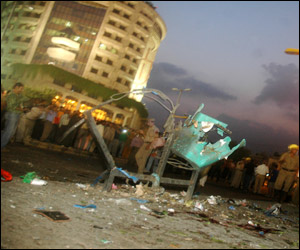
New Delhi, May 3: The Delhi serial blasts (September 13, 2008) trial has taken a curious turn with discrepancies showing up in the phone records of Atif Ameen, the terror accused gunned down in the shootout at Batla House.
Among other things, records produced in the court of Additional Sessions Judge Narinder Kumar showed the following: call logs of conversations between Ameen and another “terrorist” did not match; secondly, Ameen's application to Vodafone (EX.PW102/N) for a post-paid connection did not carry mandatory documents such as a valid address proof and a no objection certificate (NOC) from the original allottee. Without the address proof, no service provider can allot a mobile phone number while the NOC is a must for all applications seeking transfer of a number from one user to another.
According to the prosecution, Ameen switched from a pre-paid to a post-paid connection and he also wanted the transfer of a number already in use.
This led to some dramatic moments in the court room with defence lawyer M.S. Khan arguing that the Special Cell of the Delhi police had fabricated a post-paid connection in the name of Ameen with the help of a senior official of Vodafone.
Prosecution's case
According to the charge sheet filed in the 2008 Delhi serial blasts case, the team of Special Cell that gunned down Ameen tracked him to his address at L-18 at Batla House in Jamia Nagar through his Vodafone mobile number 9811004309 which was under watch. The prosecution's case is that this number belonged to Ameen and had been used for plotting and organising the Delhi and other connected blasts.
Said the chargesheet: “On 19.09.2008, on the basis of specific input, the team of Special Cell/NDR went to flat No. 108 of L-18 Batla House, Delhi, to trace the user of mobile number 9811004309. There a shootout occurred between inmates and team of Special Cell/NDR.”
Testifying in the court, the Vodafone official (a copy of his statement is in the possession of The Hindu ) said he had earlier worked for the Army Intelligence in Jammu and Kashmir and continued to liaise with the Special Cell of Delhi Police and other security agencies. However, he denied that the call or phone detail of the alleged terrorists was manipulated.
The Vodafone official admitted that there was no address proof, let alone the address proof of L-18 Batla House, attached to Ameen's application form. This led defence lawyer Khan to ask: “How can you track Atif to L-18 at Batla House when there was no address proof attached with the alleged phone application form, let alone the address proof of L-18, Batla House?”
The company official also told the court that the mobile number 9811004309 was not originally allotted to Ameen. Till August 11, 2008, which is just 39 days before the encounter of September 19, 2008, the number was a pre-paid connection in the name of Mirza Shadab. After this date, the number was transferred as a post-paid number to Ameen, a transfer, which, Mr. Khan argued in the court, was done “violating every telecom rule, without obtaining any of the mandatory documents and without the consent of the prior user Mr. Shahdab.” The defence lawyer went on to allege that the transfer was done “after the encounter to prove that the encounter was genuine.”
The Vodafone official told the court that a prepaid number used by one user could not be transferred to another user as a post-paid connection without an NOC from the former. In the event there was no NOC, “the previous allottee and the subsequent allottee had to come together for the allotment of connection.” Neither did Shadab provide an NOC nor did he accompany Ameen for the transfer: “There is nothing on record to suggest that in this case the previous allottee and Atif Ameen had come together at the time of allotment of connection to the latter.”
Mr. Khan argued that though the Vodafone official accepted in court that the process of taking a post-paid connection is “very stringent,” he had failed to explain how the violation of several rules could occur in this case.
The prosecution's case is that on September 6, 2008, Ameen (9811004309) talked to another “terrorist” on9899284784in order to organise the blasts. However, records produced by the service provider showed a mismatch between the entry timings of the conversations (between the two) as registered on the server, which, the defence argued, would be impossible in a normal situation unless records had been tampered with. However, according to legal experts, the case is still at a very early stage and no conclusions can be drawn on the basis of discrepancies brought to the court's attention. Much will depend on what further evidence the prosecution can bring, and whether it holds up to scrutiny.

Comments
Add new comment