Weak rupee makes gold smuggling, bets attractive

September 15, 2012

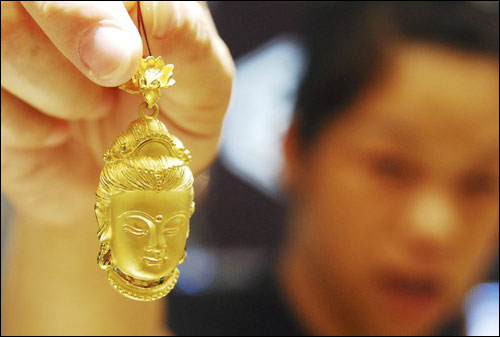
New Delhi, September 15: When 26-year-old Abdul Salam from Dubai was arrested at Mumbai airport last month with 156 gold chains concealed in his shoes, he was trying to land an irresistible windfall. Gold prices are rising faster in India than overseas. And this has brought back a profit opportunity, legal, not-quite-legal and illegal.

Gold arbitrage is promising punters as much as 12% annual return on investment. For some, it's almost Haji Mastan time again. But here's a difference - the infamous gold smuggler arbitraged on government ban on gold imports, today's shadier punters rely on the rupee's weakness against the dollar and the impact a weak rupee has on local gold prices.

There has been a 10-fold increase in the number of gold smuggling cases in recent months. Between April and June this year, authorities impounded gold worth 940 crore in some 200 cases of smuggling, up 272% over the same period last year, finance ministry data shows.

Smugglers make money if they can successfully avoid paying duties - 4% customs duty and other taxes, which add 5%-plus to the landed cost of gold.

Arbitraging on gold in less risky ways is possible - but complicated. The incentives, for all kinds of punters, is however simple to understand.

Take this price comparison. On September 10, 2011, the spot London price was $1,857/ounce. The price on MCX in Mumbai was 28,152/10 gms. On September 10, 2012, the spot London price was $1,736. The price on MCX was 32,035. In other words, while gold overseas dropped 6.5% in last one year, gold on MCX has risen almost 14%.

Why? Last September, the dollar was trading at 46.48. Now, the exchange rate is 55.36. It's this near- 20% depreciation of the rupee that has pushed up local gold prices.

The thumb rule is that every one rupee rise or fall in the exchange rate leads to a movement of 500-550 per 10 gm in the same direction on MCX. Since the rupee is expected to further weaken against the dollar as companies scramble to pay back overseas loans in the next couple of months, gold's faster rise in India is virtually guaranteed for the rest of the year.

"Normally international gold prices rise on the back of a weakening dollar. Currently, while the dollar's weakness continues to push up gold, the dollar has strengthened against the rupee. That is why Indian prices are higher than the world market. It is a pure currency play," says analyst Thiagarajan Gnanasekar at CommTrendz Research and Fund Management.

How does a canny investor - assuming he's not keen on smuggling - take advantage of this currency play?

When gold lands legally in India, it attracts taxes that add up to more than 5% (4% customs duty and local taxes). After paying that duty, there's no real possibility of arbitrage. That's why NRIs, allowed to legally import 1 kg gold per head, can't play the local market.

Theoretically, an Indian investor can buy a gold contract on New York Mercantile Exchange's Comex division, hedge the rupee against the dollar, and sell an equivalent contract on the MCX, says Ashok Mittal, CEO, Emkay Commotrade, a brokerage.

This can be a high risk strategy. You have to pay some cash upfront as margin money in both MCX and Comex along with the brokerage fees. There is the cost of hedging the rupee against the dollar.

gold


Comments

Add new comment

  • Coastaldigest.com reserves the right to delete or block any comments.
  • Coastaldigset.com is not responsible for its readers’ comments.
  • Comments that are abusive, incendiary or irrelevant are strictly prohibited.
  • Please use a genuine email ID and provide your name to avoid reject.
News Network
December 4,2025

indigoflight.jpg

Domestic carrier IndiGo has cancelled over 180 flights from three major airports — Mumbai, Delhi and Bengaluru — on Thursday, December 4, as the airline struggles to secure the required crew to operate its flights in the wake of new flight-duty and rest-period norms for pilots.

While the number of cancellations at Mumbai airport stands at 86 (41 arrivals and 45 departures) for the day, at Bengaluru, 73 flights have been cancelled, including 41 arrivals, according to a PTI report that quoted sources.

"IndiGo cancelled over 180 flights on Thursday at three airports-Mumbai, Delhi and Bengaluru," the source told the news agency.

Besides, it had cancelled as many as 33 flights at Delhi airport for Thursday, the source said, adding, "The number of cancellations is expected to be higher by the end of the day."

The Gurugram-based airline's On-Time Performance (OTP) nosedived to 19.7 per cent at six key airports — Delhi, Mumbai, Chennai, Kolkata, Bengaluru and Hyderabad — on December 3, as it struggled to get the required crew to operate its services, down from almost half of December 2, when it was 35 per cent.

"IndiGo has been facing acute crew shortage since the implementation of the second phase of the FDTL (Flight Duty Time Limitations) norms, leading to cancellations and huge delays in its operations across the airports," a source had told PTI on Wednesday.

Chaos continued at several major airports for the third day on Thursday because of the cancellations.

A spokesperson for the Kempegowda International Airport (KIA) in Bengaluru said that 73 IndiGo flights had been cancelled on Thursday.

At least 150 flights were cancelled and dozens of others delayed on Wednesday, airport sources said, leaving thousands of travellers stranded, according to news agency Reuters.

The Directorate General of Civil Aviation (DGCA) has said it is investigating IndiGo flight disruptions and has asked the airline to submit the reasons for the current situation, as well as its plans to reduce flight cancellations and delays.

It may be mentioned here that the pilots' body, Federation of Indian Pilots (FIP), has alleged that IndiGo, despite getting a two-year preparatory window before the full implementation of new flight duty and rest period norms for cockpit crew, "inexplicably" adopted a "hiring freeze".

The FIP said it has urged the safety regulator, the DGCA, not to approve airlines' seasonal flight schedules unless they have adequate staff to operate their services "safely and reliably" in accordance with the New Flight Duty Time Limitations (FDTL) norms.

In a letter to the DGCA late on Wednesday, the FIP urged the DGCA to consider re-evaluating and reallocating slots to other airlines, which have the capacity to operate them without disruption during the peak holiday and fog season if IndiGo continues to "fail in delivering on its commitments to passengers due to its own avoidable staffing shortages."

Comments

Add new comment

  • Coastaldigest.com reserves the right to delete or block any comments.
  • Coastaldigset.com is not responsible for its readers’ comments.
  • Comments that are abusive, incendiary or irrelevant are strictly prohibited.
  • Please use a genuine email ID and provide your name to avoid reject.
News Network
November 21,2025

Tejas.jpg

An Indian Air Force (IAF) Tejas fighter jet crashed on Friday, November 21, afternoon during its aerial demonstration at the Dubai Air Show, plunging to the ground at around 2:10 pm local time while performing a manoeuvre before thousands of spectators.

The IAF confirmed the incident, stating that a Tejas aircraft participating in the show had crashed and that further details were being gathered. An Air Force spokesperson said more information would be shared after initial assessments.

The crash sent thick black smoke billowing into the sky near the airport, causing panic among visitors, including families and children who had gathered to watch the display. Authorities have not yet confirmed whether the pilot managed to eject before the aircraft went down. Emergency response teams rushed to the scene, and officials have not released information on casualties or damage so far.

The Tejas is a 4.5-generation, multi-role fighter aircraft developed indigenously by Hindustan Aeronautics Limited (HAL). Designed for versatility, it is capable of offensive air support, close combat, ground attack missions and maritime operations. The aircraft family includes single-seat fighters and twin-seat trainers for both the Air Force and Navy.

HAL describes the latest version, the LCA Mk1A, as the most advanced in the series, featuring an AESA radar, an upgraded electronic warfare suite with radar-warning and self-protection jamming, smart multifunction displays, a digital map generator, a combined interrogator–transponder system and a modern radio altimeter. These enhancements significantly improve the aircraft’s combat capability and survivability.

Further updates from IAF and UAE authorities are awaited.

Comments

Add new comment

  • Coastaldigest.com reserves the right to delete or block any comments.
  • Coastaldigset.com is not responsible for its readers’ comments.
  • Comments that are abusive, incendiary or irrelevant are strictly prohibited.
  • Please use a genuine email ID and provide your name to avoid reject.