India can meet its energy needs without nuclear plants: Study

October 4, 2012


nuclear_plants
Bangalore, October 4: India's energy needs can be met entirely by solar and other renewable sources, says a new study by two professors at the Indian Institute of Science (IISc) in Bangalore.  Their report published in the journal Current Science may add ammunition to the anti-nuclear agitation in India.


The analysis by Hiremath Mitavachan and Jayaraman  Srinivasan of  IISc's Divecha Centre for Climate Change overturns the argument that nuclear power is essential for India because the country does not have enough land to exploit the potential of solar energy in India.


According to their study, 4.1 percent of the total uncultivable and waste land area in India  is enough to meet the projected annual demand of 3,400 terawatt-hour (TWh) by 2070 by solar energy alone (1 terawatt-hour per year equals 114 megawatts). The land area required will be further reduced to 3.1 percent "if we bring the other potential renewable energy sources of India into picture", they claim. They conclude that land availability is not a limiting constraint for the solar source as believed.


They say their calculations are based on present-day solar photovoltaic (PV) technology and do not include higher efficiencies achieved by new solar cells. Neither have they considered roof-top PV systems that can be established without any need for additional land.


The IISc researchers' conclusion is in conformity with that of a report prepared last year  by the Australian government which said: "There is more than enough suitable land in India, with high direct beam solar, to meet the entire nation's electricity needs in principle."


Convinced that sunlight differs from other energy sources in the way it uses the land, the researchers compared the land-use pattern of three primary energy sources - coal, nuclear and hydro - with solar energy.  They then calculated the percentage of India's land area that would be required to meet the future projected energy demand. Coal power plants not only transform the land around the facility but also require land for mining coal and its upstream processing, the authors note.  An average dam displaces 31,340 persons and submerges 8,748 hectares of land. The direct land footprint of a nuclear power plant includes power plant area, buffer zone, waste disposal area and the land that goes into mining uranium.


"Our study shows that solar power plants require less land in comparison to hydro-power plants and are comparable with coal and nuclear energy power generation when life-cycle transformations are considered," Srinivasan said.


While nuclear and fossil fuel-based technologies must continuously transform some land to extract the fuels or dispose of the waste, this is not the case with solar plants. In fact, the same land used for PV solar power plants can be utilised for other purposes like grazing.


The roof-top solar power technology, along with that proposed by IISc professors, "will be able to meet most of the electricity demand, and has the potential to transform the power sector," says Shankar Sarma, a power policy analyst  and author of forthcoming book "Integrated Power Policy."


Atul  Chokshi of the IISc Department of Materials Engineering and an expert on solar energy agrees. He reported recently  that a three kilowatt  rooftop solar panel system on the 425 million households   can generate a total energy per year 1900 TWh - half of the projected energy demand by 2070.

Comments

Add new comment

  • Coastaldigest.com reserves the right to delete or block any comments.
  • Coastaldigset.com is not responsible for its readers’ comments.
  • Comments that are abusive, incendiary or irrelevant are strictly prohibited.
  • Please use a genuine email ID and provide your name to avoid reject.
News Network
November 21,2025

Tejas.jpg

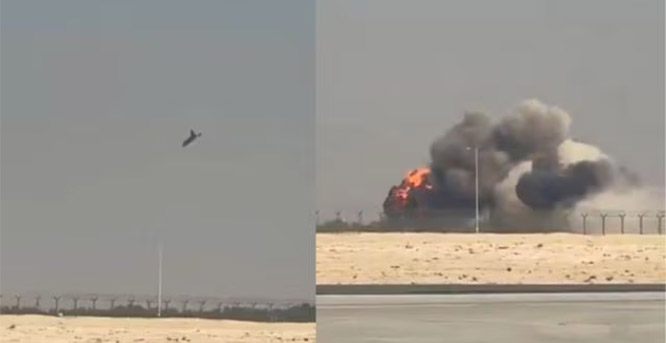
An Indian Air Force (IAF) Tejas fighter jet crashed on Friday, November 21, afternoon during its aerial demonstration at the Dubai Air Show, plunging to the ground at around 2:10 pm local time while performing a manoeuvre before thousands of spectators.

The IAF confirmed the incident, stating that a Tejas aircraft participating in the show had crashed and that further details were being gathered. An Air Force spokesperson said more information would be shared after initial assessments.

The crash sent thick black smoke billowing into the sky near the airport, causing panic among visitors, including families and children who had gathered to watch the display. Authorities have not yet confirmed whether the pilot managed to eject before the aircraft went down. Emergency response teams rushed to the scene, and officials have not released information on casualties or damage so far.

The Tejas is a 4.5-generation, multi-role fighter aircraft developed indigenously by Hindustan Aeronautics Limited (HAL). Designed for versatility, it is capable of offensive air support, close combat, ground attack missions and maritime operations. The aircraft family includes single-seat fighters and twin-seat trainers for both the Air Force and Navy.

HAL describes the latest version, the LCA Mk1A, as the most advanced in the series, featuring an AESA radar, an upgraded electronic warfare suite with radar-warning and self-protection jamming, smart multifunction displays, a digital map generator, a combined interrogator–transponder system and a modern radio altimeter. These enhancements significantly improve the aircraft’s combat capability and survivability.

Further updates from IAF and UAE authorities are awaited.

Comments

Add new comment

  • Coastaldigest.com reserves the right to delete or block any comments.
  • Coastaldigset.com is not responsible for its readers’ comments.
  • Comments that are abusive, incendiary or irrelevant are strictly prohibited.
  • Please use a genuine email ID and provide your name to avoid reject.
News Network
December 2,2025

A major upgrade in safety and monitoring is planned for Haj 2026, with every Indian pilgrim set to receive a Haj Suvidha smart wristband linked to the official Haj Suvidha mobile app. The initiative aims to support pilgrims—especially senior citizens—who may struggle with smartphones during the 45-day journey.

What the Smart Wristband Will Do

Officials said the device will come with:
•    Location tracking
•    Pedometer
•    SOS emergency button
•    Qibla compass
•    Prayer timings
•    Basic health monitoring

SP Tiwari, secretary of the UP State Haj Committee, said the goal is to make the pilgrimage safer and more comfortable.

“Most Hajis are elderly and not comfortable with mobile apps,” he said. “The smartwatch will help locate pilgrims who forget their way or cannot communicate their location.”

The wristbands will be monitored by the Consulate General of India in Saudi Arabia, similar to mobile tracking via the Haj Suvidha App.

Free Distribution and Training

•    Smart wristbands will be given free of cost.
•    Training for pilgrims will be conducted between January and February 2026.
•    Sample units will reach state Haj committees soon.
•    Final devices will be distributed as pilgrims begin their journey.

New Rules for Accommodation

Two major decisions have also been finalised for Haj 2026:
1.    Separate rooms for men and women – including married couples. They may stay on the same floor but must occupy different rooms, following stricter Saudi guidelines.
2.    Cooking banned – gas cylinders will not be allowed; all meals will be provided through official catering services arranged by the Haj Committee of India.

These decisions were finalised during a meeting of the Haj Committee of India and state representatives in Mumbai.

Haj Suvidha App Launched Earlier

The government launched the Haj Suvidha App in 2024, offering:

•    Training modules
•    Accommodation and flight details
•    Baggage information
•    SOS and translation tools
•    Grievance redressal

Haj 2026 Quota and Key States

•    India’s total Haj quota for 2026: 1,75,025 pilgrims
•    70% (1,25,000) allotted to the Haj Committee of India
•    30% (around 50,000) reserved for Haj Group Organisers

Uttar Pradesh has the largest allocation (around 30,000 seats), though approximately 18,000 pilgrims are expected to go this year. States with high pilgrim numbers include Kerala, Maharashtra and Gujarat.

Dates of Haj 2026

The pilgrimage is scheduled to take place from 24 May to 29 May, 2026 (tentative).
Haj is one of the five pillars of Islam and is mandatory for Muslims who meet the required conditions.

Comments

Add new comment

  • Coastaldigest.com reserves the right to delete or block any comments.
  • Coastaldigset.com is not responsible for its readers’ comments.
  • Comments that are abusive, incendiary or irrelevant are strictly prohibited.
  • Please use a genuine email ID and provide your name to avoid reject.