



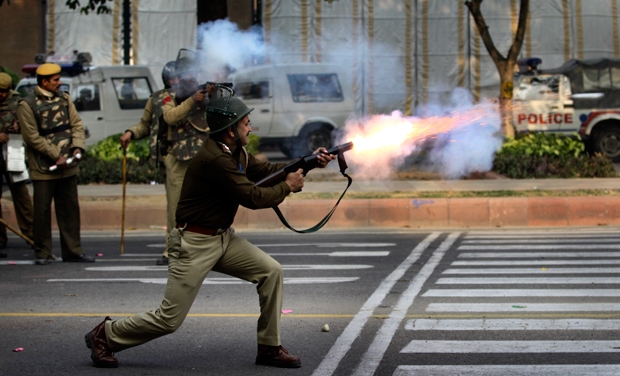
Delhi gang rape: India Gate turns into a battleground

December 24, 2012

India_Fire

New Delhi, December 24: A month before the Republic turns up at India Gate, with all its pomp and glory, people incensed by its attempt to silence their voice marched all over the place, making a bonfire of the wooden barricades that keep them off Rajpath. The mild ones who advocated peace and didn't wish to stoke the fire were soon running for cover as the heavy hand of the state descended on them with round after round of tear gas and lathicharges.

Soon, India Gate was resembling a battleground with fires burning here and there, water on the ground and smoke in the air. But blood and bruises didn't deter the protesters and some of them were back at India Gate by nightfall, setting the stage for another day of uncertainty and confrontation on Monday.

What began as a peaceful protest on a misty Sunday morning gathered storm as the day progressed, ending with a massive clean-up operation by Delhi Police with tear gas, water cannons and lathicharge. There was chaos, anger and confusion as around 10,000 protesters and several cops clashed repeatedly. Police lathicharged the crowd at least 10 times, injuring 65 people (many more didn't report at hospitals). And finally, around 5.30pm, they just went berserk - the policemen and the Rapid Action Force rained lathi blows on everyone coming in their way, including protesters, mediapersons and even families out for a walk.

At least 250 tear gas shells were lobbed and water cannons used as cops chased the protesters all the way from India Gate to ITO, Mandi House and Pragati Maidan. Delhi Police officers said the protest, which was peaceful on Saturday, had been hijacked by some political elements and hooligans who threw stones at regular intervals. Around 78 policemen were injured, including one constable identified as Subhash Tomar who is reported to be critical. Officials said he was beaten up by the violent protestors and is now on ventilator support.

The drama began early in the morning as the protesters began to assemble around 8am. The cops imposed prohibitory orders under section 144 of CrPC in all of New Delhi area and tried sending the protesters to Jantar Mantar and Ramlila Maidan by dragging and pushing them into buses. However, many protesters successfully resisted this and the crowd steadily swelled. Parallel protests took place at 10 Janpath and Jantar Mantar. Even as Metro stations were closed down and barricades put up, people continued to pour into India Gate by walking long distances.

The cops had blocked all access routes early in the morning but there was no stopping the people. Unable to deal with a growing crowd that repeatedly made attempts to breach security, the cops fired tear gas and lathicharged the protesters repeatedly even as the agitators vandalised public property. The protesters were also lathicharged at Jantar Mantar, Rail Bhawan and Mansingh Road.

While a group of JNU students marched into India Gate from Nizamuddin around 11am, other groups made their way in from Ashoka Road. A large group of protesters blocked all traffic on the India Gate C-hexagon near Hyderabad House until cops removed them. Some rowdy elements in this group jumped on top of a police vehicle, breaking the windows and hammering the bonnet with sticks, even as others pleaded with them to stop, horrified. Some protesters gheraoed MP Sandeep Dikshit's car and chased him before he was escorted into the barricaded area of Rajpath.

A few protesters from the youth wing of left parties also tried making their way to Rashtrapati Bhavan through Rafi Marg. Around 200 youngsters, along with Brinda Karat, were forcefully pushed back near Rail Bhavan when the cops used their lathis and sprayed water to disperse the protesters around 12.30pm. But this did not deter the crowds. Women rights group like National Federation of India Women tried yet again to breach security leading to a second lathicharge within an hour.

"They think they will remove us from here but we will not go," said Sheela from Trilokpuri, who along with other women sat on the road causing the traffic to come to a standstill. After this these protesters started to make their way to Ashoka Road which was already reeling under a riot-like situation.

The violence sharply escalated around 5.15pm, with the protesters pelting stones at the police and burning barricades and machans. A Delhi Doordarshan SX4 vehicle was turned over and damaged by an angry mob. Around 5.30pm, Delhi Police ordered a lathicharge and evacuation of people from India Gate.

For the next one hour, the police went on the rampage, hitting anyone in sight, lobbing more than 200 tear gas shells and using water cannons. The protesters, who moved to the roads connecting the India Gate circle, damaged more than 50 vehicles, including 12 DTC buses, and set many vehicles, including a dozen PCR vans and some private vehicles, on fire. Even moving buses with passengers inside were pelted with stones.

Minutes before the lathicharge, special commissioner of police (law and order) Dharmendra Kumar blamed 'hooligans' for the violence, claiming that unruly elements had 'hijacked' the peaceful demonstration. Delhi Police in its report to the Union home ministry said that some 'vested interests' had joined the protesters and were instigating them.

Kumar disclosed that a former chief justice of India will constitute the commission of inquiry which will go into the gangrape incident, lapses by the police and measures to be taken to ensure safety of women in Delhi and other parts of the country.

Kumar also said that if the protesters remained peaceful, the police was willing to take a delegation to the home minister. "What is the purpose of this lawlessness? People should calm down and allow police to work," he added.


Comments

Add new comment

  • Coastaldigest.com reserves the right to delete or block any comments.
  • Coastaldigset.com is not responsible for its readers’ comments.
  • Comments that are abusive, incendiary or irrelevant are strictly prohibited.
  • Please use a genuine email ID and provide your name to avoid reject.
News Network
December 2,2025

A major upgrade in safety and monitoring is planned for Haj 2026, with every Indian pilgrim set to receive a Haj Suvidha smart wristband linked to the official Haj Suvidha mobile app. The initiative aims to support pilgrims—especially senior citizens—who may struggle with smartphones during the 45-day journey.

What the Smart Wristband Will Do

Officials said the device will come with:
•    Location tracking
•    Pedometer
•    SOS emergency button
•    Qibla compass
•    Prayer timings
•    Basic health monitoring

SP Tiwari, secretary of the UP State Haj Committee, said the goal is to make the pilgrimage safer and more comfortable.

“Most Hajis are elderly and not comfortable with mobile apps,” he said. “The smartwatch will help locate pilgrims who forget their way or cannot communicate their location.”

The wristbands will be monitored by the Consulate General of India in Saudi Arabia, similar to mobile tracking via the Haj Suvidha App.

Free Distribution and Training

•    Smart wristbands will be given free of cost.
•    Training for pilgrims will be conducted between January and February 2026.
•    Sample units will reach state Haj committees soon.
•    Final devices will be distributed as pilgrims begin their journey.

New Rules for Accommodation

Two major decisions have also been finalised for Haj 2026:
1.    Separate rooms for men and women – including married couples. They may stay on the same floor but must occupy different rooms, following stricter Saudi guidelines.
2.    Cooking banned – gas cylinders will not be allowed; all meals will be provided through official catering services arranged by the Haj Committee of India.

These decisions were finalised during a meeting of the Haj Committee of India and state representatives in Mumbai.

Haj Suvidha App Launched Earlier

The government launched the Haj Suvidha App in 2024, offering:

•    Training modules
•    Accommodation and flight details
•    Baggage information
•    SOS and translation tools
•    Grievance redressal

Haj 2026 Quota and Key States

•    India’s total Haj quota for 2026: 1,75,025 pilgrims
•    70% (1,25,000) allotted to the Haj Committee of India
•    30% (around 50,000) reserved for Haj Group Organisers

Uttar Pradesh has the largest allocation (around 30,000 seats), though approximately 18,000 pilgrims are expected to go this year. States with high pilgrim numbers include Kerala, Maharashtra and Gujarat.

Dates of Haj 2026

The pilgrimage is scheduled to take place from 24 May to 29 May, 2026 (tentative).
Haj is one of the five pillars of Islam and is mandatory for Muslims who meet the required conditions.

Comments

Add new comment

  • Coastaldigest.com reserves the right to delete or block any comments.
  • Coastaldigset.com is not responsible for its readers’ comments.
  • Comments that are abusive, incendiary or irrelevant are strictly prohibited.
  • Please use a genuine email ID and provide your name to avoid reject.
News Network
December 6,2025

pilot.jpg

New Delhi: IndiGo, India’s largest airline, faced major operational turbulence this week after failing to prepare for new pilot-fatigue regulations issued by the Directorate General of Civil Aviation (DGCA). The stricter rules—designed to improve flight safety—took effect in phases through 2024, with the latest implementation on November 1. IndiGo has acknowledged that inadequate roster planning led to widespread cancellations and delays.

Below are the key DGCA rules that affected IndiGo’s operations:

1. Longer Mandatory Weekly Rest

Weekly rest for pilots has been increased from 36 hours to 48 hours.

The government says the extended break is essential to curb cumulative fatigue. This rule remains in force despite the current crisis.

2. Cap on Night Landings

Pilots can now perform only two night landings per week—a steep reduction from the earlier limit of six.

Night hours, defined as midnight to early morning, are considered the least alert period for pilots.

Given the disruptions, this rule has been temporarily relaxed for IndiGo until February 10.

3. Reduced Maximum Night Flight Duty

Flight duty that stretches into the night is now capped at 10 hours.

This measure has also been kept on hold for IndiGo until February 10 to stabilize operations.

4. Weekly Rest Cannot Be Replaced With Personal Leave

Airlines can no longer count a pilot’s personal leave as part of the mandatory 48-hour rest.

Pilots say this closes a loophole that previously reduced actual rest time.

Currently, all airlines are exempt from this rule to normalise travel.

5. Mandatory Fatigue Monitoring

Airlines must submit quarterly fatigue reports along with corrective actions to DGCA.

This system aims to create a transparent fatigue-tracking framework across the industry.

The DGCA has stressed that these rules were crafted to strengthen flight safety and align India with global fatigue-management standards. The temporary relaxations are expected to remain until February 2025, giving IndiGo time to stabilise its schedules and restore normal air travel.

Comments

Add new comment

  • Coastaldigest.com reserves the right to delete or block any comments.
  • Coastaldigset.com is not responsible for its readers’ comments.
  • Comments that are abusive, incendiary or irrelevant are strictly prohibited.
  • Please use a genuine email ID and provide your name to avoid reject.
News Network
December 4,2025

indigocrisis.jpg

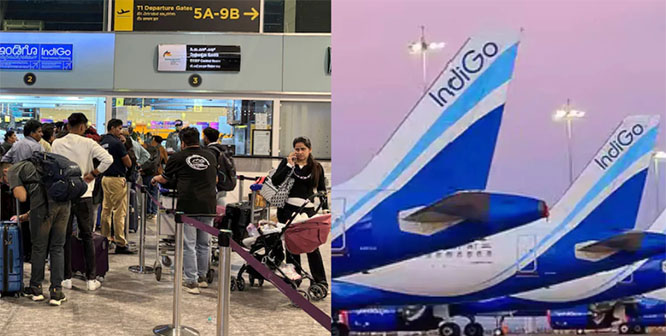
Angry outbursts, long queues, and desperate appeals filled airports across India today as IndiGo grappled with a severe operational breakdown. Hundreds of flights have been cancelled or delayed, leaving thousands of passengers stranded through the night and forcing many to spend long hours at helpdesks.

Social media was flooded with videos of fliers pleading for assistance, accusing the airline of misleading updates, and demanding accommodation after being stuck for 10 to 12 hours at airports such as Hyderabad and Bengaluru.

What Triggered the Meltdown?

IndiGo has attributed the widespread disruption to “a multitude of unforeseen operational challenges.” These include:

•    Minor technology glitches
•    Winter-season schedule adjustments
•    Bad weather
•    Congestion in the aviation network
•    New crew rostering rules (Flight Duty Time Limitations or FDTL)

Among these, the most disruptive has been the implementation of the updated FDTL norms introduced by the Directorate General of Civil Aviation (DGCA) in January 2024.

These rules were designed to reduce pilot fatigue and improve passenger safety. Key changes include:

•    Longer weekly rest periods for flight crew
•    A revised definition of “night,” extending it by an extra hour
•    Tighter caps on flight duty timing and night landings
•    Cutting night shifts for pilots and crew from six per roster cycle to just two

Once these norms became fully enforceable, airlines were required to overhaul rosters well in advance. For IndiGo, this triggered a sudden shortage of crew available for duty, leading to cascading delays and cancellations.

Why IndiGo Was Hit the Hardest

IndiGo is India’s largest airline by a wide margin, operating over 2,200 flights daily. That’s roughly double the number operated by Air India.

When an airline of this size experiences even a 10–20% disruption, it translates to 200–400 flights being delayed or grounded — producing massive spillover effects across the country.

IndiGo also relies heavily on high-frequency overnight operations, a model typical of low-cost carriers that aim to maximise aircraft utilisation and reduce downtime. The stricter FDTL norms clash with these overnight-heavy schedules, forcing the airline to pull back services.

Aviation bodies have also criticised IndiGo’s preparedness. The Airline Pilots' Association of India (ALPA) said airlines were given a two-year window to plan for the new rules but “started preparing rather late.” IndiGo, it said, failed to rebuild crew rosters 15 days in advance as required.

The Federation of Indian Pilots (FIP) went further, calling the crisis the result of IndiGo’s “prolonged and unorthodox lean manpower strategy,” and alleging that the airline adopted a hiring freeze even as it knew the new rules would require more careful staffing.

How Many Flights Are Affected?

In the past 48 hours, over 300 flights have been cancelled. At least 100 more are expected to be cancelled today.

City-wise impact:

•    Hyderabad: 33 expected cancellations; several fliers stranded overnight
•    Bengaluru: over 70 expected cancellations
•    Delhi, Mumbai, Chennai, Kolkata: widespread delays and missed connections

Passengers shared distressing accounts online.

One customer at Hyderabad airport said they waited from 6 PM to 9 AM with “no action taken” regarding their delayed Pune flight. Another said IndiGo repeatedly told them the crew was “arriving soon,” only for the delay to stretch over 12 hours.

IndiGo has apologised for the disruption and promised that operations will stabilise within 48 hours, adding that “calibrated adjustments” are being made to contain the chaos.

What Should Passengers Do Now?

For those flying in the next few days, especially with IndiGo, here are key precautions:

1. Keep Checking Flight Status
Monitor your flight closely before leaving for the airport, as delays may be announced last-minute.

2. Arrive Early
Expect long queues at counters and security due to crowding and rescheduling.

3. Carry Essentials
Pack snacks, water, basic medicines, chargers, and items for children or senior citizens. Extended waiting times should be anticipated.

4. Use Flexible Booking Options
If you booked tickets with a free-date-change or cancellation option, consider using them.
If you haven’t booked yet, prefer refundable or flexible fares, or even consider alternate airlines.

5. Follow IndiGo’s Updates
Keep an eye on IndiGo’s official social media channels and contact customer support for rebooking and refund queries.

What Needs to Change?

Pilot groups have raised concerns not just about staffing but also the planning practices behind it.
The Federation of Indian Pilots accused IndiGo of:

•    Imposing an unexplained hiring freeze despite knowing the FDTL changes were coming
•    Entering non-poaching agreements that limited talent movement
•    Keeping pilot pay frozen
•    Underestimating the need to restructure operations in advance

They have urged DGCA to approve seasonal schedules only after airlines prove they have adequate pilot strength under the new norms.

ALPA also warned that some airlines might be using the delays as an “immature pressure tactic” to push DGCA for relaxations in the new rules — which, if granted, could compromise the very safety standards the norms were meant to protect.

Both pilot bodies stressed that no exemption should dilute safety, and any deviations should be based solely on scientific risk assessment.

Is a Solution in Sight?

While IndiGo says normalcy will return within two days, aviation experts believe that fully stabilising operations could take longer, depending on how quickly the airline can:
•    Re-align rosters
•    Mobilise rested crew
•    Boost staffing
•    Adjust its winter schedule to match regulatory requirements
Passengers are advised to remain prepared for continued delays over the next few days as the airline works through its backlog. 

Comments

Add new comment

  • Coastaldigest.com reserves the right to delete or block any comments.
  • Coastaldigset.com is not responsible for its readers’ comments.
  • Comments that are abusive, incendiary or irrelevant are strictly prohibited.
  • Please use a genuine email ID and provide your name to avoid reject.