Neotra vs Traditional Slab Materials: What’s Best for Your Home?

Business Desk
August 27, 2025

fruit.jpg

Selecting the right surface material is one of the most critical decisions when building or renovating a home. From kitchens to bathrooms and every space in between, your choice influences durability, hygiene, aesthetics, and ease of maintenance. For decades, the conversation has revolved around traditional materials such as quartz, marble, and granite. While these materials have long been the benchmark for elegance and strength, evolving lifestyle demands such as higher hygiene standards, longer-lasting durability, and effortless maintenance have highlighted their limitations. This is where a new contender steps in. 

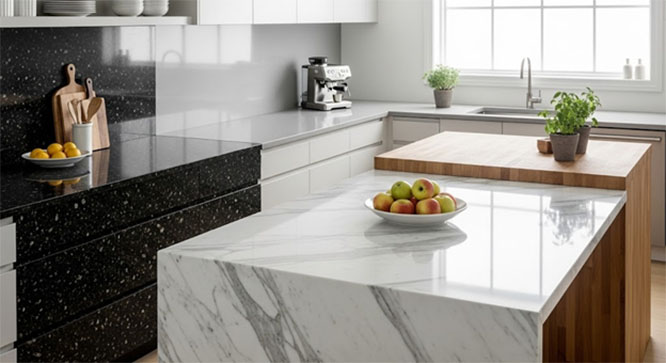
Meet Neotra: a next-generation engineered surface designed to combine the timeless beauty of natural stone with cutting-edge performance. In this comparison, we’ll explore why Neotra for kitchen countertops and other applications is rapidly becoming the smarter alternative to traditional slab materials.

What Are Traditional Slab Materials?

Before looking at why Neotra is revolutionising the market space, let’s first review what traditional options offer and where they fall short.

●    Quartz: Engineered stone made from natural quartz crystals mixed with resin and pigments. Known for being non-porous and relatively durable, it remains a popular choice for countertops and vanities.

●    Marble: A natural stone known for its elegance and classic veining. However, it is highly porous and easily stained, requiring extra care.

●    Granite: Another natural stone, granite is durable and heat-resistant but requires sealing to prevent stains.

●    Ceramic or Tile Slabs: Cost-effective and easy to customise, but prone to chipping and grout line issues.

While these traditional materials each have their strengths, they all carry drawbacks—whether in hygiene, durability, or maintenance. That’s why Neotra offers a smarter, more advanced solution that addresses these gaps without compromise.

Where Does Neotra Stand as a Surface Material?

Neotra is a next-generation engineered surface designed for the demands of modern living. It delivers the elegance of natural stone combined with state-of-the-art performance features such as superior hygiene, scratch resistance, and effortless maintenance. In short, Neotra represents the perfect union of beauty and technology.

Now, let’s examine how Neotra compares to quartz, marble, granite, and other traditional options across key performance factors.

1. Hygiene and Safety

One of the top priorities in modern homes, especially post-2020, is hygiene. Surfaces need to be safe for food preparation, resistant to bacteria, and easy to keep clean.

●    Quartz: Non-porous, which helps resist bacteria, but offers no active antimicrobial protection. Requires regular cleaning with non-abrasive products.

●    Marble/Granite: Both are porous and can absorb liquids, leading to bacterial growth if not sealed properly. Marble is particularly vulnerable to acids and staining.

●    Neotra: Engineered with advanced antibacterial, antiviral, antifungal, and anti-algae properties, Neotra actively inhibits microbial growth. Its non-porous, liquid-repellent structure ensures that spills do not seep in, delivering superior hygiene for every home.

2. Durability and Scratch Resistance

Your home’s surfaces should be able to take a beating, withstand cutting, sliding pots, and everyday impact, while staying beautiful.

●    Quartz: Durable, but can scratch with sharp knives or heavy use. Heat can also cause discolouration.

●    Marble: Prone to scratching, especially with sharp or heavy kitchenware. A soft stone that chips easily.

●    Granite: Strong and scratch-resistant, but not immune to wear over time.

    Neotra: With patented Neo Senso and Neo-Forte technology by premium Brands like Neotrastones, Neotra combines a soft-touch feel with remarkable scratch and abrasion resistance. Scoring 8+ on the Mohs hardness scale, it endures years of heavy use without losing its flawless look.

3. Heat and Fire Resistance

Kitchen surfaces, in particular, need to withstand sudden temperature changes and direct heat.
    Quartz: Contains resin, which can scorch or discolour under high heat.

●    Marble/Granite: Natural stone can withstand moderate heat but may crack with sudden temperature changes.

●    Neotra: Fully heat-resistant and fire-resistant, you can safely place hot pots, pans, or trays directly on the surface without fear of damage.

4. Maintenance and Cleaning

Modern homeowners want surfaces that are easy to clean and don’t require constant upkeep.

●    Quartz: Low maintenance but sensitive to harsh chemicals and abrasive cleaners.

●    Marble: Requires sealing and frequent polishing. Stains easily and is sensitive to acids like lemon juice and vinegar.

●    Granite: Requires periodic sealing. It can get dull over time.

●    Neotra: Resistant to detergents, cleaning agents, and chemicals. No sealing or polishing needed. A simple wipe with a soft cloth is enough to keep it clean.

5. Aesthetic Appeal

Looks matter, especially in spaces like kitchens, bathrooms, and dining areas where design meets functionality.

●    Quartz: Offers a wide variety of colours and patterns but often lacks the richness of natural textures.

●    Marble: Undeniably beautiful but inconsistent in patterning and vulnerable to fading.

●    Granite: Strong visual appeal with natural variation.

●    Neotra: Combines the elegance of natural stone with modern colour palettes and seamless finishes. Available in a wide range of tones, textures, and matte or glossy finishes that are fade-resistant and timeless.

6. Food-Safe Certification

Food safety is essential for kitchens, especially those with kids or elderly family members.

●    Quartz: Generally safe, but not all slabs are food-contact certified.

●    Marble: Not recommended for direct food contact due to porosity and chemical reactivity.

●    Granite: Can be food-safe when sealed properly, but sealing must be maintained.

●    Neotra: Fully safe for direct food contact with certification. Its non-toxic surface is ideal for meal prep, baking, and daily use.

7. Environmental and Health Considerations

In an era of eco-conscious living, more people are asking: Is my surface safe for my health and the planet?

●    Quartz: Uses resins that may emit VOCs (volatile organic compounds) if not properly manufactured.

●    Marble/Granite: Natural but mined, which may not be environmentally sustainable.

●    Neotra: Free from formaldehyde, harmful particles, and toxic emissions. A clean, green material that aligns with modern sustainability goals.

8. Versatility of Application

Can your surface be used in more places than just the kitchen?

●    Quartz/Marble: Commonly used for countertops, but limitations exist when it comes to outdoor or high-traffic commercial applications.

●    Neotra: Ideal for kitchen countertops, bathroom vanities, wall cladding, utility areas, tabletops, and even outdoor kitchens, thanks to its frost and UV resistance.

Final Verdict: Neotra vs Quartz Slabs and Traditional Stones

If you want a future-ready home that prioritises durability, hygiene, and effortless style, Neotra stands out as the superior choice. Our comparison of Neotra vs quartz and other traditional materials shows how it excels where older options fall short.

For those who refuse to compromise whether on aesthetics, performance, or sustainability Neotra delivers it all.  

Comments

Add new comment

  • Coastaldigest.com reserves the right to delete or block any comments.
  • Coastaldigset.com is not responsible for its readers’ comments.
  • Comments that are abusive, incendiary or irrelevant are strictly prohibited.
  • Please use a genuine email ID and provide your name to avoid reject.
News Network
November 29,2025

DKSsiddu.jpg

New Delhi: Karnataka chief minister Siddaramaiah and deputy CM DK Shivakumar on Saturday put up a dramatic display of unity at a closely watched joint press briefing, firmly dismissing weeks of speculation about a power-sharing tussle within the Congress. With the high command nudging both leaders to sit together and settle the dust, the meeting became a political spectacle, ending with the duo declaring that there was “no confusion, no differences.”

Calling the reports of a rift “manufactured confusion,” Siddaramaiah said the talks had gone smoothly, even joking about their breakfast. “Breakfast was very good. All three of us enjoyed it,” he said. “We want to end this confusion once and for all. For local elections and for 2028, our mission is clear — Congress must return to power. There is no difference between me and DKS, not now, not before.”

He blamed the media for fuelling rumours and reiterated absolute adherence to the party leadership. “From tomorrow, let there be no confusion. What the high command says, we will follow.”

Siddaramaiah also assured that the Assembly session starting December 8 would run smoothly and vowed that Congress would take on the BJP and JD(S) “together.”

Shivakumar echoed the chief minister word for word, stressing loyalty and discipline. “People have given us a massive mandate. It is our duty to deliver,” he said. “This government was formed under Siddaramaiah’s leadership. We both have complete trust in the high command. If they tell me to wait, I will wait.”

He added that the two leaders had discussed strategy for the 2028 Assembly elections. “Whatever the CM says, I agree. We are loyal soldiers of the party. The party may be facing challenges nationally, but we will keep it strong in Karnataka.”

Shivakumar also said Siddaramaiah would soon visit his home for lunch or dinner — another symbolic gesture meant to underline their unity.

Both leaders later posted on social media describing the breakfast meeting as “productive” and focused on “Karnataka’s priorities.”

The BJP, however, rejected the show of camaraderie as “pure bunkum,” accusing Congress of trying to paper over an internal power struggle. But Siddaramaiah and Shivakumar insisted their united front would continue — and that there was “no confusion” within the state leadership.

Comments

Add new comment

  • Coastaldigest.com reserves the right to delete or block any comments.
  • Coastaldigset.com is not responsible for its readers’ comments.
  • Comments that are abusive, incendiary or irrelevant are strictly prohibited.
  • Please use a genuine email ID and provide your name to avoid reject.
coastaldigest.com news network
November 28,2025

roadshow.jpg

Udupi district transformed into a sea of saffron and celebration on Friday, November 28, as Prime Minister Narendra Modi’s roadshow swept through the coastal temple town. Thousands of residents lined the streets, turning the event into a vibrant public spectacle filled with cheers, flags, and festive energy.

The procession route—from the helipad to the historic Sri Krishna Math—was decked with buntings, saffron flags, and multilayered security barricades. One of the district’s largest-ever security deployments was put in place for the high-profile visit, with over 3,000 police personnel on duty. The arrangement included ten SPs, 27 DSPs, 49 inspectors, 127 sub-inspectors, 232 assistant sub-inspectors, 1,608 constables, and 39 women staff.

Six platoons of the Karnataka State Reserve Police, six Quick Response Teams, bomb detection units, and dog squads were stationed across Udupi. Enhanced surveillance covered Adi Udupi, Bannanje bus stand, and the Sri Krishna Math parking zone, with combing operations carried out along the roadshow corridor.

At the 800-year-old Sri Krishna Math, preparations reached a ceremonial peak. Paryaya Puttige Math seer Sugunendra Teertha Swamiji said the Prime Minister would take part in the Laksha Kantha Geetha Parayana, a mass chanting of the Bhagavad Gita by one lakh devotees, and inaugurate the new Suvarna Teertha Mantapa.

“He will first offer floral tributes to saint-poet Kanakadasa and then unveil the golden covering over the Kanakana Kindi,” the seer said.

The Prime Minister will also receive a Poorna Kumbha welcome and have darshan of Lord Sri Krishna, Mukhyaprana Devaru, and the Suvarna Paduke. Union Minister Pralhad Joshi, Karnataka Governor Thaawarchand Gehlot, Minister Bairathi Suresh, Dharmadhikari D. Veerendra Heggade, and seers from the Ashta Maths are expected to join the ceremony.

Ahead of his arrival, the Prime Minister posted on X that he felt “honoured” to attend the spiritually significant gathering. “This is a special occasion that brings together people from different sections of society for a recital of the Gita. This Matha has a very special significance in our cultural life,” he wrote, noting the institution’s long-standing legacy rooted in the teachings of Sri Madhvacharya.

roadshow2.jpg

Comments

Add new comment

  • Coastaldigest.com reserves the right to delete or block any comments.
  • Coastaldigset.com is not responsible for its readers’ comments.
  • Comments that are abusive, incendiary or irrelevant are strictly prohibited.
  • Please use a genuine email ID and provide your name to avoid reject.
News Network
December 2,2025

Puttur: The long-cherished dream of a government medical college in Puttur has moved a decisive step closer to reality, with the Karnataka State Finance Department granting its official approval for the construction of a new 300-bed hospital.

Puttur MLA Ashok Kumar Rai announced the crucial development to reporters on Monday, confirming that the official communication from the finance department was issued on November 27. This 300-bed facility is intended to be the cornerstone for the establishment of the government medical college, a project announced in the state budget.

Fast-Track Implementation

The MLA outlined an aggressive timeline for the project:

•    A Detailed Project Report (DPR) for the hospital is expected to be ready within 45 days.

•    The tender process for the construction will be completed within two months.

Following the completion of the tender process, Chief Minister Siddaramaiah is scheduled to lay the foundation stone for the project.

"Setting up a medical college in Puttur is a historical decision by the Congress government in Karnataka," Rai stated. The project has an estimated budget allocation of Rs 1,000 crore for the medical college.

Focus on Medical Education Department

The MLA highlighted a key strategic move: requesting the government to implement the hospital construction through the Medical Education Department instead of the Health and Family Welfare Department. This is intended to streamline the entire process of establishing the full medical college, ensuring the facilities—including labs, operation theatres, and other necessary infrastructure—adhere to the strict guidelines set by the Medical Council of India (MCI). The proposed site for the project is in Bannur.

Rai also took the opportunity to address political criticism, stating that the government has fulfilled its promise despite "apprehensions" and "mocking and criticising" from opposition parties who had failed to take similar initiatives when they were in power. "Chief Minister Siddaramaiah has kept his word," he added.

Comments

Add new comment

  • Coastaldigest.com reserves the right to delete or block any comments.
  • Coastaldigset.com is not responsible for its readers’ comments.
  • Comments that are abusive, incendiary or irrelevant are strictly prohibited.
  • Please use a genuine email ID and provide your name to avoid reject.