



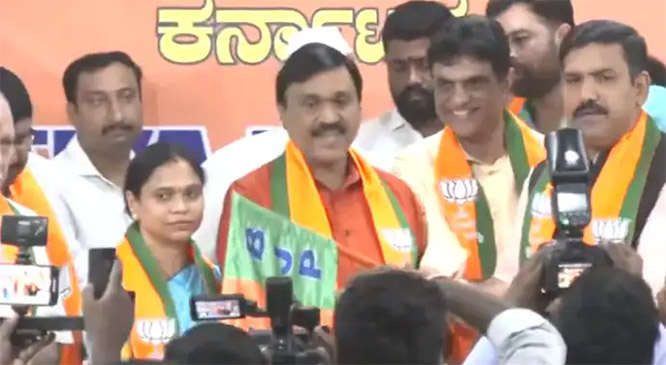
‘No conditions, no expectations. I am back on mother's lap’, says mining baron Janardhana Reddy as he rejoins BJP

News Network
March 25, 2024

reddymining.jpg

Bengaluru, Mar 25: Former Karnataka Minister and mining baron G Janardhana Reddy on Monday rejoined the BJP ahead of the 2024 Lok Sabha polls.

The Gangavati MLA, who is an accused in an illegal mining case, had formed the 'Kalyana Rajya Pragati Paksha' (KRPP) ahead of the state assembly polls last year, snapping his two-decade-old association with the BJP.

Reddy today merged his KRPP with the BJP as he, along with wife Aruna Lakshmi and some family members, joined the party in the presence of its veteran leader and former Chief Minister B S Yediyurappa, state President B Y Vijayendra, and others.

Reddy had recently met Union Home Minister Amit Shah in New Delhi.

However, in the February 27 Rajya Sabha polls he had extended support to the Congress candidate.

Calling it a "home coming", Reddy explained that the move to merge KRPP with the BJP is to "make Narendra Modi the Prime Minister a third time".

"Amit Shah had invited me to Delhi and told me that -- there is no question of extending outside support (KRPP supporting BJP in LS polls) and instead I should join the BJP and work for it, as I took my political birth in the party. Accepting it, I'm joining the party," he said.

Praising Yediyurappa and the leader's contribution in his political growth, Reddy said he is happy that he will be working in the party now with the veteran leader's son Vijayendra.

"I will work as a common party worker along with other leaders under the leadership of Vijayendra. I have not come with any conditions or expectations. Whatever responsibility the party gives me, I will honestly work.

"BJP was always there in my blood, but due to some reasons I had gone out, but today I feel I have come back to my mother's lap. Looking at my brothers here, I don't feel like I'm coming back to the BJP office after 13 years," he added.

Welcoming Reddy back into the party, Vijayendra said his joining will strengthen BJP in the Kalyana Karnataka region.

"Liking Narendra Modi's leadership and accepting BJP's ideology, Reddy has rejoined the party. Reddy has said that Karnataka should have a larger contribution in making Modi PM once again -- to ensure that BJP and JD(S) alliance win all the 28 Lok Sabha seats in the state, he is merging his KRPP with BJP and is joining the party," he said.

Before the assembly polls last year, Reddy had been largely politically inactive for nearly 12 years since his arrest by the CBI for an alleged role in a mining scam. During this period, he had a brief stint ahead of the 2018 assembly polls when he campaigned for his close friend and former Minister B Sriramulu in Molakalmuru Assembly segment.

In the run up to the 2018 assembly polls, the then BJP national president Amit Shah, in response to a reporter's question, had distanced the party from him and stressed that "the BJP has nothing to do with Janardhana Reddy." Accused in a multi-crore illegal mining case, he has been out on bail since 2015. Several conditions were imposed by the top court in its order which includes prohibiting him from visiting Ballari in Karnataka and Ananthpur and Kadapa in Andhra Pradesh.

Because of these restrictions, he had to contest the 2023 Assembly polls from Gangavati in Koppal district.

Expressing his displeasure about the way BJP had ignored him, Reddy had announced a new party last year and also took a dig at his brothers -- Karunakara Reddy and Somashekar Reddy -- and Sriramulu, as they remained with the BJP.

The three of them had unsuccessfully contested the Assembly polls, with Reddy's new party said to have impacted their performance in the election.

Sriramulu, a ST community leader and former Minister is now the BJP's candidate from the Bellary (Ballari) Lok Sabha constituency.

Reddy had played an instrumental role in strengthening the BJP in the Ballari district and is still believed to enjoy a considerable clout there as well as in adjoining districts like Chitradurga, Koppal and Raichur, which could be useful for the BJP in the Lok Sabha polls.

Reddy and his brother-in-law B V Srinivas Reddy, managing director of Obalapuram Mining Company (OMC), were arrested by the CBI on September 5, 2011.

The company is accused of changing mining lease boundary markings and indulging in illegal mining in the Ballari Reserve Forest area, spread over Ballari in Karnataka and the Anantpur district of Andhra Pradesh.

Reddy first came to political limelight during the 1999 Lok Sabha elections, when he campaigned for BJP leader, the late Sushma Swaraj, who had contested against Congress' Sonia Gandhi from Ballari.

Former Congress Minister T John's son Thomas John also joined the BJP today.

Comments

Add new comment

  • Coastaldigest.com reserves the right to delete or block any comments.
  • Coastaldigset.com is not responsible for its readers’ comments.
  • Comments that are abusive, incendiary or irrelevant are strictly prohibited.
  • Please use a genuine email ID and provide your name to avoid reject.
News Network
February 1,2026

Bengaluru: Karnataka Deputy Chief Minister D K Shivakumar on Sunday criticised the Union Budget presented by Finance Minister Nirmala Sitharaman, claiming it offered no tangible benefit to the state.

Though he said he was yet to study the budget in detail, Shivakumar asserted that Karnataka had gained little from it. “There is no benefit for our state from the central budget. I was observing it. They have now named a programme after Mahatma Gandhi, after repealing the MGNREGA Act that was named after him,” he said.

Speaking to reporters here, the Deputy Chief Minister demanded the restoration of MGNREGA, and made it clear that the newly enacted rural employment scheme — VB-G RAM G — which proposes a 60:40 fund-sharing formula between the Centre and the states, would not be implemented in Karnataka.

“I don’t see any major share for our state in this budget,” he added.

Shivakumar, who also holds charge of Bengaluru development, said there were high expectations for the city from the Union Budget. “The Prime Minister calls Bengaluru a ‘global city’, but what has the Centre done for it?” he asked.

He also drew attention to the problems faced by sugar factories, particularly those in the cooperative sector, alleging a lack of timely decisions and support from the central government.

Noting that the Centre has the authority to fix the minimum support price (MSP) for agricultural produce, Shivakumar said the Union government must take concrete steps to protect farmers’ interests.

Comments

Add new comment

  • Coastaldigest.com reserves the right to delete or block any comments.
  • Coastaldigset.com is not responsible for its readers’ comments.
  • Comments that are abusive, incendiary or irrelevant are strictly prohibited.
  • Please use a genuine email ID and provide your name to avoid reject.
News Network
January 23,2026

Mangaluru: The Karnataka Government Polytechnic (KPT), Mangaluru, has achieved autonomous status from the All India Council for Technical Education (AICTE), becoming the first government polytechnic in the country to receive such recognition in its 78-year history. The status was granted by AICTE, New Delhi, and subsequently approved by the Karnataka Board of Technical Education in October last year.

Officials said the autonomy was conferred a few months ago. Until recently, AICTE extended autonomous status only to engineering colleges, excluding diploma institutions. However, with a renewed national focus on skill development, several government polytechnics across India have now been granted autonomy.

KPT, the second-largest polytechnic in Karnataka, was established in 1946 with four branches and has since expanded to offer eight diploma programmes, including computer science and polymer technology. The institution is spread across a 19-acre campus.

Ravindra M Keni, the first dean of the institution, told The Times of India that AICTE had proposed autonomous status for polytechnic institutions that are over 25 years old. “Many colleges applied. In the first round, 100 institutions were shortlisted, which was further narrowed down to 15 in the second round. We have already completed one semester after becoming an autonomous institution,” he said. He added that nearly 500 students are admitted annually across eight three-year diploma courses.

Explaining the factors that helped KPT secure autonomy, Keni said the institution has consistently recorded 100 per cent admissions and placements for its graduates. He also noted its strong performance in sports, with the college emerging champions for 12 consecutive years, along with active student participation in NCC and NSS activities.

Autonomous status allows KPT to design industry-oriented curricula, conduct examinations, prepare question papers, and manage academic documentation independently. The institution can also directly collaborate with industries and receive priority funding from AICTE or the Ministry of Education. While academic autonomy has been granted, financial control will continue to rest with the state government.

“There will be separate committees for examinations, question paper setting, boards of studies, and boards of examiners. The institution will now have the freedom to conduct admissions without government notifications and issue its own marks cards,” Keni said, adding that new academic initiatives would be planned after a year of functioning under the autonomous framework.

Comments

Add new comment

  • Coastaldigest.com reserves the right to delete or block any comments.
  • Coastaldigset.com is not responsible for its readers’ comments.
  • Comments that are abusive, incendiary or irrelevant are strictly prohibited.
  • Please use a genuine email ID and provide your name to avoid reject.
News Network
January 23,2026

Karnataka Governor Thaawarchand Gehlot read only three lines from the 122-paragraph address prepared by the Congress-led state government while addressing the joint session of the Legislature on Thursday, effectively bypassing large sections critical of the BJP-led Union government.

The omitted portions of the customary Governor’s address outlined what the state government described as a “suppressive situation in economic and policy matters” under India’s federal framework. The speech also sharply criticised the Centre’s move to replace the Mahatma Gandhi National Rural Employment Guarantee Act (MGNREGA) with the Viksit Bharat–Guarantee for Rozgar and Ajeevika Mission (Gramin) Act, commonly referred to as the VB-GRAM (G) Act.

Governor Gehlot had earlier conveyed his objection to several paragraphs that were explicitly critical of the Union government. On Thursday, he confined himself to the opening lines — “I extend a warm welcome to all of you to the joint session of the State legislature. I am extremely pleased to address this august House” — before jumping directly to the concluding sentence of the final paragraph.

He ended the address by reading the last line of paragraph 122: “Overall, my government is firmly committed to doubling the pace of the State’s economic, social and physical development. Jai Hind — Jai Karnataka.”

According to the prepared speech, the Karnataka government demanded the scrapping of the VB-GRAM (G) Act, describing it as “contractor-centric” and detrimental to rural livelihoods, and called for the full restoration of MGNREGA. The state government argued that the new law undermines decentralisation, weakens labour protections, and centralises decision-making in violation of constitutional norms.

Key points from the unread sections of the speech:

•    Karnataka facing a “suppressive” economic and policy environment within the federal system

•    Repeal of MGNREGA described as a blow to rural livelihoods

•    VB-GRAM (G) Act accused of protecting corporate and contractor interests

•    New law alleged to weaken decentralised governance

•    Decision-making said to be imposed by the Centre without consulting states

•    Rights of Adivasis, women, backward classes and agrarian communities curtailed

•    Labourers allegedly placed under contractor control

•    States facing mounting fiscal stress due to central policies

•    VB-GRAM (G) Act accused of enabling large-scale corruption

Comments

Add new comment

  • Coastaldigest.com reserves the right to delete or block any comments.
  • Coastaldigset.com is not responsible for its readers’ comments.
  • Comments that are abusive, incendiary or irrelevant are strictly prohibited.
  • Please use a genuine email ID and provide your name to avoid reject.