



'No way back' in Myanmar's crucible of communal hate

Agencies
September 25, 2017

Myanmar, Sept 25: Hindus once sold food to Rohingyas, spoke the same language and even cut the hair of their Muslim neighbours. But co-existence among the collage of ethnicities in Myanmar's Rakhine state has been ruptured -- perhaps irreversibly -- by the bloodshed of the last month.

Violence has periodically cut through the western state, where communal rivalries have been sharpened by British colonial meddling, chicanery by Myanmar's army and a fierce dispute over who does -- and does not -- belong in Rakhine.

But the events of August 25, when raids by Rohingya militants unleashed a swirl of violence across the north, have sunk Rakhine to new depths of hate.

"All of our family died in the village... we will not go back," said Chaw Shaw Chaw Thee, one of the hundreds of displaced Hindus seeking shelter in the state capital Sittwe.

The 20-year-old said she lost 23 family members as Rohingya militants swarmed the clutch of Hindu villages in Kha Maung Seik, near the Bangladesh border.

On Sunday the army said 28 badly-decomposed bodies of Hindu men, women and children had been pulled from two mass graves in the same area.

It was not immediately clear if they belonged to Chaw Shaw Chaw Thee's family. Heavily pregnant when she fled, she gave birth at a disused football stadium in Sittwe, where hundreds of traumatised Hindus now sleep on grubby mats in the overcrowded concourse.

An army lockdown has made it impossible to independently verify what happened in the villages of northern Rakhine, an area dominated by Rohingya Muslims who are a minority elsewhere in the mainly Buddhist country.

But allegations, carved along ethnic lines, are spinning out as conspiracy and competing for identity claims override empathy between former neighbours.

Hindus, who make up less than one percent of Rakhine's population, accuse Rohingya of massacring them, burning their homes and kidnapping women for marriage.

Meanwhile, the Rohingya, some 430,000 of whom have fled to Bangladesh, trade accusations with ethnic Rakhine Buddhists of grisly mob attacks and army "clearance operations" that have emptied their villages.

Small ethnic groups such as the Mro, Thet and Diagnet have also been caught up in the killings and chaos of the last month.

"We were barbers for Muslims, our women sold things in Muslim villages, I had Muslim friends, we had no problems," said Kyaw Kyaw Naing, a 34-year-old Hindu who can dance across linguistic divides in Hindi, Rakhine, Burmese and Rohingya.

Community ties in what is also Myanmar's poorest state have now unravelled. "We want to go back, but we will not if the Muslims are there."

Last week Myanmar's leader Aung san Suu Kyi told the international community that Rohingya refugees were welcome back if they were properly "verified".

But delivering on that promise will be almost impossible in a country where the status of the Rohingya is incendiary.

The Rohingya say they are a distinct ethnic group whose roots stretch back centuries.

Myanmar's powerful military insists they are "Bengalis" who were first brought to the country by British colonisers and have continued to pour in illegally ever since.

"It can't be solved in the short-term... to be stable and harmonious could take decades," Oo Hla Saw, a lawmaker for the Arakan National Party, which represents Rakhine Buddhists, told AFP.

Rakhine's history is bitterly contested and flecked by rivalries. Once a proud a Buddhist kingdom with a deep Muslim influence from trade and settlement, Rakhine's demographics were overhauled by British colonial administrators.

They shunted in large numbers of Hindu Indians and Bengali Muslims as farm hands to an area already populated by a soup of ethnicities including the Rohingya and Rakhine.

The Japanese invasion during World War II saw Rakhine clash with Rohingya, who were perceived to have been favoured by the retreating British.

Since 1962 the military has kindled anti-Rohingya sentiment, painting itself as the protector of the Buddhist faith from conquest by Islam.

Three major campaigns -- in 1978, the early 90s and now -- have driven Rohingya from Myanmar in huge numbers.

The army, which ran the country for 50 years and still has its hands on key levers of power, has also gradually rubbed out the group's legal status.

A 1982 law stripped Rohingya of citizenship, subjecting them to suffocating controls on everything from where they can travel to how many children they can have.

"The army wants to clear the Muslim community from Rakhine state," says Kyaw Min, a Rohingya and former MP, who has had his citizenship revoked.

"The intention is to drive down the Rohingya population. They have achieved that in the south of Rakhine, now they are targeting the north." Repression has fed Rohingya militancy, according to analysts.

Last month a government-backed commission on Rakhine's troubles, led by former UN chief Kofi Annan, urged "all communities to move beyond entrenched historical narratives".

But a few hours after its report was published, the militants attacked, sparking a ferocious military response that the UN believes amounts to "ethnic cleansing".

The report also urged the government to boost the economy to uplift a poor population and build community bonds.

Business ties and personal relations once defied communal lines, with Rohingya who could not legally own property relying on Rakhine neighbours to secure deeds for them on the sly.

Now the fearful displaced inside Rakhine say there is no way they can ever again live alongside Rohingya neighbours.

Khin Saw Nyo, 48, an ethnic Rakhine, said nearby Muslim villagers suddenly turned on her community near the Bangladesh border, forcing them to flee to the mountains.

"We will die if we go back," she told AFP from inside a monastery sheltering refugees in Sittwe, adding Rohingya militants are still preparing to strike. "They warned us to eat well... they said the next time we will not escape."

Comments

Add new comment

  • Coastaldigest.com reserves the right to delete or block any comments.
  • Coastaldigset.com is not responsible for its readers’ comments.
  • Comments that are abusive, incendiary or irrelevant are strictly prohibited.
  • Please use a genuine email ID and provide your name to avoid reject.
News Network
November 27,2025

Bengaluru, Nov 27: Karnataka Chief Minister Siddaramaiah’s camp is reportedly on alert as the Congress leadership tussle in the state intensifies, particularly amid speculation over the potential promotion of Deputy Chief Minister D.K. Shivakumar. Siddaramaiah is said to be in a “wait-and-watch” mode after admitting to “confusion” earlier this week and urging the party to “put a full stop” to it.

Sources say his supporters are ready to act if senior leaders — including party chief Mallikarjun Kharge, Sonia Gandhi, and Rahul Gandhi — give any indication of backing Shivakumar. If the party insists on a leadership change, Siddaramaiah’s camp has a list of alternatives, underscoring the deep rift between the two leaders. One possible candidate is Home Minister G. Parameshwara, a Siddaramaiah loyalist and influential Dalit leader.

The strategy was reportedly finalized at a meeting led by PWD Minister Satish Jarkiholi, another Siddaramaiah supporter, who stressed that Delhi leaders need to resolve the issue. Kharge and the Gandhis are expected to meet soon, after which Siddaramaiah and Shivakumar may be summoned to Delhi.

Shivakumar has largely stayed non-confrontational, publicly endorsing Siddaramaiah and downplaying speculation about his own ambitions. However, he has made pointed comments emphasizing the importance of honoring promises, directed at Siddaramaiah.

The feud traces back to the 2023 state election, when Siddaramaiah was chosen as Chief Minister while Shivakumar, who led the party’s campaign, was made Deputy CM and state party chief — a departure from the Congress’ usual “one post per person” rule.

There were also hints of a prior understanding that Siddaramaiah would step down midway through the term. As the halfway mark passed last week, Shivakumar-aligned lawmakers have ramped up pressure on the party for a leadership change, with Shivakumar himself hinting at stepping down as state party chief to pursue the top job.

Comments

Add new comment

  • Coastaldigest.com reserves the right to delete or block any comments.
  • Coastaldigset.com is not responsible for its readers’ comments.
  • Comments that are abusive, incendiary or irrelevant are strictly prohibited.
  • Please use a genuine email ID and provide your name to avoid reject.
News Network
November 22,2025

gaza.jpg

The Israeli regime’s forces have killed two Palestinian children in the Gaza Strip every day since the ceasefire began in early October, UNICEF has warned.

The UN children’s agency said on Friday that Israeli forces continue to attack Palestinians in Gaza even though the agreement was meant to stop the killing.

“Since 11 October, while the ceasefire has been in effect, at least 67 children have been killed in conflict-related incidents in the Gaza Strip. Dozens more have been injured. That is an average of almost two children killed every day since the ceasefire took effect,” UNICEF spokesperson Ricardo Pires said in Geneva, reminding that each number in the statistics represents a child whose life had ended violently.

“These are not statistics,” he said. “Each child had a story, a family, and a future that was stolen from them.”

Data from Palestinian factions, human rights groups, and government bodies recorded since the US-brokered ceasefire deal went into effect on October 10 show that Israeli forces have carried out numerous attacks, each constituting a separate ceasefire violation.

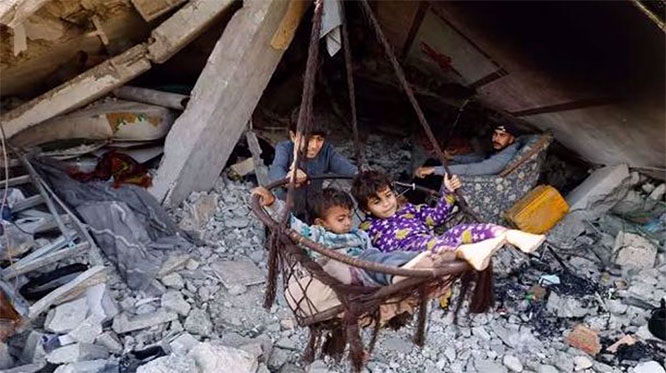
UNICEF teams say they repeatedly continue to witness heart-wrenching scenes of fearful Palestinian children sleeping outdoors with amputated limbs, while others live as orphans in flooded, makeshift shelters.

“I saw this myself in August. There is no safe place for them. The world cannot normalize their suffering,” Pires said, lamenting that the UN could “do a lot more if the aid that is really needed was entering faster.”

The UNICEF spokesperson warned that with the advent of winter, the risks for hundreds of thousands of displaced children will increase.

He warned, “The stakes are incredibly high” for children as winter acts as a threat multiplier, where children have no heating, no insulation, and few blankets. He said respiratory infections rise.

“Too many children have already paid the highest price,” Pires said. “Too many are still paying it, even under a ceasefire. The world promised them it would stop and that we would protect them.”

“Now we must act like it,” the UNICEF spokesperson added.

Since the Israeli regime launched its genocidal war against Palestinians in Gaza in October 2023, it has killed nearly 70,000 people in the territory, most of them women and children, and injured over 170,000 more, while reducing most of the structures in the enclave to rubble.

Comments

Add new comment

  • Coastaldigest.com reserves the right to delete or block any comments.
  • Coastaldigset.com is not responsible for its readers’ comments.
  • Comments that are abusive, incendiary or irrelevant are strictly prohibited.
  • Please use a genuine email ID and provide your name to avoid reject.
News Network
December 2,2025

Puttur: The long-cherished dream of a government medical college in Puttur has moved a decisive step closer to reality, with the Karnataka State Finance Department granting its official approval for the construction of a new 300-bed hospital.

Puttur MLA Ashok Kumar Rai announced the crucial development to reporters on Monday, confirming that the official communication from the finance department was issued on November 27. This 300-bed facility is intended to be the cornerstone for the establishment of the government medical college, a project announced in the state budget.

Fast-Track Implementation

The MLA outlined an aggressive timeline for the project:

•    A Detailed Project Report (DPR) for the hospital is expected to be ready within 45 days.

•    The tender process for the construction will be completed within two months.

Following the completion of the tender process, Chief Minister Siddaramaiah is scheduled to lay the foundation stone for the project.

"Setting up a medical college in Puttur is a historical decision by the Congress government in Karnataka," Rai stated. The project has an estimated budget allocation of Rs 1,000 crore for the medical college.

Focus on Medical Education Department

The MLA highlighted a key strategic move: requesting the government to implement the hospital construction through the Medical Education Department instead of the Health and Family Welfare Department. This is intended to streamline the entire process of establishing the full medical college, ensuring the facilities—including labs, operation theatres, and other necessary infrastructure—adhere to the strict guidelines set by the Medical Council of India (MCI). The proposed site for the project is in Bannur.

Rai also took the opportunity to address political criticism, stating that the government has fulfilled its promise despite "apprehensions" and "mocking and criticising" from opposition parties who had failed to take similar initiatives when they were in power. "Chief Minister Siddaramaiah has kept his word," he added.

Comments

Add new comment

  • Coastaldigest.com reserves the right to delete or block any comments.
  • Coastaldigset.com is not responsible for its readers’ comments.
  • Comments that are abusive, incendiary or irrelevant are strictly prohibited.
  • Please use a genuine email ID and provide your name to avoid reject.