'No way back' in Myanmar's crucible of communal hate

Agencies
September 25, 2017

Myanmar, Sept 25: Hindus once sold food to Rohingyas, spoke the same language and even cut the hair of their Muslim neighbours. But co-existence among the collage of ethnicities in Myanmar's Rakhine state has been ruptured -- perhaps irreversibly -- by the bloodshed of the last month.

Violence has periodically cut through the western state, where communal rivalries have been sharpened by British colonial meddling, chicanery by Myanmar's army and a fierce dispute over who does -- and does not -- belong in Rakhine.

But the events of August 25, when raids by Rohingya militants unleashed a swirl of violence across the north, have sunk Rakhine to new depths of hate.

"All of our family died in the village... we will not go back," said Chaw Shaw Chaw Thee, one of the hundreds of displaced Hindus seeking shelter in the state capital Sittwe.

The 20-year-old said she lost 23 family members as Rohingya militants swarmed the clutch of Hindu villages in Kha Maung Seik, near the Bangladesh border.

On Sunday the army said 28 badly-decomposed bodies of Hindu men, women and children had been pulled from two mass graves in the same area.

It was not immediately clear if they belonged to Chaw Shaw Chaw Thee's family. Heavily pregnant when she fled, she gave birth at a disused football stadium in Sittwe, where hundreds of traumatised Hindus now sleep on grubby mats in the overcrowded concourse.

An army lockdown has made it impossible to independently verify what happened in the villages of northern Rakhine, an area dominated by Rohingya Muslims who are a minority elsewhere in the mainly Buddhist country.

But allegations, carved along ethnic lines, are spinning out as conspiracy and competing for identity claims override empathy between former neighbours.

Hindus, who make up less than one percent of Rakhine's population, accuse Rohingya of massacring them, burning their homes and kidnapping women for marriage.

Meanwhile, the Rohingya, some 430,000 of whom have fled to Bangladesh, trade accusations with ethnic Rakhine Buddhists of grisly mob attacks and army "clearance operations" that have emptied their villages.

Small ethnic groups such as the Mro, Thet and Diagnet have also been caught up in the killings and chaos of the last month.

"We were barbers for Muslims, our women sold things in Muslim villages, I had Muslim friends, we had no problems," said Kyaw Kyaw Naing, a 34-year-old Hindu who can dance across linguistic divides in Hindi, Rakhine, Burmese and Rohingya.

Community ties in what is also Myanmar's poorest state have now unravelled. "We want to go back, but we will not if the Muslims are there."

Last week Myanmar's leader Aung san Suu Kyi told the international community that Rohingya refugees were welcome back if they were properly "verified".

But delivering on that promise will be almost impossible in a country where the status of the Rohingya is incendiary.

The Rohingya say they are a distinct ethnic group whose roots stretch back centuries.

Myanmar's powerful military insists they are "Bengalis" who were first brought to the country by British colonisers and have continued to pour in illegally ever since.

"It can't be solved in the short-term... to be stable and harmonious could take decades," Oo Hla Saw, a lawmaker for the Arakan National Party, which represents Rakhine Buddhists, told AFP.

Rakhine's history is bitterly contested and flecked by rivalries. Once a proud a Buddhist kingdom with a deep Muslim influence from trade and settlement, Rakhine's demographics were overhauled by British colonial administrators.

They shunted in large numbers of Hindu Indians and Bengali Muslims as farm hands to an area already populated by a soup of ethnicities including the Rohingya and Rakhine.

The Japanese invasion during World War II saw Rakhine clash with Rohingya, who were perceived to have been favoured by the retreating British.

Since 1962 the military has kindled anti-Rohingya sentiment, painting itself as the protector of the Buddhist faith from conquest by Islam.

Three major campaigns -- in 1978, the early 90s and now -- have driven Rohingya from Myanmar in huge numbers.

The army, which ran the country for 50 years and still has its hands on key levers of power, has also gradually rubbed out the group's legal status.

A 1982 law stripped Rohingya of citizenship, subjecting them to suffocating controls on everything from where they can travel to how many children they can have.

"The army wants to clear the Muslim community from Rakhine state," says Kyaw Min, a Rohingya and former MP, who has had his citizenship revoked.

"The intention is to drive down the Rohingya population. They have achieved that in the south of Rakhine, now they are targeting the north." Repression has fed Rohingya militancy, according to analysts.

Last month a government-backed commission on Rakhine's troubles, led by former UN chief Kofi Annan, urged "all communities to move beyond entrenched historical narratives".

But a few hours after its report was published, the militants attacked, sparking a ferocious military response that the UN believes amounts to "ethnic cleansing".

The report also urged the government to boost the economy to uplift a poor population and build community bonds.

Business ties and personal relations once defied communal lines, with Rohingya who could not legally own property relying on Rakhine neighbours to secure deeds for them on the sly.

Now the fearful displaced inside Rakhine say there is no way they can ever again live alongside Rohingya neighbours.

Khin Saw Nyo, 48, an ethnic Rakhine, said nearby Muslim villagers suddenly turned on her community near the Bangladesh border, forcing them to flee to the mountains.

"We will die if we go back," she told AFP from inside a monastery sheltering refugees in Sittwe, adding Rohingya militants are still preparing to strike. "They warned us to eat well... they said the next time we will not escape."


Comments

Add new comment

  • Coastaldigest.com reserves the right to delete or block any comments.
  • Coastaldigset.com is not responsible for its readers’ comments.
  • Comments that are abusive, incendiary or irrelevant are strictly prohibited.
  • Please use a genuine email ID and provide your name to avoid reject.
News Network
November 21,2025

malpe.jpg

Udupi: The Malpe Police have arrested two men from Uttar Pradesh for allegedly sharing classified information related to Indian Navy vessels with individuals in Pakistan, posing a serious threat to national security.

According to a complaint filed by the CEO of Udupi Cochin Shipyard, Malpe—an institution under the Union Ministry of Ports, Shipping and Waterways—the prime accused, Rohit (29), was working as an insulator through subcontractor M/S Shushma Marine Pvt Ltd. He had earlier served at Cochin Shipyard Limited in Kochi, Kerala, where naval ships are under construction.

Udupi SP Hariram Shankar said the accused had unlawfully shared, via WhatsApp, confidential identification numbers of Navy-related ships and other classified details while working in Kerala, allegedly for illegal gains.

After joining the Malpe shipyard unit, Rohit reportedly continued collecting sensitive information through a friend in Kochi and circulated it to unauthorised individuals, violating national security protocols and potentially endangering India’s sovereignty, unity, and integrity.

Based on the complaint, Malpe Police registered a case under Section 152 of the Bharatiya Nyaya Sanhita (BNS) and Sections 3 and 5 of the Official Secrets Act, 1923.

A police team led by Karkala Subdivision Assistant Superintendent of Police Harsha Priyamvada—along with PSI Anil Kumar D, ASI Harish, and PC Ravi Jadhav—conducted the investigation and arrested the two accused, identified as Rohit (29) and Santri (37), both residents of Sultanpur district, Uttar Pradesh.

The duo was produced before the court, which remanded them in judicial custody till December 3. Further investigation is in progress.

Comments

Add new comment

  • Coastaldigest.com reserves the right to delete or block any comments.
  • Coastaldigset.com is not responsible for its readers’ comments.
  • Comments that are abusive, incendiary or irrelevant are strictly prohibited.
  • Please use a genuine email ID and provide your name to avoid reject.
coastaldigest.com news network
November 28,2025

roadshow.jpg

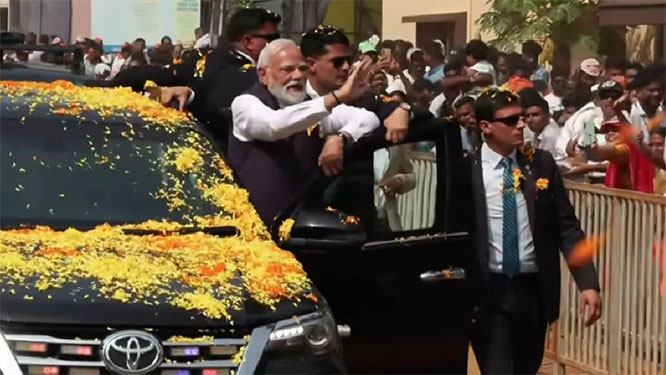
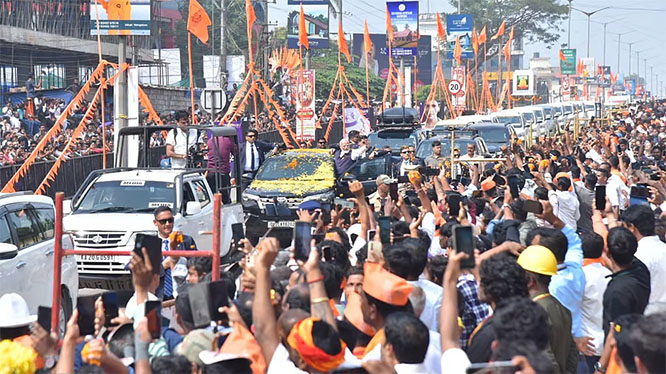
Udupi district transformed into a sea of saffron and celebration on Friday, November 28, as Prime Minister Narendra Modi’s roadshow swept through the coastal temple town. Thousands of residents lined the streets, turning the event into a vibrant public spectacle filled with cheers, flags, and festive energy.

The procession route—from the helipad to the historic Sri Krishna Math—was decked with buntings, saffron flags, and multilayered security barricades. One of the district’s largest-ever security deployments was put in place for the high-profile visit, with over 3,000 police personnel on duty. The arrangement included ten SPs, 27 DSPs, 49 inspectors, 127 sub-inspectors, 232 assistant sub-inspectors, 1,608 constables, and 39 women staff.

Six platoons of the Karnataka State Reserve Police, six Quick Response Teams, bomb detection units, and dog squads were stationed across Udupi. Enhanced surveillance covered Adi Udupi, Bannanje bus stand, and the Sri Krishna Math parking zone, with combing operations carried out along the roadshow corridor.

At the 800-year-old Sri Krishna Math, preparations reached a ceremonial peak. Paryaya Puttige Math seer Sugunendra Teertha Swamiji said the Prime Minister would take part in the Laksha Kantha Geetha Parayana, a mass chanting of the Bhagavad Gita by one lakh devotees, and inaugurate the new Suvarna Teertha Mantapa.

“He will first offer floral tributes to saint-poet Kanakadasa and then unveil the golden covering over the Kanakana Kindi,” the seer said.

The Prime Minister will also receive a Poorna Kumbha welcome and have darshan of Lord Sri Krishna, Mukhyaprana Devaru, and the Suvarna Paduke. Union Minister Pralhad Joshi, Karnataka Governor Thaawarchand Gehlot, Minister Bairathi Suresh, Dharmadhikari D. Veerendra Heggade, and seers from the Ashta Maths are expected to join the ceremony.

Ahead of his arrival, the Prime Minister posted on X that he felt “honoured” to attend the spiritually significant gathering. “This is a special occasion that brings together people from different sections of society for a recital of the Gita. This Matha has a very special significance in our cultural life,” he wrote, noting the institution’s long-standing legacy rooted in the teachings of Sri Madhvacharya.

roadshow2.jpg

Comments

Add new comment

  • Coastaldigest.com reserves the right to delete or block any comments.
  • Coastaldigset.com is not responsible for its readers’ comments.
  • Comments that are abusive, incendiary or irrelevant are strictly prohibited.
  • Please use a genuine email ID and provide your name to avoid reject.
News Network
November 29,2025

DKSsiddu.jpg

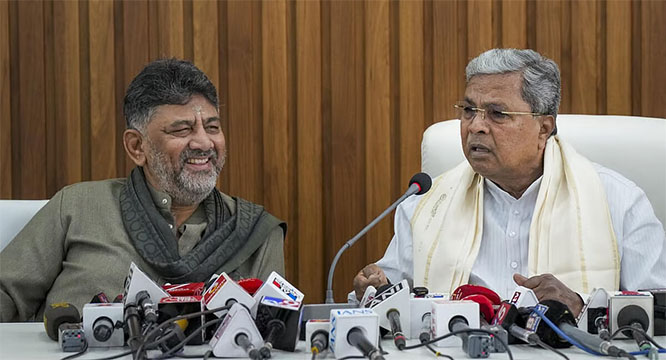
New Delhi: Karnataka chief minister Siddaramaiah and deputy CM DK Shivakumar on Saturday put up a dramatic display of unity at a closely watched joint press briefing, firmly dismissing weeks of speculation about a power-sharing tussle within the Congress. With the high command nudging both leaders to sit together and settle the dust, the meeting became a political spectacle, ending with the duo declaring that there was “no confusion, no differences.”

Calling the reports of a rift “manufactured confusion,” Siddaramaiah said the talks had gone smoothly, even joking about their breakfast. “Breakfast was very good. All three of us enjoyed it,” he said. “We want to end this confusion once and for all. For local elections and for 2028, our mission is clear — Congress must return to power. There is no difference between me and DKS, not now, not before.”

He blamed the media for fuelling rumours and reiterated absolute adherence to the party leadership. “From tomorrow, let there be no confusion. What the high command says, we will follow.”

Siddaramaiah also assured that the Assembly session starting December 8 would run smoothly and vowed that Congress would take on the BJP and JD(S) “together.”

Shivakumar echoed the chief minister word for word, stressing loyalty and discipline. “People have given us a massive mandate. It is our duty to deliver,” he said. “This government was formed under Siddaramaiah’s leadership. We both have complete trust in the high command. If they tell me to wait, I will wait.”

He added that the two leaders had discussed strategy for the 2028 Assembly elections. “Whatever the CM says, I agree. We are loyal soldiers of the party. The party may be facing challenges nationally, but we will keep it strong in Karnataka.”

Shivakumar also said Siddaramaiah would soon visit his home for lunch or dinner — another symbolic gesture meant to underline their unity.

Both leaders later posted on social media describing the breakfast meeting as “productive” and focused on “Karnataka’s priorities.”

The BJP, however, rejected the show of camaraderie as “pure bunkum,” accusing Congress of trying to paper over an internal power struggle. But Siddaramaiah and Shivakumar insisted their united front would continue — and that there was “no confusion” within the state leadership.

Comments

Add new comment

  • Coastaldigest.com reserves the right to delete or block any comments.
  • Coastaldigset.com is not responsible for its readers’ comments.
  • Comments that are abusive, incendiary or irrelevant are strictly prohibited.
  • Please use a genuine email ID and provide your name to avoid reject.