Nobel 2017 season opens with medicine prize

Agencies
October 2, 2017

Stockholm, Oct 2: This year's Nobel season opens Monday with the announcement of the medicine prize, turning the page on Bob Dylan's literature prize stunner that stole the spotlight in last year's award season.

Like every year, speculation is rife about the possible winners, given the number of worthy laureates in the fields of medicine, physics, chemistry, literature, peace and economics.

The Nobel medicine prize committee at the Karolinska Institute is first out to announce its choice of laureates, on Monday at 11:30 am (0930 GMT) at the earliest.

Sweden's newspaper of reference, Dagens Nyheter, suggested American oncologist Dennis Slamon could be honoured for his research on breast cancer and the drug treatment Herceptin.

Or possibly American James Allison, a pioneer in the field of immunotherapy that combats cancer cells and the winner of the 2015 Lasker Prize -- often considered the US equivalent of a Nobel medicine prize. If this method were awarded, Allison could share the prize with Arlene Sharpe and Gordon Freeman.

Meanwhile Swedish public radio SR tipped the prize could go to researchers who worked on a cure for Hepatitis C, Ralf Bartenschlager of Germany and Americans Charles Rice and Michael Sofia -- a trio also awarded the Lasker Prize, in 2016.

Waves, scissors or batteries?

The medicine prize will be followed by the physics prize announcement on Tuesday, with the discovery of gravitational waves regularly mentioned as a possible winner.

Sending ripples through space and time, gravitational waves were first predicted by Albert Einstein a century ago as part of his theory of general relativity, but the first hard evidence of their existence came only in 2015, when two US detectors found the first such signal.

That discovery could however be considered too recent by the Nobel committee.

According to Dagens Nyheter, the jury could instead choose to honour the discovery of exoplanets by Swiss astrophysicians Michel Mayor and Didier Queloz.

On Wednesday, the chemistry prize committee could give the nod to a gene-editing technique known as the CRISPR-Cas9 DNA snipping tool, a type of genetic "scissors" used to cut out a mutated gene in a human embryo and replace it by a corrected version.

But that discovery could also be too early for a Nobel, as a legal dispute rages over who discovered the technique.

It has been claimed on the one hand by the French-American research duo of Emmanuelle Charpentier and Jennifer Doudna, and on the other by Chinese-born American Feng Zhang.

Another recurring favourite for the chemistry prize is John Goodenough, a 95-year old electrochemist whose pioneering work led to the invention of rechargeable lithium ion battery present in cell phones, computers and electric cars.

Anti-nuke buzz for peace prize

Perhaps the most watched Nobel is the peace prize, the only one to be announced in Oslo and due on Friday.

This year, anti-nuclear efforts could win, some have suggested. Tensions have escalated between Washington and Pyongyang after North Korea's sixth nuclear test, and there is growing uncertainty over the Iran deal, which US President Donald Trump has threatened to tear up.

Two key orchestrators of that accord, Iranian Foreign Minister Mohammad Javad Zarif and EU foreign policy chief Federica Mogherini, are seen as strong contenders by the head of the Peace Research Institute of Oslo (Prio), Henrik Urdal.

"With North Korea also at stake, it's very important to support initiatives that guard against the development and proliferation of nuclear weapons," he said.

The names of the candidates are kept secret for at least 50 years, but those eligible to nominate candidates — including former laureates, lawmakers and government ministers around the world, and some university professors — are allowed to disclose their choices.

Those believed to be on the list include Syria's White Helmets rescue service, Congolese doctor Denis Mukwege, jailed Saudi blogger Raif Badawi and Edward Snowden, who revealed the scope of America's NSA electronic surveillance programme.

Meanwhile, the Swedish Academy has yet to set the date for its literature prize announcement, but it traditionally falls on a Thursday so October 5 and 12 are seen as possible dates.

The Academy's choice of US singer songwriter Bob Dylan last year was so divisive that Stockholm's literary circles have predicted the Academy will go for a more conservative name this year, such as Italy's Claudio Magris, Kenya's Ngugi wa Thiong'o, Canadian author Margaret Atwood or Syrian poet Adonis.

The economics prize will be announced on October 9.

This year, each Nobel comes with a nine million kronor ($1.1-million, 940,500-euro) prize sum, to be shared if several laureates are honoured in the same discipline.

Comments

Add new comment

  • Coastaldigest.com reserves the right to delete or block any comments.
  • Coastaldigset.com is not responsible for its readers’ comments.
  • Comments that are abusive, incendiary or irrelevant are strictly prohibited.
  • Please use a genuine email ID and provide your name to avoid reject.
News Network
November 26,2025

students.jpg

Bengaluru, Nov 26: Karnataka is taking its first concrete steps towards lifting a three-decade-old ban on student elections in colleges and universities. Deputy Chief Minister D.K. Shivakumar announced Wednesday that the state government will form a small committee to study the reintroduction of campus polls, a practice halted in 1989 following incidents of violence.

Speaking at a 'Constitution Day' event organised by the Karnataka Congress, Mr. Shivakumar underscored the move's aim: nurturing new political leadership from the grassroots.

"Recently, (Leader of the Opposition in Lok Sabha) Rahul Gandhi wrote a letter to me and Chief Minister (Siddaramaiah) asking us to think about restarting student elections," Shivakumar stated. "I'm announcing today that we'll form a small committee and seek a report on this."

Student elections were banned in Karnataka in 1989, largely due to concerns over violence and the infiltration of political party affiliates into campus life. The ban effectively extinguished vibrant student bodies and the pipeline of young leaders they often produced.

Mr. Shivakumar, who also serves as the Karnataka Congress president, said that former student leaders will be consulted to "study the pros and cons" of the re-introduction.

Acknowledging the history of the ban, he added, "There were many criminal activities taking place back then. We’ll see how we can conduct (student) elections by regulating such criminal activities."

The Deputy CM reminisced about his own journey, which began on campus. He recalled his political activism at Sri Jagadguru Renukacharya College leading to his first Assembly ticket in 1985 at the age of 23. "That's how student leadership was at the time. Such leadership has gone today. College elections have stopped," he lamented, adding that for many, college elections were "like a big movement" where leaders were forged.

The move, driven by the Congress high command's push to cultivate young talent, will face scrutiny from academics and university authorities who have, in the past, expressed concern that the return of polls could disrupt the peaceful academic environment and turn campuses into political battlegrounds.

Comments

Add new comment

  • Coastaldigest.com reserves the right to delete or block any comments.
  • Coastaldigset.com is not responsible for its readers’ comments.
  • Comments that are abusive, incendiary or irrelevant are strictly prohibited.
  • Please use a genuine email ID and provide your name to avoid reject.
News Network
December 2,2025

Puttur: The long-cherished dream of a government medical college in Puttur has moved a decisive step closer to reality, with the Karnataka State Finance Department granting its official approval for the construction of a new 300-bed hospital.

Puttur MLA Ashok Kumar Rai announced the crucial development to reporters on Monday, confirming that the official communication from the finance department was issued on November 27. This 300-bed facility is intended to be the cornerstone for the establishment of the government medical college, a project announced in the state budget.

Fast-Track Implementation

The MLA outlined an aggressive timeline for the project:

•    A Detailed Project Report (DPR) for the hospital is expected to be ready within 45 days.

•    The tender process for the construction will be completed within two months.

Following the completion of the tender process, Chief Minister Siddaramaiah is scheduled to lay the foundation stone for the project.

"Setting up a medical college in Puttur is a historical decision by the Congress government in Karnataka," Rai stated. The project has an estimated budget allocation of Rs 1,000 crore for the medical college.

Focus on Medical Education Department

The MLA highlighted a key strategic move: requesting the government to implement the hospital construction through the Medical Education Department instead of the Health and Family Welfare Department. This is intended to streamline the entire process of establishing the full medical college, ensuring the facilities—including labs, operation theatres, and other necessary infrastructure—adhere to the strict guidelines set by the Medical Council of India (MCI). The proposed site for the project is in Bannur.

Rai also took the opportunity to address political criticism, stating that the government has fulfilled its promise despite "apprehensions" and "mocking and criticising" from opposition parties who had failed to take similar initiatives when they were in power. "Chief Minister Siddaramaiah has kept his word," he added.

Comments

Add new comment

  • Coastaldigest.com reserves the right to delete or block any comments.
  • Coastaldigset.com is not responsible for its readers’ comments.
  • Comments that are abusive, incendiary or irrelevant are strictly prohibited.
  • Please use a genuine email ID and provide your name to avoid reject.
News Network
November 29,2025

DKSsiddu.jpg

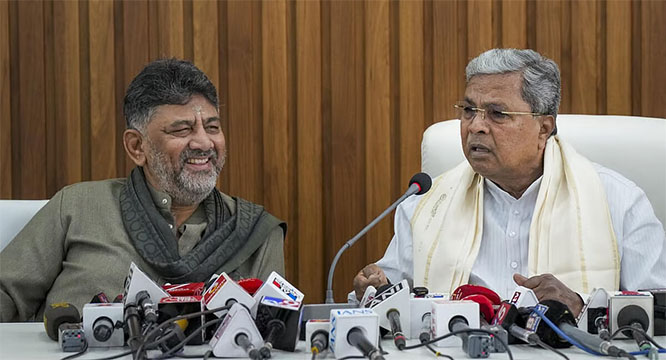
New Delhi: Karnataka chief minister Siddaramaiah and deputy CM DK Shivakumar on Saturday put up a dramatic display of unity at a closely watched joint press briefing, firmly dismissing weeks of speculation about a power-sharing tussle within the Congress. With the high command nudging both leaders to sit together and settle the dust, the meeting became a political spectacle, ending with the duo declaring that there was “no confusion, no differences.”

Calling the reports of a rift “manufactured confusion,” Siddaramaiah said the talks had gone smoothly, even joking about their breakfast. “Breakfast was very good. All three of us enjoyed it,” he said. “We want to end this confusion once and for all. For local elections and for 2028, our mission is clear — Congress must return to power. There is no difference between me and DKS, not now, not before.”

He blamed the media for fuelling rumours and reiterated absolute adherence to the party leadership. “From tomorrow, let there be no confusion. What the high command says, we will follow.”

Siddaramaiah also assured that the Assembly session starting December 8 would run smoothly and vowed that Congress would take on the BJP and JD(S) “together.”

Shivakumar echoed the chief minister word for word, stressing loyalty and discipline. “People have given us a massive mandate. It is our duty to deliver,” he said. “This government was formed under Siddaramaiah’s leadership. We both have complete trust in the high command. If they tell me to wait, I will wait.”

He added that the two leaders had discussed strategy for the 2028 Assembly elections. “Whatever the CM says, I agree. We are loyal soldiers of the party. The party may be facing challenges nationally, but we will keep it strong in Karnataka.”

Shivakumar also said Siddaramaiah would soon visit his home for lunch or dinner — another symbolic gesture meant to underline their unity.

Both leaders later posted on social media describing the breakfast meeting as “productive” and focused on “Karnataka’s priorities.”

The BJP, however, rejected the show of camaraderie as “pure bunkum,” accusing Congress of trying to paper over an internal power struggle. But Siddaramaiah and Shivakumar insisted their united front would continue — and that there was “no confusion” within the state leadership.

Comments

Add new comment

  • Coastaldigest.com reserves the right to delete or block any comments.
  • Coastaldigset.com is not responsible for its readers’ comments.
  • Comments that are abusive, incendiary or irrelevant are strictly prohibited.
  • Please use a genuine email ID and provide your name to avoid reject.