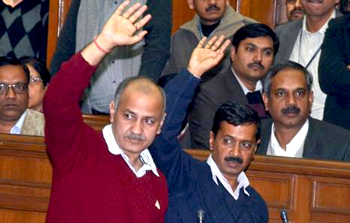
Now, part II of script will unfold

February 15, 2014

Kejriwal_resigned
New Delhi, Feb 15: Delhi Chief Minister Arvind Kejriwal’s resignation, with all the sound and fury, would have been surprising if it did not happen. When, in December 2013, the Aam Aadmi Party formed a government in Delhi, it had a single objective in mind — to pass the Jan Lokpal Bill failing which to bow out of office as a martyr punished for taking on the corrupt. The script has played out almost perfectly.

Mr. Kejriwal was bound by his own past to make the passage of the Bill non-negotiable. Indeed, the anti-corruption law defines the AAP, it is the reason why the party was able to make the impossible transition from a political greenhorn to a party in power.

The Jan Lokpal Bill was the centrepiece of the 2011-2012 Anna Hazare movement. To those who thronged the fast venues of Anna, the specific clauses in the legislation — which many experts saw as draconian with the Lokpal himself potentially turning into a Frankenstein’s monster — were of no concern. As Mr. Kejriwal said in a 2011 interview: “See, people did not understand the details of the JLB. They simply saw it as a dawai [medicine] for corruption.”

The larger symbolism of the Jan Lokpal Bill is why Mr. Kejriwal took on the might of the Centre and Delhi’s Lieutenant-Governor on the constitutional validity of its introduction and passage in the Assembly. There was always going to be two views on this given that the Congress was in the saddle at the Centre, and a different version of the Lokpal Bill had recently been passed by Parliament. The Congress could obviously not support the AAP government’s Jan Lokpal Bill and the Lokpal Bill passed by Parliament for which credit was given to Rahul Gandhi.

In the event, the Jan Lokpal Bill got blocked right at the stage of introduction with the Union Home Ministry insisting upon prior permission from the Lt. Governor. Mr. Kejriwal contested this furiously: He quoted experts who made the opposite case, he petitioned the Lt. Governor and argued that if the Delhi government was not going to be allowed to pass even a Bill, it made no sense for it to exist. With the Congress and the Bharatiya Janata Party teaming up to vote against the Bill’s introduction, the State government’s fate was sealed.

Whichever way the Bill went, Mr. Kejriwal was certain to have claimed it as his victory. Indeed, when initially it seemed as if the Delhi government had managed to introduce the Bill, there were jubilant shouts of “victory” from the crowds of AAP volunteers gathered outside the Assembly.

Mr. Kejriwal’s exit line predictably skewered the Congress and the BJP. “The two corrupt parties have got together to defeat me because they were scared I was going after Mukesh Ambani. They could not afford for me to expose the nexus.”

High on drama

The AAP government’s short life was high on drama; in less than two months it courted more controversy than governments would in a year. Mr. Kejriwal and his Ministers probably overdid the histrionics. And yet, few would dispute that on corruption, the AAP went where none dared to go. The FIR against Mr. Ambani — and the deafening silence of the other parties l’affaire K-G Basin — says as much.

Part II of the script will see the AAP take the message to the country as a whole — and set itself as the gold standard for probity and honesty.


Comments

Add new comment

  • Coastaldigest.com reserves the right to delete or block any comments.
  • Coastaldigset.com is not responsible for its readers’ comments.
  • Comments that are abusive, incendiary or irrelevant are strictly prohibited.
  • Please use a genuine email ID and provide your name to avoid reject.
News Network
December 6,2025

pilot.jpg

New Delhi: IndiGo, India’s largest airline, faced major operational turbulence this week after failing to prepare for new pilot-fatigue regulations issued by the Directorate General of Civil Aviation (DGCA). The stricter rules—designed to improve flight safety—took effect in phases through 2024, with the latest implementation on November 1. IndiGo has acknowledged that inadequate roster planning led to widespread cancellations and delays.

Below are the key DGCA rules that affected IndiGo’s operations:

1. Longer Mandatory Weekly Rest

Weekly rest for pilots has been increased from 36 hours to 48 hours.

The government says the extended break is essential to curb cumulative fatigue. This rule remains in force despite the current crisis.

2. Cap on Night Landings

Pilots can now perform only two night landings per week—a steep reduction from the earlier limit of six.

Night hours, defined as midnight to early morning, are considered the least alert period for pilots.

Given the disruptions, this rule has been temporarily relaxed for IndiGo until February 10.

3. Reduced Maximum Night Flight Duty

Flight duty that stretches into the night is now capped at 10 hours.

This measure has also been kept on hold for IndiGo until February 10 to stabilize operations.

4. Weekly Rest Cannot Be Replaced With Personal Leave

Airlines can no longer count a pilot’s personal leave as part of the mandatory 48-hour rest.

Pilots say this closes a loophole that previously reduced actual rest time.

Currently, all airlines are exempt from this rule to normalise travel.

5. Mandatory Fatigue Monitoring

Airlines must submit quarterly fatigue reports along with corrective actions to DGCA.

This system aims to create a transparent fatigue-tracking framework across the industry.

The DGCA has stressed that these rules were crafted to strengthen flight safety and align India with global fatigue-management standards. The temporary relaxations are expected to remain until February 2025, giving IndiGo time to stabilise its schedules and restore normal air travel.

Comments

Add new comment

  • Coastaldigest.com reserves the right to delete or block any comments.
  • Coastaldigset.com is not responsible for its readers’ comments.
  • Comments that are abusive, incendiary or irrelevant are strictly prohibited.
  • Please use a genuine email ID and provide your name to avoid reject.
News Network
December 6,2025

indigoticket.jpg

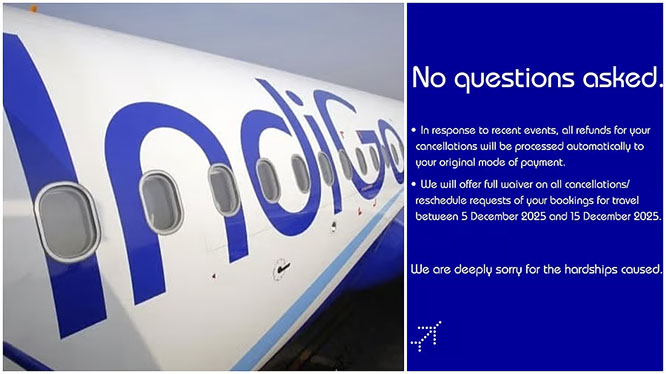
With IndiGo flight disruptions impacting thousands of passengers, the airline on Saturday said that it will offer full waiver on all cancellations/reschedule requests for travel bookings between December 5, 2025 and December 15, 2025.

Earlier in the day, the civil aviation ministry had directed the airline to complete the ticket refund process for the cancelled flights by Sunday evening, as well as ensure baggage separated from the travellers are delivered in the next two days.

In a post on X, titled 'No questions asked', IndiGo wrote, "In response to recent events, all refunds for your cancellations will be processed automatically to your original mode of payment."

"We are deeply sorry for the hardships caused," it further added.

Several passengers, however, complained of not getting full refund as promised by the airline.

Netizens have shared screenchots of getting charged for airline cancellation fee and convenience fee.

"Please tell me why u have did this airline cancellation charges when u say full amount will be refunded (sic)," a user wrote sharing a screenshot of the refund page.

"Well, but you have still debited the convenience charges," wrote another.

Passengers have also raised concerns about the "cancel" option being disabled on the IndiGo app. "First enable the 'Cancel' button on your App & offer full refund on tickets cancelled by customers between the said dates," wrote a user.

A day after the country's largest airline, IndiGo, cancelled more than 1,000 flights and caused disruptions for the fifth day on Saturday, the ministry said that any delay or non-compliance in refund processing will invite immediate regulatory action.

The refund process for all cancelled or disrupted flights must be completed by 8 pm on Sunday, the ministry said in a statement.

"Airlines have also been instructed not to levy any rescheduling charges for passengers whose travel plans were affected by cancellations," it said.

On Saturday, more than 400 flights were cancelled at various airports.

IndiGo has also been instructed to set up dedicated passenger support and refund facilitation cells.

Comments

Add new comment

  • Coastaldigest.com reserves the right to delete or block any comments.
  • Coastaldigset.com is not responsible for its readers’ comments.
  • Comments that are abusive, incendiary or irrelevant are strictly prohibited.
  • Please use a genuine email ID and provide your name to avoid reject.
News Network
December 16,2025

jordan.jpg

Prime Minister Narendra Modi on Monday held talks with Jordan’s King Abdullah II in Amman, during which the two leaders discussed ways to further strengthen bilateral relations, with the Prime Minister outlining an eight-point vision covering key areas of cooperation.

Describing the meeting as “productive”, PM Modi said he shared a roadmap focused on trade and economy, fertilisers and agriculture, information technology, healthcare, infrastructure, critical and strategic minerals, civil nuclear cooperation, and people-to-people ties.

In a post on social media platform X, the Prime Minister praised King Abdullah II’s personal commitment to advancing India–Jordan relations, particularly as both countries mark the 75th anniversary of the establishment of diplomatic ties this year.

“Held productive discussions with His Majesty King Abdullah II in Amman. His personal commitment towards vibrant India-Jordan relations is noteworthy. This year, we are celebrating the 75th anniversary of our bilateral diplomatic relations,” PM Modi said.

The meeting took place at the Al Husseiniya Palace, where the two leaders also exchanged views on regional and global issues of mutual interest. According to the Ministry of External Affairs (MEA), both sides agreed to further deepen cooperation in areas including trade and investment, defence and security, counter-terrorism and de-radicalisation, fertilisers and agriculture, infrastructure, renewable energy, tourism, and heritage.

The MEA said both leaders reaffirmed their united stand against terrorism.

PM Modi arrived in Amman earlier on Monday and was received by Jordanian Prime Minister Jafar Hassan, who accorded him a formal welcome. Following the talks, King Abdullah II hosted a banquet dinner in honour of the Prime Minister, reflecting the warmth of bilateral ties.

Jordan is the first leg of PM Modi’s three-nation tour. From Amman, the Prime Minister will travel to Ethiopia at the invitation of Prime Minister Abiy Ahmed Ali, marking his first official visit to the African nation. The tour will conclude with a visit to Oman.

Comments

Add new comment

  • Coastaldigest.com reserves the right to delete or block any comments.
  • Coastaldigset.com is not responsible for its readers’ comments.
  • Comments that are abusive, incendiary or irrelevant are strictly prohibited.
  • Please use a genuine email ID and provide your name to avoid reject.