



New law requires Indian schools in Saudi Arabia to teach local history and geography

News Network
December 13, 2022

Riyadh, Dec 13: The Saudi Ministry of Education is giving the finishing touches to the bylaw regulating the functioning of private schools in the Kingdom.

According to the bylaw, it is mandatory for private schools that follow a foreign curriculum including Indian curriculum to teach the history and geography of Saudi Arabia. These schools shall teach Saudi students national identity as a subject in the curriculum. Punitive measures, including fines of up to SR500000, will be taken against violators of the regulations.

It is permissible for the private sector and the non-profit sector to provide education services in various phases of general education by applying quality standards, and improving the level of performance and outputs through private schools.

Teachers in private schools are required to obtain a valid professional license issued by the Saudi Education and Training Evaluation Commission.

The regulations state that Saudis or foreign investors can apply for a license to run foreign schools. Saudis and foreign investors can also apply together in partnership between them. Public interest entities can also apply for a license.

According to the new bylaw, the applicant must obtain a commercial registration necessary to practice the activity beforehand and must not have previously faced disciplinary action while serving in a government or private school.

If the applicant is a foreign investor, he or she must have obtained a license from the Ministry of Investment, in addition to proof of previous experience in extending educational services. The investment license must cover educational activities and services.

If the owner of the establishment fails to meet one of the conditions stipulated in the bylaw, they may transfer the licensing right to another person who fulfills these conditions within a period of three months or the end of the school year whichever is earlier, after obtaining permission from the Ministry of Education.

The new bylaw obligates private schools to appoint a principal and qualified educational and administrative staff in accordance with the size of the school and to formulate rules with regard to tuition fees and the mechanism for collecting them.

It is permissible for a private school to request an amendment in the academic calendar in accordance with the rules set by the Ministry of Education. In the event schools receive incentives, subsidies, or financial loans, a balance sheet of revenues and expenditures shall be prepared and deposited in a special account.

The bylaw stipulates that the Ministry of Education approves incentives to enable and encourage the practice of providing educational services by private schools in accordance with the rules for incentives approved by the relevant authorities. These include assistance in cash and kind, technical subsidies, and the use of land, buildings, and state-owned buildings in the education sector as per an investment or usufruct agreement concluded by the ministry or its representative with the beneficiary of the subsidy.

According to the bylaw, infringement of its provisions and rules, offending the religion of Islam, Saudi Arabia, its leaders and public figures, and the breach of intellectual security of society or health and safety requirements are punishable violations.

Punitive measures will be taken against the offenders. There will be one or more penalties, taking into account the situation of students during the academic year. The penalties include a warning and suspension of new admissions until the violation is corrected, which is mandatory within 14 days from the date of serving a warning notice. The school may face a fine not exceeding SR500,000, final closure of school or revocation of its license, and deportation of the school principal or any one of its teachers.

The size of the violation and its recurrence is taken into account when imposing the penalties. The size of the school, the quality of its outputs, and its community participation in difficult conditions are also considered. An appeal to the minister against decisions issued with regard to the penalties is permissible within a month of its issuance.

Comments

Add new comment

  • Coastaldigest.com reserves the right to delete or block any comments.
  • Coastaldigset.com is not responsible for its readers’ comments.
  • Comments that are abusive, incendiary or irrelevant are strictly prohibited.
  • Please use a genuine email ID and provide your name to avoid reject.
News Network
January 19,2026

New Delhi: Setting speculation to the rest, the CPI(M) has made it clear that it is open to have an electoral understanding with the Congress “to defeat” the Trinamool Congress and the BJP in West Bengal Assembly election even as it is all set to take on the grand old party in Kerala accusing it of “found wanting” in fighting the Hindutva forces.

The CPI(M) also said that it will contest the Tamil Nadu election “with DMK and its allies to defeat the BJP and its allies”, amid a section in the Congress triggering confusion about its participation in the M K Stalin-led coalition over demand over power-sharing and more seats. It is also willing to join hands with Congress and others in Assam and Puducherry to defeat the BJP.

The decisions came at a three-day meeting of the CPI(M) Central Committee in Thiruvananthapuram, which ended on Sunday after reviewing the poll preparations in the poll-bound states.

The CPI(M)'s decision came even as a section led by West Bengal Congress president Subhankar Sarkar is averse to tying up with the Left Front, claiming that their party is not benefitted by the electoral understanding. Both Congress and CPI(M)-led Left Front had electoral understanding in 2016 and 2021 Assembly elections and 2024 Lok Sabha polls.

Congress and the Left Front fought together for the first time in 2016 when Congress won 44 seats and the CPI(M) got 26. In 2021, the Left Front and the Congress drew a blank. In the 2024 Lok Sabha polls, Congress managed to win one seat while the Left did not win any. In the 2019 Lok Sabha polls, both fought against each other with Congress winning two and the Left none.

“In Bengal, the party will work for the defeat of both the TMC and the BJP, which are trying to polarise the society. We will try to rally all the forces that are ready to work against them,” the CPI(M) said in a statement without naming Congress by name. Senior leaders said there is no change in its strategy of pooling all non-BJP, non-TMC votes.

However, the party was critical of the Congress in Kerala where both will fight against each other.

The CPI(M) said it would "expose the BJP-led Union government’s denial of rightful dues to Kerala, the fiscal constraints imposed and the overall attack on federalism" as also "expose the failure of the Congress to effectively counter this attack on federalism, as the largest opposition party in the Parliament".

"The Congress, especially in Kerala, was found wanting in the fight against communal RSS-BJP, ideologically and this will also be exposed before the people," it added.

In Assam, it said, the CPI(M) will work for the mobilisation of all the anti-BJP parties and forces and defeat the rabidly communal and divisive BJP government. The Left parties are cooperating with Congress in the north-eastern state. In Puducherry, it said it will work for the defeat of the BJP alliance government.

Comments

Add new comment

  • Coastaldigest.com reserves the right to delete or block any comments.
  • Coastaldigset.com is not responsible for its readers’ comments.
  • Comments that are abusive, incendiary or irrelevant are strictly prohibited.
  • Please use a genuine email ID and provide your name to avoid reject.
News Network
January 23,2026

Mangaluru: The Karnataka Government Polytechnic (KPT), Mangaluru, has achieved autonomous status from the All India Council for Technical Education (AICTE), becoming the first government polytechnic in the country to receive such recognition in its 78-year history. The status was granted by AICTE, New Delhi, and subsequently approved by the Karnataka Board of Technical Education in October last year.

Officials said the autonomy was conferred a few months ago. Until recently, AICTE extended autonomous status only to engineering colleges, excluding diploma institutions. However, with a renewed national focus on skill development, several government polytechnics across India have now been granted autonomy.

KPT, the second-largest polytechnic in Karnataka, was established in 1946 with four branches and has since expanded to offer eight diploma programmes, including computer science and polymer technology. The institution is spread across a 19-acre campus.

Ravindra M Keni, the first dean of the institution, told The Times of India that AICTE had proposed autonomous status for polytechnic institutions that are over 25 years old. “Many colleges applied. In the first round, 100 institutions were shortlisted, which was further narrowed down to 15 in the second round. We have already completed one semester after becoming an autonomous institution,” he said. He added that nearly 500 students are admitted annually across eight three-year diploma courses.

Explaining the factors that helped KPT secure autonomy, Keni said the institution has consistently recorded 100 per cent admissions and placements for its graduates. He also noted its strong performance in sports, with the college emerging champions for 12 consecutive years, along with active student participation in NCC and NSS activities.

Autonomous status allows KPT to design industry-oriented curricula, conduct examinations, prepare question papers, and manage academic documentation independently. The institution can also directly collaborate with industries and receive priority funding from AICTE or the Ministry of Education. While academic autonomy has been granted, financial control will continue to rest with the state government.

“There will be separate committees for examinations, question paper setting, boards of studies, and boards of examiners. The institution will now have the freedom to conduct admissions without government notifications and issue its own marks cards,” Keni said, adding that new academic initiatives would be planned after a year of functioning under the autonomous framework.

Comments

Add new comment

  • Coastaldigest.com reserves the right to delete or block any comments.
  • Coastaldigset.com is not responsible for its readers’ comments.
  • Comments that are abusive, incendiary or irrelevant are strictly prohibited.
  • Please use a genuine email ID and provide your name to avoid reject.
News Network
January 19,2026

trump.jpg

Donald Trump has linked his repeated threats to seize Greenland to his failure to win the Nobel Peace Prize, in a letter to Norwegian Prime Minister Jonas Gahr Støre.

The authenticity of the letter, in which Trump says he no longer feels obligated to “think purely of peace,” was confirmed by Støre to the Norwegian newspaper VG.

“Considering your country decided not to give me the Nobel Peace Prize for having stopped eight wars plus, I no longer feel an obligation to think purely of peace,” Trump wrote, adding he can now “think about what is good and proper for the United States.”

Støre said Trump’s letter was in response to a short message he had sent earlier, on behalf of himself and Finland’s President Alexander Stubb.

Trump has escalated rhetoric toward Greenland, a self-governing Danish territory, insisting the US will take control “one way or the other.” Over the weekend, he tweeted: “Now it is time, and it will be done!!!”

On Saturday, Trump threatened a 10% tariff on imports from Denmark, Norway, Sweden, France, Germany, the UK, the Netherlands, and Finland from 1 February until the US is allowed to purchase the island. EU diplomats met for emergency talks on possible retaliatory tariffs and sanctions.

In his letter, Trump argued Denmark “cannot protect” Greenland from Russia or China, questioning Danish ownership: “There are no written documents; it’s only that a boat landed there hundreds of years ago.” He added that NATO should support the US, claiming the world is “not secure unless we have complete and total control of Greenland.”

Trump’s stance has unsettled the EU and NATO, as he refused to rule out military action to take control of the mineral-rich island.

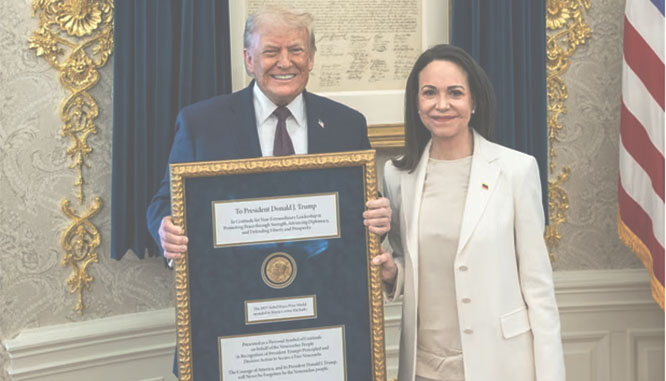
The Nobel Peace Prize is awarded by the independent Norwegian Nobel Committee, not the government. Trump had campaigned for last year’s prize, which went to Venezuelan opposition leader María Corina Machado, who dedicated her award to him.

Støre reiterated that the Nobel Prize decision rests solely with the committee.

Comments

Add new comment

  • Coastaldigest.com reserves the right to delete or block any comments.
  • Coastaldigset.com is not responsible for its readers’ comments.
  • Comments that are abusive, incendiary or irrelevant are strictly prohibited.
  • Please use a genuine email ID and provide your name to avoid reject.