Union Minister Kiren Rijiju graces Indian community interaction program in Riyadh

News Network
January 13, 2025

kiranrejiju.jpg

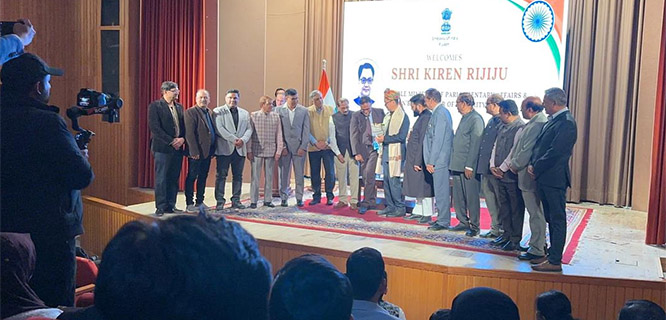
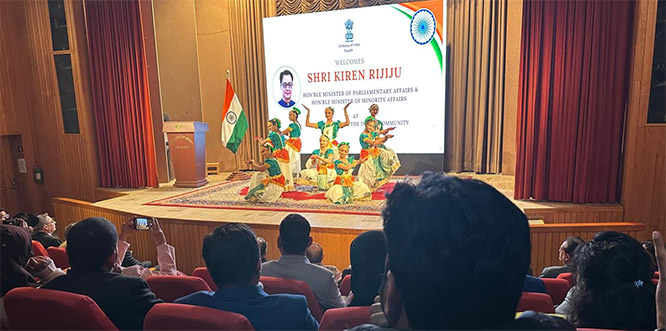
Riyadh: The Indian Embassy in Riyadh hosted a grand Indian Community Interaction Program at its auditorium in the Diplomatic Quarter, attended by the Honorable Minister for Parliamentary and Minority Affairs, Shri Kiren Rijiju. The event, which commenced at 6 PM (KSA time) brought together a vibrant gathering of Indian community members, Embassy officials and dignitaries.

The Minister was warmly welcomed by the Indian community steering committee with a traditional Himachali cap and shawl, symbolizing Indian cultural richness and diversity. The Honorable Indian Ambassador to Saudi Arabia, Dr. Suhel Ajaz Khan, shared the dais. 

In his address, Shri Kiran Rijiju emphasized the growing strategic partnership between India and Saudi Arabia, describing it as critical for fostering mutual growth and supporting the well-being of the Indian diaspora. He remarked, “India and Saudi Arabia share ancient ties, which have evolved into a robust partnership spanning trade, education, technology and culture.”

“The Kingdom is not only home to 2.6 million Indians but also a key ally in advancing global stability and prosperity,” he said. With the Indian diaspora in Saudi Arabia being the second-largest globally, Shri Rijiju equated their number to the population of many nations.

Shri Rijiju underscored the shared commitment to strengthening cultural and economic links, which directly benefit the Indian community in Saudi Arabia and their families in India. 

He captivated the audience with his thoughtful address, expressing gratitude to the Indian diaspora for their invaluable contributions. Reflecting on his earlier visits to the Kingdom as a Member of Parliament and individual basis, he emphasized the significance of this trip as Minister for Parliamentary and Minority Affairs and it’s going to be helpful to the people, especially Hajjis and all Indian diasporas, who are living in the Kingdom. 

Hajj 2025 Preparations & Increase in Hajj Quota

A major highlight of Shri Rijiju’s address was the Government of India’s efforts to improve the Hajj experience for Indian pilgrims. He announced an increase in the Hajj quota for 2025 and introduced new guidelines aimed at ensuring safety, efficiency, and comfort, especially for elderly pilgrims, women and others. 

The Minister emphasized India’s collaboration with Saudi authorities to streamline travel, accommodation, and healthcare facilities for pilgrims, ensuring a hassle-free and spiritually fulfilling experience. He reiterated the government’s commitment to safeguarding the interests of Hajjis, reflecting India’s proactive approach to catering to the needs of its citizens abroad.

Rising Global Stature of India

Shri Rijiju also emphasized and spoke about India’s emergence as a global power. “Unlike a decade ago, India today is a center of global influence with strong ties to almost every nation; India is becoming a global center of power, linked to almost every nation,” he said. The world’s perception of India and Indians has transformed positively, and every Indian can now feel a profound sense of pride,” he stated.

Commendation for Embassy and Cultural Performances

The minister praised the Indian Embassy in Riyadh and the Consulate in Jeddah for their exceptional works including managing one of the busiest workloads among Indian missions globally, such as issuing around 600 passports daily. He also praised their active involvement in promoting bilateral relations.

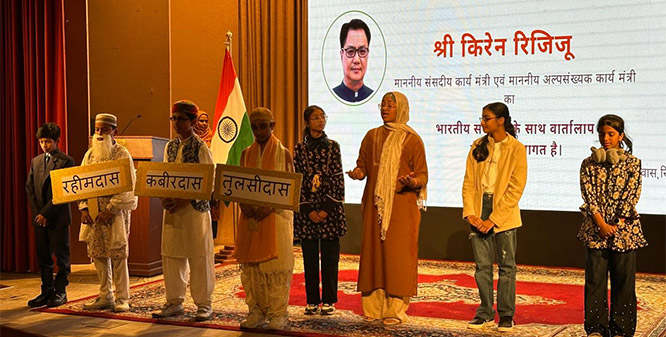
The evening featured cultural performances by students from Indian International Schools in Riyadh. Classical dances, along with a special performance marking Vishwa Hindi Divas, captivated the audience. Shri Rijiju applauded the students for showcasing the richness of India’s linguistic and cultural diversity, emphasizing equal respect for all Indian languages such as Tamil, Malayalam, Kannada, Telugu, Marati, Rasthani, Manipuri, Dogra etc. 

The event concluded with the Minister distributing prizes to winners of various competitions, leaving attendees inspired and proud of their shared cultural roots. Dinesh Setia, First Secretary at the Indian Embassy, ensured the program’s seamless flow as the master of ceremonies.

The Indian community expressed gratitude to Shri Rijiju for his inspiring vision and praised the Embassy for hosting a memorable evening.

(Inputs from P.A. Hameed Padubidri, Riyadh)
kiranrejiju2.jpg

kiranrejiju1.jpg

Comments

Add new comment

  • Coastaldigest.com reserves the right to delete or block any comments.
  • Coastaldigset.com is not responsible for its readers’ comments.
  • Comments that are abusive, incendiary or irrelevant are strictly prohibited.
  • Please use a genuine email ID and provide your name to avoid reject.
News Network
December 13,2025

New Delhi: School-going children are picking up drug and smoking habits and engaging in consumption of alcohol, with the average age of introduction to such harmful substances found to be around 13 years, suggesting a need for earlier interventions as early as primary school, a multi-city survey by AIIMS-Delhi said.

The findings also showed substance use increased in higher grades, with grade XI/XII students two times more likely to report use of substances when compared with grade VIII students. This emphasised the importance of continued prevention and intervention through middle and high school.

The study led by Dr Anju Dhawan of AIIMS's National Drug Dependence Treatment Centre, published in the National Medical Journal of India this month, looks at adolescent substance use across diverse regions.

The survey included 5,920 students from classes 8, 9, 11 and 12 in urban government, private and rural schools across 10 cities -- Bengaluru, Chandigarh, Delhi, Dibrugarh, Hyderabad, Imphal, Jammu, Lucknow, Mumbai, and Ranchi. The data were collected between May 2018 and June 2019.

The average age of initiation for any substance was 12.9 (2.8) years. It was lowest for inhalants (11.3 years) followed by heroin (12.3 years) and opioid pharmaceuticals (without prescription; 12.5 years).

Overall, 15.1 per cent of participants reported lifetime use, 10.3 per cent reported past year use, and 7.2 per cent reported use in the past month of any substance, the study found.

The most common substances used in the past year, after tobacco (4 per cent) and alcohol (3.8 per cent), were opioids (2.8 per cent), followed by cannabis (2 per cent) and inhalants (1.9 per cent). Use of non-prescribed pharmaceutical opioids was most common among opioid users (90.2 per cent).

On being asked, 'Do you think this substance is easily available for a person of your age' separately for each substance category, nearly half the students (46.3 per cent) endorsed that tobacco products and more than one-third of the students (36.5 per cent) agreed that a person of their age can easily procure alcohol products.

Similarly, for Bhang (21.9 per cent), ganja/charas (16.1 per cent), inhalants (15.2 per cent), sedatives (13.7 per cent), opium and heroin (10 per cent each), the students endorsed that these can be easily procured.

About 95 per cent of the children, irrespective of their grade, agreed with the statement that 'drug use is harmful'.

The rates of substance use (any) among boys were significantly higher than those of girls for substance use (ever), use in the past year and use in the past 30 days. Compared to grade VIII students, grade IX students were more likely, and grade XI/XII students were twice as likely to have used any substance (ever).

The likelihood of past-year use of any substance was also higher for grade IX students and for grade XI/XII students as compared to grade VIII students.

About 40 per cent of students mentioned that they had a family member who used tobacco or alcohol each. The use of cannabis (any product) and opioid (any product) by a family member was reported by 8.2 per cent and 3.9 per cent of students, respectively, while the use of other substances, such as inhalants/sedatives by family was 2-3 per cent, the study found.

A relatively smaller percentage of students reported use of tobacco or alcohol among peers as compared to among family members, while a higher percentage reported inhalants, sedatives, cannabis or opioid use among peers.

Children using substances (past year) compared to non-users reported significantly higher any substance use by their family members and peers.

There were 25.7 per cent students who replied 'yes' to the question 'conflicts/fights often occur in your family'. Most students also replied affirmatively to 'family members are aware of how their time is being spent' and 'damily members are aware of with whom they spend their time'.

Comments

Add new comment

  • Coastaldigest.com reserves the right to delete or block any comments.
  • Coastaldigset.com is not responsible for its readers’ comments.
  • Comments that are abusive, incendiary or irrelevant are strictly prohibited.
  • Please use a genuine email ID and provide your name to avoid reject.
News Network
November 30,2025

girlnomore.jpg

Mangaluru, Nov 30: A 22-year-old college student succumbed to her injuries at a private hospital in Mangaluru today, days after she was hit by a goods tempo while crossing a road in Padubidri.

The deceased has been identified as Preksha, a resident of Nadsalu Billitota in Padubidri. The fatal incident occurred as Preksha, who was returning home after completing her examination, attempted to cross the service road towards Mangaluru. She was struck by a goods tempo approaching from the Udupi side, causing her to fall and sustain a severe head injury.

Prompt action from local residents ensured she received immediate first aid before being rushed to a hospital in Mangaluru for specialised treatment. Despite medical efforts, she passed away while undergoing care.

Preksha was a student at Karavali College, Vamanjoor on the outskirts of Mangaluru city. The tragedy is compounded by the fact that she belonged to a financially vulnerable family, having previously lost her father. She is survived by her mother and brother.

A case related to the accident has been registered at the Padubidri police station, and an investigation is underway to determine the exact circumstances that led to the collision. The incident highlights the growing concerns over road safety, particularly on busy service roads, and serves as a tragic reminder of the human cost of traffic accidents.

Comments

Add new comment

  • Coastaldigest.com reserves the right to delete or block any comments.
  • Coastaldigset.com is not responsible for its readers’ comments.
  • Comments that are abusive, incendiary or irrelevant are strictly prohibited.
  • Please use a genuine email ID and provide your name to avoid reject.
News Network
December 2,2025

A major upgrade in safety and monitoring is planned for Haj 2026, with every Indian pilgrim set to receive a Haj Suvidha smart wristband linked to the official Haj Suvidha mobile app. The initiative aims to support pilgrims—especially senior citizens—who may struggle with smartphones during the 45-day journey.

What the Smart Wristband Will Do

Officials said the device will come with:
•    Location tracking
•    Pedometer
•    SOS emergency button
•    Qibla compass
•    Prayer timings
•    Basic health monitoring

SP Tiwari, secretary of the UP State Haj Committee, said the goal is to make the pilgrimage safer and more comfortable.

“Most Hajis are elderly and not comfortable with mobile apps,” he said. “The smartwatch will help locate pilgrims who forget their way or cannot communicate their location.”

The wristbands will be monitored by the Consulate General of India in Saudi Arabia, similar to mobile tracking via the Haj Suvidha App.

Free Distribution and Training

•    Smart wristbands will be given free of cost.
•    Training for pilgrims will be conducted between January and February 2026.
•    Sample units will reach state Haj committees soon.
•    Final devices will be distributed as pilgrims begin their journey.

New Rules for Accommodation

Two major decisions have also been finalised for Haj 2026:
1.    Separate rooms for men and women – including married couples. They may stay on the same floor but must occupy different rooms, following stricter Saudi guidelines.
2.    Cooking banned – gas cylinders will not be allowed; all meals will be provided through official catering services arranged by the Haj Committee of India.

These decisions were finalised during a meeting of the Haj Committee of India and state representatives in Mumbai.

Haj Suvidha App Launched Earlier

The government launched the Haj Suvidha App in 2024, offering:

•    Training modules
•    Accommodation and flight details
•    Baggage information
•    SOS and translation tools
•    Grievance redressal

Haj 2026 Quota and Key States

•    India’s total Haj quota for 2026: 1,75,025 pilgrims
•    70% (1,25,000) allotted to the Haj Committee of India
•    30% (around 50,000) reserved for Haj Group Organisers

Uttar Pradesh has the largest allocation (around 30,000 seats), though approximately 18,000 pilgrims are expected to go this year. States with high pilgrim numbers include Kerala, Maharashtra and Gujarat.

Dates of Haj 2026

The pilgrimage is scheduled to take place from 24 May to 29 May, 2026 (tentative).
Haj is one of the five pillars of Islam and is mandatory for Muslims who meet the required conditions.

Comments

Add new comment

  • Coastaldigest.com reserves the right to delete or block any comments.
  • Coastaldigset.com is not responsible for its readers’ comments.
  • Comments that are abusive, incendiary or irrelevant are strictly prohibited.
  • Please use a genuine email ID and provide your name to avoid reject.