



Over 169 million IT filers yet to link Pan with Aadhar

Agencies
October 4, 2017

New Delhi, Oct 4: Over 169 million income tax online filers have not yet linked their pan numbers with their Aadhar despite extending the deadline from last August, according Arvind Gupta, the National Head of the Information Technology Department of the Bharatiya Janata Party.
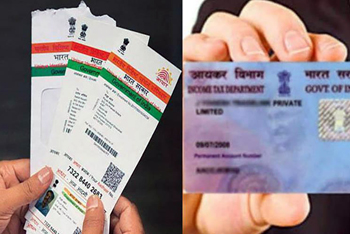
Speaking at the CyFy2017 panel on "Security through Identity", organised by Observer Research Foundation, Mr.Gupta revealed that only 100 million online IT filers have linked their pan with Aadhar so far.
He said this showed that there might be lots of fake pan cards.

Gupta said after the success of direct benefit transfers (DBTs) which has succeeded in eliminating middlemen and corruption, the government should now extend digital initiatives to the health and land sectors. He said digitalisation would help both these sectors tremendously.

"In fact, the government slowly implement 200 odd programmes like the DBT," Gupta added.

Sahil Kini, who was part of the initial government team which worked on Aadhar, said there is a need for the creation of Regulator in the digital area also, as in the cases of other resources, to effectively monitor and control data space. He suggested the regulator should be a good technical engineer who will be able to understand and monitor the medium for effective management.

"I am looking at it (Regulator) more from the technical side and not policy side though regulator job involves both sides," he said.

He also stressed the need for strong laws to prevent misuse of data and personal information with Aadhar.

Both Gupta and Sahil said the government is planning to come up with a complete law on Aadhar, information security and privacy concerns.

In order to prevent Aadhar data being misused as being reported in the media, Sunil Abraham, the Executive Director of the Centre for Internet and Society, suggested an alternative system of creating tokens from Aadhar identity and that token number being used to verify the identity of the person. He said this would help curb Aadhar data theft.

Former Prime Minister of Sweden Carl Bildt warned against the thinking of creating cyber assault weapons, saying the world we are living in are much more vulnerable than we are aware off and these cyber assault weapons would make the world worse even.

"Stay away from cyber warfare. It is very very dangerous and unimaginable," he said.

Talking of the nuclear threats from North Korea and US's counter threats, Bildt said nuclear wars are much worse than the biological wars and asked "where are we leading to?".

He said while many may be overwhelmed by pace of tech development now, "I argue this is just the beginning of where we are heading. What we are seeing is the last days of the industrial age and the beginnings of the tech age."

Bildt said within five years, we will have 95 percent of world population covered by mobile broadband with capacity better than what is available in Europe today.

He suggested that the norms and values of the internet should be the values and the norms of society. "We want to live in free, open and secure society," he said.

According to him, security is important in society, but freedom is more important. We need to build societies that have both. They are not incompatible. There should not be undue surveillance, censorship but states have some responsibility, under clear and transparent parliamentary supervision, he said

"We are the security of the internet," Bildt said.

The former Swedish PM said states are powerful enough to do things that others can't. Every state has the ability to be a superpower in the digital world.

"Norms should be there for every state: don't do to other states, what they can also do to you."

States must understand they all have equal potential of power in the digital world, thus there is a balance, he said.

Former Dutch Foreign Minister Uri Rosenthal said when internet is in motion, we see competing narratives, which the itnernet will have to adapt to and even love.

Adam Segal, Director of the Digital and Cyberspace Policy Programme, Council on Foreign Relations, said we are seeing the consoldiation of the Chinese model, a whole new rnage of controls on tech, ban on VPNs, real name registration, implementation of cyber security laws, brand new diplomatic initiatives with one belt, one road.

He said while every state in virtual realm has more power than they do in real world, China is one of the most important states shaping the future.

"We are seeing restructuring of powers based on tech giants and governments," he said.

Latha Reddy, former ambassador and deputy NSA, asked "Should digital spaces have governing ethics? I think they should. Using tech without ethics sets a dangerous precedent, for instance, the Hela case. It took 60 years for the US court to recognise violation of rights of the victim."

The two-day conference had sessions on 'The big questions: Technology, security and society'; 'No man's LAN: The militarisation of cyberspace'; 'War and peace in the digital age'; 'Predatry data: Gender and tech'; 'Harvesting the cloud'; 'Blue, while and chrome: The future of work'; 'Chasing Unicorns: The startup generation'; 'Digital vulnerabilities: Capacity building for tracking cyber crime'; 'The new code war'; 'Command and CTRL: Emerging Regime on Lethal Autonomous Weapons'; 'Encryption: The end of surveillance?'; 'Unbundling 'Convergence'; 'Information operations'; 'Security through identity'; 'Dangerous disclosures: Cyber security incident reporting'; 'Securing the digital economy'; 'Hearts and minds: Countering extremism through media' and 'Radical narratives: Countering violence outline'.

Comments

Add new comment

  • Coastaldigest.com reserves the right to delete or block any comments.
  • Coastaldigset.com is not responsible for its readers’ comments.
  • Comments that are abusive, incendiary or irrelevant are strictly prohibited.
  • Please use a genuine email ID and provide your name to avoid reject.
News Network
January 23,2026

Mangaluru: The Karnataka Government Polytechnic (KPT), Mangaluru, has achieved autonomous status from the All India Council for Technical Education (AICTE), becoming the first government polytechnic in the country to receive such recognition in its 78-year history. The status was granted by AICTE, New Delhi, and subsequently approved by the Karnataka Board of Technical Education in October last year.

Officials said the autonomy was conferred a few months ago. Until recently, AICTE extended autonomous status only to engineering colleges, excluding diploma institutions. However, with a renewed national focus on skill development, several government polytechnics across India have now been granted autonomy.

KPT, the second-largest polytechnic in Karnataka, was established in 1946 with four branches and has since expanded to offer eight diploma programmes, including computer science and polymer technology. The institution is spread across a 19-acre campus.

Ravindra M Keni, the first dean of the institution, told The Times of India that AICTE had proposed autonomous status for polytechnic institutions that are over 25 years old. “Many colleges applied. In the first round, 100 institutions were shortlisted, which was further narrowed down to 15 in the second round. We have already completed one semester after becoming an autonomous institution,” he said. He added that nearly 500 students are admitted annually across eight three-year diploma courses.

Explaining the factors that helped KPT secure autonomy, Keni said the institution has consistently recorded 100 per cent admissions and placements for its graduates. He also noted its strong performance in sports, with the college emerging champions for 12 consecutive years, along with active student participation in NCC and NSS activities.

Autonomous status allows KPT to design industry-oriented curricula, conduct examinations, prepare question papers, and manage academic documentation independently. The institution can also directly collaborate with industries and receive priority funding from AICTE or the Ministry of Education. While academic autonomy has been granted, financial control will continue to rest with the state government.

“There will be separate committees for examinations, question paper setting, boards of studies, and boards of examiners. The institution will now have the freedom to conduct admissions without government notifications and issue its own marks cards,” Keni said, adding that new academic initiatives would be planned after a year of functioning under the autonomous framework.

Comments

Add new comment

  • Coastaldigest.com reserves the right to delete or block any comments.
  • Coastaldigset.com is not responsible for its readers’ comments.
  • Comments that are abusive, incendiary or irrelevant are strictly prohibited.
  • Please use a genuine email ID and provide your name to avoid reject.
News Network
February 1,2026

Bengaluru, Feb 1: For travelers landing at Kempegowda International Airport (KIA), the sleek, wood-paneled curves of Terminal 2 promise a world-class welcome. But the famed “Garden City” charm quickly withers at the curb. As India’s aviation sector swells to record numbers—handling over 43 million passengers in Bengaluru alone this past year—the “last mile” has turned into a marathon of frustration.

The Bengaluru Logjam: Rules vs Reality

While the city awaits the 2027 completion of the Namma Metro Blue Line, the interim has been chaotic. Recent “decongestion” rules at Terminal 1 have pushed app-based cab pickups to distant parking zones, forcing weary passengers into a 20-minute walk with luggage.

“I landed after ten months away and felt like a stranger in my own city,” says Ruchitha Jain, a Koramangala resident. “My driver couldn’t find me, staff couldn’t guide me, and the so-called ‘Premium’ lane is just a fancy tax on convenience.”

•    The Cost of Distance: A 40-km cab ride can now easily cross ₹1,500, driven by demand pricing and airport surcharges.

•    The Bus Gap: While Vayu Vajra remains a lifeline, its ₹300–₹400 fare is often cited as the most expensive airport bus service in the country.

A National Pattern of Disconnect

The struggle is not unique to Karnataka. From Chennai’s coast to Hyderabad’s plateau, India’s airports tell a familiar story: brilliant runways, broken exits.

City:    Primary Issue   |    Recent Development

Bengaluru:    Cab pickup restrictions & distance  |    App-based taxis shifted to far parking zones; long walks and fare spikes reported

Chennai:    Multi-Level Parking (MLCP) hike  |    Passengers report 40-minute walks to reach cab pickup points

Hyderabad:    “Taxi mafia” & touting  |    Over 440 touting cases reported; security presence intensified

Mumbai:    Fare scams  |     Tourists charged ₹18,000 for just 400 metres, triggering police action

In Hyderabad, travelers continue to battle entrenched local groups that intimidate Uber and Ola drivers, pushing passengers toward overpriced private taxis. Chennai flyers, meanwhile, complain that reaching the designated pickup zones now takes longer than short-haul flights from cities like Coimbatore.

The ‘Budget Day’ Hope

As Finance Minister Nirmala Sitharaman presents the Union Budget 2026 today, the aviation sector is watching closely. With the government’s renewed emphasis on multimodal integration, there is cautious hope for funding toward seamless airport-metro-bus hubs.

The vision is clear: a future where planes, trains, and metros speak the same language. Until then, passengers at KIA—and airports across India—will continue to discover that the hardest part of flying isn’t the thousands of kilometres in the air, but the last few on the ground.

Comments

Add new comment

  • Coastaldigest.com reserves the right to delete or block any comments.
  • Coastaldigset.com is not responsible for its readers’ comments.
  • Comments that are abusive, incendiary or irrelevant are strictly prohibited.
  • Please use a genuine email ID and provide your name to avoid reject.
coastaldigest.com news network
January 19,2026

rizwanzameer.jpg

Bengaluru: As the dust settles on the recent legislative session, the corridors of Vidhana Soudha are buzzing with more than just policy talk. A high-stakes game of political musical chairs has begun, exposing a deepening rift within the Congress party’s Muslim leadership as a major Cabinet reshuffle looms.

With the party hierarchy signaling a "50% refresh" to gear up for the 2028 Assembly elections, the race to fill three projected Muslim ministerial berths has transformed from a strategic discussion into an all-out turf war.

The "Star Son" Spark

The internal friction turned public this week following provocative remarks by Zaid Khan, actor and son of Wakf Minister Zameer Ahmed Khan. Zaid’s claim—that his father "helped" secure a ticket for Shivajinagar MLA Rizwan Arshad in 2023—has acted as a lightning rod for resentment.

Rizwan’s camp was quick to fire back, dismissing the comment as a desperate attempt by Zameer to manufacture seniority. "Rizwan’s political pedigree was forged in the NSUI and Youth Congress long before Zameer even stepped into the party," a supporter noted, highlighting Rizwan’s tenure as an AICC secretary and his two-term presidency of the State Youth Congress.

A Tale of Two Loyalists

While both Zameer Ahmed Khan and Rizwan Arshad are staunch allies of Chief Minister Siddaramaiah and represent Bengaluru strongholds, their political DNA could not be more different:

•    Zameer Ahmed Khan: A four-time MLA who crossed over from JD(S) in 2018. Known for his "overzealous" and often polarizing outreach during communal flashpoints—from the DJ Halli riots to the recent Wakf land notice controversy—his style has frequently left the Congress high command in a state of "discomfort."

•    Rizwan Arshad: A homegrown organizational man. Seen as a "quiet performer," Arshad represents the sophisticated, moderate face of the party, preferred by those who find Zameer’s brand of politics too volatile.

The Outsiders Looking In

The bickering isn't limited to a duo. The "Beary" community, represented by leaders like N A Haris and Saleem Ahmed, is demanding its pound of flesh. Saleem Ahmed, the Chief Whip in the Legislative Council, has dropped the veil of diplomacy, openly declaring his ministerial aspirations.

"I was the only working president not included in the Cabinet last time," Saleem noted pointedly, signaling that the "loyalty quota" is no longer enough to keep the peace.

As Chief Minister Siddaramaiah prepares to finalize the list, he faces a delicate balancing act: rewarding the aggressive grassroots mobilization of Zameer’s camp without alienating the organizational stalwarts and minority sub-sects who feel increasingly sidelined by the "Chamarajpet-Shivajinagar" binary.

Comments

Add new comment

  • Coastaldigest.com reserves the right to delete or block any comments.
  • Coastaldigset.com is not responsible for its readers’ comments.
  • Comments that are abusive, incendiary or irrelevant are strictly prohibited.
  • Please use a genuine email ID and provide your name to avoid reject.