



New Delhi, Oct 4: Over 169 million income tax online filers have not yet linked their pan numbers with their Aadhar despite extending the deadline from last August, according Arvind Gupta, the National Head of the Information Technology Department of the Bharatiya Janata Party.
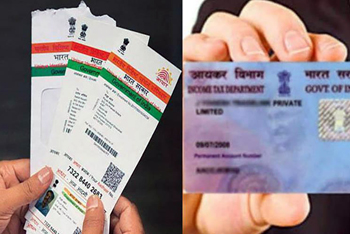
Speaking at the CyFy2017 panel on "Security through Identity", organised by Observer Research Foundation, Mr.Gupta revealed that only 100 million online IT filers have linked their pan with Aadhar so far.
He said this showed that there might be lots of fake pan cards.
Gupta said after the success of direct benefit transfers (DBTs) which has succeeded in eliminating middlemen and corruption, the government should now extend digital initiatives to the health and land sectors. He said digitalisation would help both these sectors tremendously.
"In fact, the government slowly implement 200 odd programmes like the DBT," Gupta added.
Sahil Kini, who was part of the initial government team which worked on Aadhar, said there is a need for the creation of Regulator in the digital area also, as in the cases of other resources, to effectively monitor and control data space. He suggested the regulator should be a good technical engineer who will be able to understand and monitor the medium for effective management.
"I am looking at it (Regulator) more from the technical side and not policy side though regulator job involves both sides," he said.
He also stressed the need for strong laws to prevent misuse of data and personal information with Aadhar.
Both Gupta and Sahil said the government is planning to come up with a complete law on Aadhar, information security and privacy concerns.
In order to prevent Aadhar data being misused as being reported in the media, Sunil Abraham, the Executive Director of the Centre for Internet and Society, suggested an alternative system of creating tokens from Aadhar identity and that token number being used to verify the identity of the person. He said this would help curb Aadhar data theft.
Former Prime Minister of Sweden Carl Bildt warned against the thinking of creating cyber assault weapons, saying the world we are living in are much more vulnerable than we are aware off and these cyber assault weapons would make the world worse even.
"Stay away from cyber warfare. It is very very dangerous and unimaginable," he said.
Talking of the nuclear threats from North Korea and US's counter threats, Bildt said nuclear wars are much worse than the biological wars and asked "where are we leading to?".
He said while many may be overwhelmed by pace of tech development now, "I argue this is just the beginning of where we are heading. What we are seeing is the last days of the industrial age and the beginnings of the tech age."
Bildt said within five years, we will have 95 percent of world population covered by mobile broadband with capacity better than what is available in Europe today.
He suggested that the norms and values of the internet should be the values and the norms of society. "We want to live in free, open and secure society," he said.
According to him, security is important in society, but freedom is more important. We need to build societies that have both. They are not incompatible. There should not be undue surveillance, censorship but states have some responsibility, under clear and transparent parliamentary supervision, he said
"We are the security of the internet," Bildt said.
The former Swedish PM said states are powerful enough to do things that others can't. Every state has the ability to be a superpower in the digital world.
"Norms should be there for every state: don't do to other states, what they can also do to you."
States must understand they all have equal potential of power in the digital world, thus there is a balance, he said.
Former Dutch Foreign Minister Uri Rosenthal said when internet is in motion, we see competing narratives, which the itnernet will have to adapt to and even love.
Adam Segal, Director of the Digital and Cyberspace Policy Programme, Council on Foreign Relations, said we are seeing the consoldiation of the Chinese model, a whole new rnage of controls on tech, ban on VPNs, real name registration, implementation of cyber security laws, brand new diplomatic initiatives with one belt, one road.
He said while every state in virtual realm has more power than they do in real world, China is one of the most important states shaping the future.
"We are seeing restructuring of powers based on tech giants and governments," he said.
Latha Reddy, former ambassador and deputy NSA, asked "Should digital spaces have governing ethics? I think they should. Using tech without ethics sets a dangerous precedent, for instance, the Hela case. It took 60 years for the US court to recognise violation of rights of the victim."
The two-day conference had sessions on 'The big questions: Technology, security and society'; 'No man's LAN: The militarisation of cyberspace'; 'War and peace in the digital age'; 'Predatry data: Gender and tech'; 'Harvesting the cloud'; 'Blue, while and chrome: The future of work'; 'Chasing Unicorns: The startup generation'; 'Digital vulnerabilities: Capacity building for tracking cyber crime'; 'The new code war'; 'Command and CTRL: Emerging Regime on Lethal Autonomous Weapons'; 'Encryption: The end of surveillance?'; 'Unbundling 'Convergence'; 'Information operations'; 'Security through identity'; 'Dangerous disclosures: Cyber security incident reporting'; 'Securing the digital economy'; 'Hearts and minds: Countering extremism through media' and 'Radical narratives: Countering violence outline'.

Comments
Add new comment