



Petro Gate: Police file charge sheet against 13 accused

April 18, 2015

New Delhi, April 18: Delhi Police today filed charge sheet against 13 persons arrested in connection with the Petroleum Ministry document leak case.
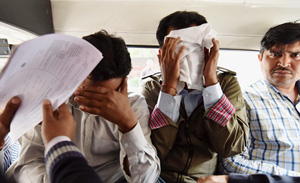
petro gate

Crime Branch of Delhi Police filed the charge sheet before Metropolitan Magistrate Akash Jain, who fixed April 20 for its consideration.

According to police sources, the accused have been charge sheeted for the alleged offences punishable under sections 457 (trespass), 380 (theft), 420 (cheating), 468 (forgery for the purpose of cheating), 471 (using as genuine forged documents), 120-B (criminal conspiracy) and 34 (common intention) of IPC.

The court fixed the 44-page charge sheet for consideration before Chief Metropolitan Magistrate Sanjay Khanagwal, who was on leave today.

The police have arrayed 42 prosecution witnesses in the case.

Police sources said that provisions of the stringent Official Secrets Act (OSA) have not been invoked against the accused yet and further investigation is going on.

On April 15, the Ministry of Petroleum and Natural Gas in its report had told the court that eight documents recovered from the accused in the case were classified in nature and none of documents seized from them were in public domain.

Among the 13 accused are five corporate executives-- Shailesh Saxena from RIL, Vinay Kumar from Essar, K K Naik from Cairns India, Subhash Chandra from Jubilant Energy and Rishi Anand from Reliance ADAG.

Other eight accused are Ishwar Singh, Asharam, Rajkumar Chaubey, Lalta Prasad, Rakesh Kumar, Virender Kumar, energy consultant Prayas Jain and journalist Shantanu Saikia.

All the accused are in judicial custody.

On April 10, the court had sought reports from the Home and the Petroleum ministries about the nature of documents recovered by the investigators during their probe.

On February 20, police had arrested the five accused corporate executives alleging that they used to procure the classified documents from other arrested accused Lalta Prasad and Rakesh, and used to pay them.

The documents were then supplied to the firms by these officials for their benefit, the police had alleged.

A total of 16 people have been arrested so far in connection with the two separate FIRs lodged by Crime Branch.

On February 20, police had arrested the five corporate executives alleging that they used to procure the classified documents from Lalta Prasad and Rakesh and used to pay them.

The documents were then supplied to the firms by these officials for their benefit, the police had alleged.

The police had earlier told the court that sensitive documents of Ministries of Coal, Power and others were recovered during the investigation.

In its FIR, the police had said that photocopies of sensitive documents including inputs on the Finance Minister's budget speech were recovered from the possession of accused Rakesh Kumar.

"Photocopy of documents with heading input material on National Gas Grid for inclusion in Finance Minister's budget speech 2015-16," it had said in its FIR.

A total of 16 people have been arrested so far in connection with two separate FIRs lodged by the Crime Branch.

Comments

Add new comment

  • Coastaldigest.com reserves the right to delete or block any comments.
  • Coastaldigset.com is not responsible for its readers’ comments.
  • Comments that are abusive, incendiary or irrelevant are strictly prohibited.
  • Please use a genuine email ID and provide your name to avoid reject.
News Network
December 13,2025

New Delhi: School-going children are picking up drug and smoking habits and engaging in consumption of alcohol, with the average age of introduction to such harmful substances found to be around 13 years, suggesting a need for earlier interventions as early as primary school, a multi-city survey by AIIMS-Delhi said.

The findings also showed substance use increased in higher grades, with grade XI/XII students two times more likely to report use of substances when compared with grade VIII students. This emphasised the importance of continued prevention and intervention through middle and high school.

The study led by Dr Anju Dhawan of AIIMS's National Drug Dependence Treatment Centre, published in the National Medical Journal of India this month, looks at adolescent substance use across diverse regions.

The survey included 5,920 students from classes 8, 9, 11 and 12 in urban government, private and rural schools across 10 cities -- Bengaluru, Chandigarh, Delhi, Dibrugarh, Hyderabad, Imphal, Jammu, Lucknow, Mumbai, and Ranchi. The data were collected between May 2018 and June 2019.

The average age of initiation for any substance was 12.9 (2.8) years. It was lowest for inhalants (11.3 years) followed by heroin (12.3 years) and opioid pharmaceuticals (without prescription; 12.5 years).

Overall, 15.1 per cent of participants reported lifetime use, 10.3 per cent reported past year use, and 7.2 per cent reported use in the past month of any substance, the study found.

The most common substances used in the past year, after tobacco (4 per cent) and alcohol (3.8 per cent), were opioids (2.8 per cent), followed by cannabis (2 per cent) and inhalants (1.9 per cent). Use of non-prescribed pharmaceutical opioids was most common among opioid users (90.2 per cent).

On being asked, 'Do you think this substance is easily available for a person of your age' separately for each substance category, nearly half the students (46.3 per cent) endorsed that tobacco products and more than one-third of the students (36.5 per cent) agreed that a person of their age can easily procure alcohol products.

Similarly, for Bhang (21.9 per cent), ganja/charas (16.1 per cent), inhalants (15.2 per cent), sedatives (13.7 per cent), opium and heroin (10 per cent each), the students endorsed that these can be easily procured.

About 95 per cent of the children, irrespective of their grade, agreed with the statement that 'drug use is harmful'.

The rates of substance use (any) among boys were significantly higher than those of girls for substance use (ever), use in the past year and use in the past 30 days. Compared to grade VIII students, grade IX students were more likely, and grade XI/XII students were twice as likely to have used any substance (ever).

The likelihood of past-year use of any substance was also higher for grade IX students and for grade XI/XII students as compared to grade VIII students.

About 40 per cent of students mentioned that they had a family member who used tobacco or alcohol each. The use of cannabis (any product) and opioid (any product) by a family member was reported by 8.2 per cent and 3.9 per cent of students, respectively, while the use of other substances, such as inhalants/sedatives by family was 2-3 per cent, the study found.

A relatively smaller percentage of students reported use of tobacco or alcohol among peers as compared to among family members, while a higher percentage reported inhalants, sedatives, cannabis or opioid use among peers.

Children using substances (past year) compared to non-users reported significantly higher any substance use by their family members and peers.

There were 25.7 per cent students who replied 'yes' to the question 'conflicts/fights often occur in your family'. Most students also replied affirmatively to 'family members are aware of how their time is being spent' and 'damily members are aware of with whom they spend their time'.

Comments

Add new comment

  • Coastaldigest.com reserves the right to delete or block any comments.
  • Coastaldigset.com is not responsible for its readers’ comments.
  • Comments that are abusive, incendiary or irrelevant are strictly prohibited.
  • Please use a genuine email ID and provide your name to avoid reject.