PM Modi says, India will always support Palestine; bats for dialogue with Israel

Agencies
February 10, 2018

Ramallah (West Bank), Feb 10: Prime Minister Narendra Modi today met Mahmoud Abbas on a historic visit to Palestine during which the Palestinian President sought India's role in achieving a "just and desired peace" with Israel in accordance with the two-state solution.

President Abbas received Modi, the first Indian Prime Minister to make an official visit to Palestine, in an official ceremony at the presidential compound, also known as Muqata'a, in Ramallah - the Palestinian seat of government.

They discussed the full range of India-Palestine ties following which the two sides signed six agreements worth around USD 50 million that includes setting up of a USD 30 million super speciality hospital in Beit Sahur.

Three agreements in the education sector worth USD 5 million, one MoU for procurement of equipment and machinery for the National Printing Press and one for construction of a centre for empowering women were also signed.

At a joint press statement with Modi, President Abbas acknowledged that the Indian leadership has always stood by peace in Palestine.

Abbas said he had "fruitfull and constructive" talks with Prime Minister Modi and he updated the Indian leader on the overall developing situation in Palestine and in the region.

He said Palestine is always ready to engage in negotiations to achieve freedom and independence in accordance with the two-state solution along the lines of 1967 and internationally legitimate resolutions so that both Palestine and Israel can co-exist in peace and security, provided that East Jerusalem is the Capital of the state of Palestine.

He said the formation of a multi-lateral mechanism that is produced by an international peace convention is the most ideal way to broker such negotiations with Israel.

"We rely on India's role as an international voice of great standing and weigh through its historical role in the Non-Aligned Movement and in all international forum and its increasingly growing power on the strategic and economic levels, in a way that is conducive to just and desired peace in our region," President Abbas said.

The two-state solution envisions independent Israeli and Palestinian states coexisting side by side peacefully. The Palestinians see East Jerusalem as their future capital.

Prime Minister Modi assured President Abbas that India is committed to the Palestinian people's interests.

"Friendship between India and Palestine has stood the test of time. The people of Palestine have shown remarkable courage in the face of several challenges. India will always support Palestines development journey," Modi said.

The Prime Minister said India hopes for return of peace in the West Asian region.

"We hope for peace and stability in Palestine, we believe a permanent solution is possible with dialogue. Only diplomacy and farsightedness can set free from violence and baggage of the past. We know it is not easy but we need to keep trying as a lot is at stake," Modi said.

Though India has shied away from becoming a party in the Israel-Palestinian conflict, the Palestinian leader on several occasions has stressed on a possible role for New Delhi in the Middle East peace process.

India believes in a two-state solution in which both Israel and a future Palestinian state coexist peacefully.

Modi's visit to Palestine comes amid heightened tensions in the region after US President Donald Trump recognised Jerusalem as the capital of Israel.

The unilateral US decision to declare Jerusalem as the capital of Israel was challenged at the UN General Assembly where 128 nations, including India, voted to turn down the move as "null and void".

Trump's decision to declare Jerusalem as Israel's capital angered the Palestinians, sparked protests in the Middle East and raised concern that it could further destabilise the region, marred by decades of the Israeli-Palestinian conflict.

During his maiden visit to Israel last year, Modi did not travel to Ramallah. His standalone visit to Israel had led to many analysts questioning the future of the Indo-Palestine ties. This time Modi skipped Israel in a clear message that India is de-hyphenating its ties with Israel and Palestine.

President Abbas also conferred the 'Grand Collar of the State of Palestine' on Prime Minister Modi, recognising his key contribution to promote ties between India and Palestine.

The Grand Collar is Highest order given to foreign dignitaries - Kings, Heads of State/Government and persons of similar rank.

Modi thanked Abbas, saying "this is a matter of proud for India. This is also the reflective of the friendship between India and Palestine."

Earlier, the two leaders exchanged hugs and stood for the national anthem of the two countries and then inspected the guard of honour before their bilateral talks.

Archbishop of Catholic Church, Poulos Marcuzzo, and religious leaders of the Al-Aqsa mosque were also at the Muqata'a to greet Modi.

Modi flew in a Jordanian army helicopter straight from Amman to Ramallah, where he was received by his Palestinian counterpart Rami Hamdallah. Prime Minister Modi's chopper was escorted by choppers from Israel Air Force.

Soon after his arrival, Prime Minister Modi visited the Mausoleum of Yasser Arafat in Ramallah and laid a wreath at the grave of the iconic Palestinian leader. He was accompanied by his Palestinian counterpart Hamdallah.

After paying homage to Arafat, Modi took a short tour of the Arafat Museum located adjacent to the mausoleum.

Comments

Add new comment

  • Coastaldigest.com reserves the right to delete or block any comments.
  • Coastaldigset.com is not responsible for its readers’ comments.
  • Comments that are abusive, incendiary or irrelevant are strictly prohibited.
  • Please use a genuine email ID and provide your name to avoid reject.
News Network
December 2,2025

DKSsiddu.jpg

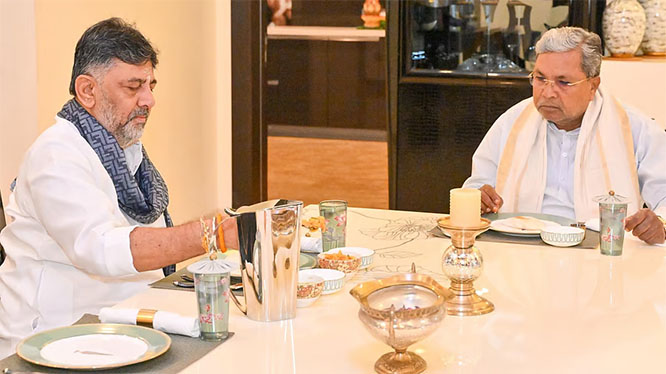
Bengaluru: 'Nati koli saaru' (country chicken curry) considered one of Chief Minister Siddaramaiah’s favourites along with steaming hot idlis was on the breakfast menu at Deputy CM D K Shivakumar’s residence on Tuesday, according to official sources.

The spread also included 'nati koli' fry, vada and pongal, among other items, they said.

In an apparent show of unity, Siddaramaiah visited Shivakumar’s residence for breakfast, just days after the two leaders shared a meal amid a simmering power tussle in the state Congress.

Siddaramaiah drove to the Deputy CM’s residence in Sadashivanagar, where he was received by Shivakumar and his brother D K Suresh, who is a former Congress MP.

Suresh and Kunigal MLA H D Ranganath, a relative of Shivakumar, joined them for breakfast, which featured a mix of vegetarian and non-vegetarian dishes.

Speaking to reporters later, Siddaramaiah said Shivakumar had invited him during his visit to the CM’s residence for breakfast on Saturday.

Asked about the difference between the two meals, the chief minister said, "At his (Shivakumar’s) house it was non-veg, while at my house it was veg. He is a vegetarian, I am a non-vegetarian. I had not prepared non-veg. I told DK to get chicken from the village as you won’t get the original in Bengaluru."

Shivakumar said he had initially invited Siddaramaiah to his residence, but the CM had suggested visiting his place first and reciprocating later. "It was a vegetarian breakfast at the CM’s house on Saturday," he noted.

"Today, I invited him (the CM) to my house. He enjoyed the breakfast, which had his Mysuru taste," Shivakumar added. At this point, Siddaramaiah remarked that Shivakumar’s wife is also from Mysuru.

Saturday’s breakfast at Siddaramaiah’s official residence, held as part of efforts by the Congress high command to ease tensions in the leadership dispute between the two, reportedly included idlis and sambar, according to official sources.

Comments

Add new comment

  • Coastaldigest.com reserves the right to delete or block any comments.
  • Coastaldigset.com is not responsible for its readers’ comments.
  • Comments that are abusive, incendiary or irrelevant are strictly prohibited.
  • Please use a genuine email ID and provide your name to avoid reject.
News Network
November 26,2025

students.jpg

Bengaluru, Nov 26: Karnataka is taking its first concrete steps towards lifting a three-decade-old ban on student elections in colleges and universities. Deputy Chief Minister D.K. Shivakumar announced Wednesday that the state government will form a small committee to study the reintroduction of campus polls, a practice halted in 1989 following incidents of violence.

Speaking at a 'Constitution Day' event organised by the Karnataka Congress, Mr. Shivakumar underscored the move's aim: nurturing new political leadership from the grassroots.

"Recently, (Leader of the Opposition in Lok Sabha) Rahul Gandhi wrote a letter to me and Chief Minister (Siddaramaiah) asking us to think about restarting student elections," Shivakumar stated. "I'm announcing today that we'll form a small committee and seek a report on this."

Student elections were banned in Karnataka in 1989, largely due to concerns over violence and the infiltration of political party affiliates into campus life. The ban effectively extinguished vibrant student bodies and the pipeline of young leaders they often produced.

Mr. Shivakumar, who also serves as the Karnataka Congress president, said that former student leaders will be consulted to "study the pros and cons" of the re-introduction.

Acknowledging the history of the ban, he added, "There were many criminal activities taking place back then. We’ll see how we can conduct (student) elections by regulating such criminal activities."

The Deputy CM reminisced about his own journey, which began on campus. He recalled his political activism at Sri Jagadguru Renukacharya College leading to his first Assembly ticket in 1985 at the age of 23. "That's how student leadership was at the time. Such leadership has gone today. College elections have stopped," he lamented, adding that for many, college elections were "like a big movement" where leaders were forged.

The move, driven by the Congress high command's push to cultivate young talent, will face scrutiny from academics and university authorities who have, in the past, expressed concern that the return of polls could disrupt the peaceful academic environment and turn campuses into political battlegrounds.

Comments

Add new comment

  • Coastaldigest.com reserves the right to delete or block any comments.
  • Coastaldigset.com is not responsible for its readers’ comments.
  • Comments that are abusive, incendiary or irrelevant are strictly prohibited.
  • Please use a genuine email ID and provide your name to avoid reject.
News Network
November 22,2025

gaza.jpg

The Israeli regime’s forces have killed two Palestinian children in the Gaza Strip every day since the ceasefire began in early October, UNICEF has warned.

The UN children’s agency said on Friday that Israeli forces continue to attack Palestinians in Gaza even though the agreement was meant to stop the killing.

“Since 11 October, while the ceasefire has been in effect, at least 67 children have been killed in conflict-related incidents in the Gaza Strip. Dozens more have been injured. That is an average of almost two children killed every day since the ceasefire took effect,” UNICEF spokesperson Ricardo Pires said in Geneva, reminding that each number in the statistics represents a child whose life had ended violently.

“These are not statistics,” he said. “Each child had a story, a family, and a future that was stolen from them.”

Data from Palestinian factions, human rights groups, and government bodies recorded since the US-brokered ceasefire deal went into effect on October 10 show that Israeli forces have carried out numerous attacks, each constituting a separate ceasefire violation.

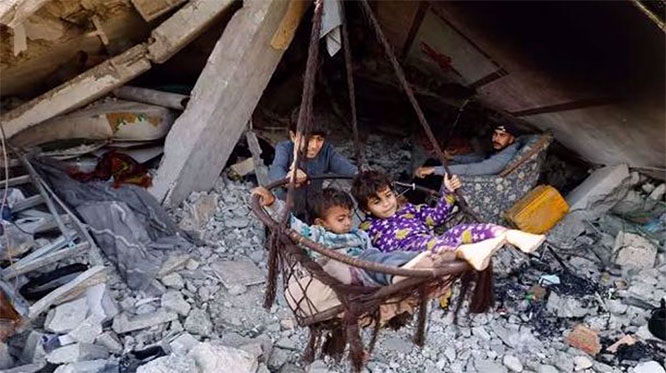
UNICEF teams say they repeatedly continue to witness heart-wrenching scenes of fearful Palestinian children sleeping outdoors with amputated limbs, while others live as orphans in flooded, makeshift shelters.

“I saw this myself in August. There is no safe place for them. The world cannot normalize their suffering,” Pires said, lamenting that the UN could “do a lot more if the aid that is really needed was entering faster.”

The UNICEF spokesperson warned that with the advent of winter, the risks for hundreds of thousands of displaced children will increase.

He warned, “The stakes are incredibly high” for children as winter acts as a threat multiplier, where children have no heating, no insulation, and few blankets. He said respiratory infections rise.

“Too many children have already paid the highest price,” Pires said. “Too many are still paying it, even under a ceasefire. The world promised them it would stop and that we would protect them.”

“Now we must act like it,” the UNICEF spokesperson added.

Since the Israeli regime launched its genocidal war against Palestinians in Gaza in October 2023, it has killed nearly 70,000 people in the territory, most of them women and children, and injured over 170,000 more, while reducing most of the structures in the enclave to rubble.

Comments

Add new comment

  • Coastaldigest.com reserves the right to delete or block any comments.
  • Coastaldigset.com is not responsible for its readers’ comments.
  • Comments that are abusive, incendiary or irrelevant are strictly prohibited.
  • Please use a genuine email ID and provide your name to avoid reject.