



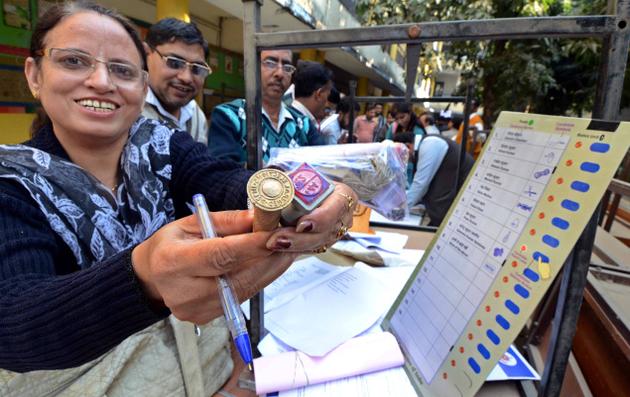
Polling begins in Delhi

December 4, 2013

DELHI_ASSEMBL

New Delhi, Dec 4: Polling for the 70-member Delhi Assembly elections began on Wednesday morning where Congress is engaged in an electoral battle with BJP, while new entrant in the fray Aam Admi Party’s possible impact is being watched keenly.

The voting began at 8 a.m. at over 11,000 polling stations out of which 630 have been identified as critical and hyper critical.

A total of 1.19 crore voters are eligible to exercise their franchise, out of which 66.11 lakh are men and 53.20 lakh are women. The number of first time voters is 4.05 lakh.

A total of 810 candidates are in the fray in the three-cornered contest between Congress, BJP and AAP.

While BJP has fielded candidates in 66 constituencies Congress and AAP are contesting from all 70 seats.

BSP, which was the third largest party in last Assembly election, has fielded candidates at 69 seats, NCP in nine and Samajwadi Party at 27 seats. A total of 224 independents are also in the fray.

A total of 32,801 personnel of Delhi Police and 107 companies of central paramilitary forces have been deployed to ensure peaceful elections.

In a bid to boost voter turnout, nine ‘model’ polling stations with spruced-up infrastructure have been set up for the first time.

The entry of Arvind Kejriwal’s AAP has changed the dimension of the elections and it will be interesting to see whether the newbie will just be a “spoiler” or win some seats as predicted by opinion polls, riding on its anti-corruption plank.

The elections in Delhi and four other states are being seen as the semifinal for the Lok Sabha polls to be held next year.

The stakes in this election are high for three-time Chief Minister Sheila Dikshit, who mainly highlighted her achievements and development agenda during the campaigning, while BJP’s Chief Ministerial candidate Harsh Vardhan promised to cut power tariff by 30 per cent and slash vegetable prices within 30 days of coming to power.

The BJP has also promised to give 12 subsidised LPG cylinders in a year to each household instead of current nine, besides ensuring full statehood. It has also promised to set up a dedicated Women Security Force to ensure safety of women.

In its manifesto, Congress has promised to set up a Single Command System to address the problems of multiplicity of authorities and a common economic zone for the entire National Capital Region to minimise load on Delhi’s infrastructure. It has also promised to construct double-decker flyovers to ease traffic congestion.

The AAP said it will pass the Jan Lokpal Bill within 15 days of coming to power, besides promising to cut power tariff by 50 per cent. It said 700 litres of water per day will be given free to each household.


Comments

Add new comment

  • Coastaldigest.com reserves the right to delete or block any comments.
  • Coastaldigset.com is not responsible for its readers’ comments.
  • Comments that are abusive, incendiary or irrelevant are strictly prohibited.
  • Please use a genuine email ID and provide your name to avoid reject.
News Network
December 6,2025

pilot.jpg

New Delhi: IndiGo, India’s largest airline, faced major operational turbulence this week after failing to prepare for new pilot-fatigue regulations issued by the Directorate General of Civil Aviation (DGCA). The stricter rules—designed to improve flight safety—took effect in phases through 2024, with the latest implementation on November 1. IndiGo has acknowledged that inadequate roster planning led to widespread cancellations and delays.

Below are the key DGCA rules that affected IndiGo’s operations:

1. Longer Mandatory Weekly Rest

Weekly rest for pilots has been increased from 36 hours to 48 hours.

The government says the extended break is essential to curb cumulative fatigue. This rule remains in force despite the current crisis.

2. Cap on Night Landings

Pilots can now perform only two night landings per week—a steep reduction from the earlier limit of six.

Night hours, defined as midnight to early morning, are considered the least alert period for pilots.

Given the disruptions, this rule has been temporarily relaxed for IndiGo until February 10.

3. Reduced Maximum Night Flight Duty

Flight duty that stretches into the night is now capped at 10 hours.

This measure has also been kept on hold for IndiGo until February 10 to stabilize operations.

4. Weekly Rest Cannot Be Replaced With Personal Leave

Airlines can no longer count a pilot’s personal leave as part of the mandatory 48-hour rest.

Pilots say this closes a loophole that previously reduced actual rest time.

Currently, all airlines are exempt from this rule to normalise travel.

5. Mandatory Fatigue Monitoring

Airlines must submit quarterly fatigue reports along with corrective actions to DGCA.

This system aims to create a transparent fatigue-tracking framework across the industry.

The DGCA has stressed that these rules were crafted to strengthen flight safety and align India with global fatigue-management standards. The temporary relaxations are expected to remain until February 2025, giving IndiGo time to stabilise its schedules and restore normal air travel.

Comments

Add new comment

  • Coastaldigest.com reserves the right to delete or block any comments.
  • Coastaldigset.com is not responsible for its readers’ comments.
  • Comments that are abusive, incendiary or irrelevant are strictly prohibited.
  • Please use a genuine email ID and provide your name to avoid reject.