



Qatar: two years of crisis in the Gulf

Agencies
June 3, 2019

Doha, Jun 3: Two years ago Saudi Arabia, the United Arab Emirates and their allies cut ties with Qatar, sparking a major diplomatic crisis in the Gulf region.

Here is a recap.

Simmering regional tensions boil over on June 5, 2017, when Saudi Arabia and its allies Bahrain, Egypt and the United Arab Emirates announced they are severing diplomatic ties with Qatar.

They accuse it of supporting Islamist movements and seeking closer ties with Riyadh's regional rival Iran -- charges Qatar denies.

The four close land and maritime borders with the Gulf peninsula, suspend air links and expel Qatari citizens.

In a country dependent on food imports, there is alarm over whether the border closures will lead to food shortages in Qatar.

Saudi Arabia also closes the Riyadh bureau of Qatari broadcaster Al Jazeera.

On June 22 the Saudi-led bloc sends Qatar a list of 13 demands which include shutting down Al Jazeera, curbing relations with Iran and closing a Turkish military base it hosts.

Doha on July 4 rejects the demands as "unrealistic".

Saudi Arabia and its allies threaten new sanctions.

On July 25 they unveil a "terrorist" blacklist of 18 groups and individuals suspected of links to Islamist extremists and to Qatar.

The blacklist grows to include almost 90 names.

Seeking support from outside the region and vowing to uphold its sovereignty, Qatar signs a series of defence deals with foreign powers.

They include a December contract with France for a dozen Rafale fighter jets and 50 Airbus A321 passenger planes, and a deal with Britain to buy Typhoon fighters.

It also buys warships from Italy and F-15 fighter jets from the United States.

In January 2018 it approves legislation allowing 100-percent foreign ownership in most sectors of its economy.

Previously reliant on its Gulf neighbours, it increasingly turns towards Iran and Turkey, particularly for food imports.

In April Qatar ruler Sheikh Tamim bin Hamad Al-Thani says "we do not and we will not tolerate people who fund terrorism" during a meeting in the US with President Donald Trump.

Trump calls him "a friend", softening his tone after having supported the Saudi-led bloc and accusing Qatar of funding terrorism.

In June French daily Le Monde reports that Saudi Arabia threatened military action against Qatar if it acquired Russia's top-of-the-range S-400 air defence missile system.

In late June the dispute moves to the UN's top court, the International Court of Justice (ICJ) in The Hague, where Qatar accuses the UAE of racial discrimination and human rights abuses against its citizens in the Emirates.

The court orders the UAE in July to protect the rights of its Qatari citizens, including by ending measures that would stop Qatari students from completing their studies.

The UAE in May 2019 accuses Qatar before the ICJ of "aggravating" the two-year-old crisis and of "false accusations".

A day later, Qatar accuses the Emirates of a "campaign of violence and hatred" against its citizens.

The UAE detains for a week a Qatari military ship that had violated its territorial waters.

In May 2019 there is the first high-level contact between the opposing sides in two years when Qatar's Prime Minister Sheikh Abdullah bin Nasser Al-Thani attends three regional summits in Saudi Arabia's holy city of Mecca.

Comments

Add new comment

  • Coastaldigest.com reserves the right to delete or block any comments.
  • Coastaldigset.com is not responsible for its readers’ comments.
  • Comments that are abusive, incendiary or irrelevant are strictly prohibited.
  • Please use a genuine email ID and provide your name to avoid reject.
News Network
November 30,2025

The United Nations Committee against Torture (CAT) has condemned the Israeli regime for enforcing a policy of “organized torture” against Palestinians.

In a report published on Friday, CAT stated that the occupying regime enforces a deliberate policy of “organized and widespread torture and ill-treatment” against Palestinian abductees, particularly since October 7, 2023, when Israel launched its genocidal war on Gaza.

The committee expressed “deep concern over repeated severe beatings, dog attacks, electrocution, water-boarding, use of prolonged stress positions [and] sexual violence” inflicted on Palestinians.

Palestinian prisoners were degraded by “being made to act like animals or being urinated on,” systematically denied medical care, and subjected to excessive restraints, “in some cases resulting in amputation,” the report added.

CAT also condemned the routine application of “unlawful combatants law” to justify the prolonged detention without trial of thousands of Palestinian men, women, and children.

More than 10,000 Palestinians, including women and children, are currently held in Israeli prisons, according to Palestinian and international human rights groups, with 3,474 Palestinians in “administrative detention,” meaning they are imprisoned without trial for indefinite periods.

The report highlighted the “high proportion of children who are currently detained without charge or on remand,” noting that while Israel sets the age of criminal responsibility at 12, even younger children have been abducted.

Children designated as security prisoners face severe restrictions on family contact, may be subjected to solitary confinement, and are denied access to education, in clear violation of international law.

The committee further suggested that Israel’s policies across the Occupied Territories constitute collective torture against the Palestinian population.

“A range of policies adopted by Israel in the course of its continued unlawful presence in the Occupied Palestinian Territory amounts to cruel, inhuman or degrading living conditions for the Palestinian population,” the report said.

On Thursday, the Palestinian resistance movement Hamas condemned the systematic killing and torture of Palestinian abductees in Israeli prisons, urging international action to halt these abuses.

Citing human rights data, Hamas stated that 94 Palestinians have been killed in Israeli prisons since the start of Tel Aviv’s genocidal war on Gaza.

“This reflects an organized criminal approach that has turned these prisons into direct killing grounds to eliminate our people,” the resistance movement said.

Hamas called on the international community, the UN, and human rights organizations to immediately pressure Israel to end crimes against prisoners and uphold their rights as guaranteed by all international conventions and norms.

Comments

Add new comment

  • Coastaldigest.com reserves the right to delete or block any comments.
  • Coastaldigset.com is not responsible for its readers’ comments.
  • Comments that are abusive, incendiary or irrelevant are strictly prohibited.
  • Please use a genuine email ID and provide your name to avoid reject.
News Network
November 21,2025

israel.jpg

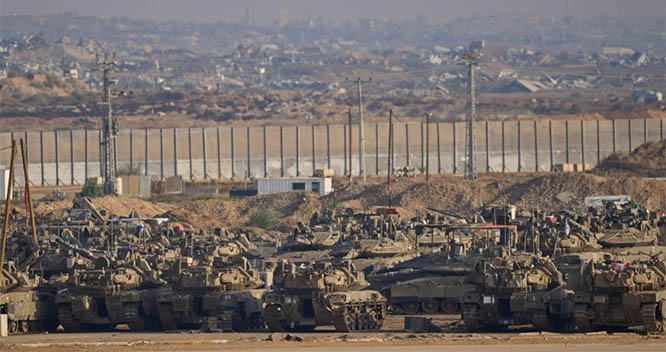
Local authorities say the Israeli military has expanded the so-called “yellow line” truce demarcation in Gaza City and repositioned its forces deeper into the territory in violation of a ceasefire agreement that came into force on October 10, besieging dozens of Palestinian families.

Gaza’s Government Media Office announced in a statement on Thursday that Israeli forces widened the boundary by shifting the markers, and advanced roughly 300 meters (984 feet) into the neighborhoods of Ash-Shaaf, An-Nazzaz and Baghdad Street.

The move pushed further into civilian areas, trapping families who were unable to flee as tanks rolled forward, it added.

“The fate of many of these families remains unknown amidst the shelling that targeted the area,” the office said, adding that the expansion of the yellow line shows a “blatant disregard” for the ceasefire deal.

On Friday, sources said the Israeli military carried out continued air and artillery strikes inside the so-called “yellow line” east of Khan Younis in the southern Gaza Strip.

According to the reports, Israeli warplanes and tanks targeted areas within the zone. One Palestinian was reported killed and several others wounded in the strikes, the sources said.

The fresh aggression came only a day after 25 Palestinians were killed in Israeli airstrikes on Gaza City and Khan Younis on Wednesday.

The media office reported that Israel has consistently violated the truce deal since its implementation last month, with near-daily attacks by air, artillery and direct shootings.

The office said over 400 violations have been documented. These breaches have resulted in the deaths of more than 300 Palestinians and left hundreds injured.

The Government Media Office in Gaza urged the guarantors of the ceasefire — the US, Egypt, Qatar and Turkey — to take swift action to halt the ongoing violations and facilitate the delivery of food, shelter materials, medical aid, and infrastructure equipment.

The so-called “yellow line,” set out in the agreement between Israel and Hamas resistance movement, refers to a non-physical partition where the Israeli military repositioned itself when the truce deal took effect.

It has allowed Israel, which routinely fires at Palestinians who approach the line, to retain control over more than half of the Gaza Strip.

International bodies, including the UN Independent International Commission of Inquiry, the International Association of Genocide Scholars, Amnesty International, Human Rights Watch, B’Tselem, and other rights groups, have concluded that the Israeli war on Gaza amounts to genocide.

In the attacks in Gaza since October 2023, Israel has killed at least 69,546 people and injured 170,833 others, leveling large swaths of the territory and displacing almost all of the population. 

Comments

Add new comment

  • Coastaldigest.com reserves the right to delete or block any comments.
  • Coastaldigset.com is not responsible for its readers’ comments.
  • Comments that are abusive, incendiary or irrelevant are strictly prohibited.
  • Please use a genuine email ID and provide your name to avoid reject.