Rahul attacks govt in Lok Sabha over farmers' issue

April 20, 2015

New Delhi, Apr 20: Rahul Gandhi today led the opposition attack in the Lok Sabha on the government over the problems being faced by farmers, saying it had "failed" them and specifically targeted Prime Minister Narendra Modi over it.
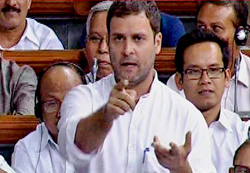
Rahul Gandhi

In his first speech in the Budget Session, the Congress Vice President said the government was "ignoring" the farming community and favouring the industrialists and rich people, which was a "blunder" as the farmers will 'harm" BJP in future.

"The acche din government has failed the country" on the issue of farmers, he said while participating in a short duration discussion on 'The Agrarian Situation in the Country'.

He said farmers are responsible for laying the "foundation" for whatever the country has achieved but they are being ignored by the government.

Taking digs at the Prime Minister, he said Modi "should switch over to the side of farmers and labourers from that of high and mighty and industrialists" as it will benefit BJP politically and harm Congress.

"I will offer an advice to the Prime Minister. He will gain politically if he changes sides as farmers are over 67 per cent of population. You are making a blunder by harming farmers and labourers and they will harm you in future. If you switch over to their side it will help you and may harm us," he said.

Rahul, who was absent in the House during the first part of the Budget session as he was away, said he has been wondering over the Prime Minister's policies, which were "affecting" farmers, since Modi knows the "political calculations" and has just won the elections.

"Then it occurred to me that the price of farmers' land has been rising and your corporate friends covet these lands. You are weakening the farmers now and then use this axe of land ordinance to hit them," he said, charging that the government wanted to acquire land to help industrialists.

Amid continuous uproar and clashes between the treasury and opposition benches, Rahul cited figures to underline that farmers and agriculture are being neglected under the NDA.

He said the agriculture sector grew by only one percent during the 10-month-old Modi government and had grown by 2.6 per cent during the previous NDA government.

He accused the government of giving out contradictory figures about the damages suffered by farmers during the recent unseasonal rains and said BJP would function like this as it was used to speaking different voices.

At this, Agriculture Minister Radha Mohan Singh intervened to say that figures were different as the states had revised these.

Later, Rahul told reporters outside the Parliament House that "the basic point is that the government doesn't understand the pain of the farmers and common people."

In the House, he said the 10-year UPA regime had ensured sharp rise in the MSPs of wheat, rice and sugarcane. While wheat MSP shot up from Rs 640 to 1400 per quintal and that of rice and sugarcane rose from Rs 560 and Rs 73 to Rs 1310 and Rs 220 respectively, he said.

During the present government, the MSP of wheat has been raised by only Rs 50, sugarcane by Rs 10 and cotton by Rs 50, Gandhi said.

Gandhi's attack comes a day after Congress launched an all-out war on the government over the controversial land bill in a farmers' rally yesterday which was addressed by party President Sonia Gandhi besides a host of other senior leaders, including him.

Earlier, Jay Prakash Narayan Yadav (RJD) said that the schemes like 'Make In India' will not succeed in the absence of a strong farming sector.

He demanded a loan waiver scheme to help the farmers who had suffered a lot on account of natural calamity.

Describing the Land Acquisition Bill as a 'black law', Yadav said his party would continue to oppose it within and outside Parliament as it was against the interest of farmers.

Tariq Anwar (NCP) asked the government to favourably consider the need for a loan waiver scheme as the farmers were in crisis.

Nand Kumar Singh Chouhan (BJP) appreciated the decision of the government to give higher compensation to farmers for loss of crop on account of unseasonal rains and hailstorm.

He suggested that crop insurance scheme should be improved to provide timely help to the farmers in distress.

Shiv Sena member Vinayak Bhaurao Raut regretted that the state government was not helping the farmers suffering from crop loss to the desired extent and suggested a change in the methodology for assessing crop loss.

He suggested that the members should be involved in the assessment of crop loss.

Raut also demand expeditious implementation of the centre's scheme to provide higher compensation to farmers in crisis.

Krishna Raj (BJP) regretted that the Uttar Pradesh government was not doing anything to help the farmers who had lost their crops and were forced to commit suicide.

She asked the central government to undertake fresh assessment of the damaged crops in the UP as the state government had not done it properly.

Her party colleague Keshav Prasad Maurya asked the government improve the crop insurance scheme as several small farmers do not have enough resources to pay insurance premium.

Also, he added, there should be a time limit for payment of relief to distressed farmers.

P V M Reddy (YSR Congress) suggested that the government should fix reasonable minimum support price (MSP) for farm products.

Sunil Kumar Singh (BJP) said that since independence, not much had been done to improve farm sector.

A P Jithender Reddy (TRS) underlined the need for increasing public expenditure and promoting land reforms to improve farming in the country.


Comments

Add new comment

  • Coastaldigest.com reserves the right to delete or block any comments.
  • Coastaldigset.com is not responsible for its readers’ comments.
  • Comments that are abusive, incendiary or irrelevant are strictly prohibited.
  • Please use a genuine email ID and provide your name to avoid reject.
News Network
December 13,2025

New Delhi: School-going children are picking up drug and smoking habits and engaging in consumption of alcohol, with the average age of introduction to such harmful substances found to be around 13 years, suggesting a need for earlier interventions as early as primary school, a multi-city survey by AIIMS-Delhi said.

The findings also showed substance use increased in higher grades, with grade XI/XII students two times more likely to report use of substances when compared with grade VIII students. This emphasised the importance of continued prevention and intervention through middle and high school.

The study led by Dr Anju Dhawan of AIIMS's National Drug Dependence Treatment Centre, published in the National Medical Journal of India this month, looks at adolescent substance use across diverse regions.

The survey included 5,920 students from classes 8, 9, 11 and 12 in urban government, private and rural schools across 10 cities -- Bengaluru, Chandigarh, Delhi, Dibrugarh, Hyderabad, Imphal, Jammu, Lucknow, Mumbai, and Ranchi. The data were collected between May 2018 and June 2019.

The average age of initiation for any substance was 12.9 (2.8) years. It was lowest for inhalants (11.3 years) followed by heroin (12.3 years) and opioid pharmaceuticals (without prescription; 12.5 years).

Overall, 15.1 per cent of participants reported lifetime use, 10.3 per cent reported past year use, and 7.2 per cent reported use in the past month of any substance, the study found.

The most common substances used in the past year, after tobacco (4 per cent) and alcohol (3.8 per cent), were opioids (2.8 per cent), followed by cannabis (2 per cent) and inhalants (1.9 per cent). Use of non-prescribed pharmaceutical opioids was most common among opioid users (90.2 per cent).

On being asked, 'Do you think this substance is easily available for a person of your age' separately for each substance category, nearly half the students (46.3 per cent) endorsed that tobacco products and more than one-third of the students (36.5 per cent) agreed that a person of their age can easily procure alcohol products.

Similarly, for Bhang (21.9 per cent), ganja/charas (16.1 per cent), inhalants (15.2 per cent), sedatives (13.7 per cent), opium and heroin (10 per cent each), the students endorsed that these can be easily procured.

About 95 per cent of the children, irrespective of their grade, agreed with the statement that 'drug use is harmful'.

The rates of substance use (any) among boys were significantly higher than those of girls for substance use (ever), use in the past year and use in the past 30 days. Compared to grade VIII students, grade IX students were more likely, and grade XI/XII students were twice as likely to have used any substance (ever).

The likelihood of past-year use of any substance was also higher for grade IX students and for grade XI/XII students as compared to grade VIII students.

About 40 per cent of students mentioned that they had a family member who used tobacco or alcohol each. The use of cannabis (any product) and opioid (any product) by a family member was reported by 8.2 per cent and 3.9 per cent of students, respectively, while the use of other substances, such as inhalants/sedatives by family was 2-3 per cent, the study found.

A relatively smaller percentage of students reported use of tobacco or alcohol among peers as compared to among family members, while a higher percentage reported inhalants, sedatives, cannabis or opioid use among peers.

Children using substances (past year) compared to non-users reported significantly higher any substance use by their family members and peers.

There were 25.7 per cent students who replied 'yes' to the question 'conflicts/fights often occur in your family'. Most students also replied affirmatively to 'family members are aware of how their time is being spent' and 'damily members are aware of with whom they spend their time'.

Comments

Add new comment

  • Coastaldigest.com reserves the right to delete or block any comments.
  • Coastaldigset.com is not responsible for its readers’ comments.
  • Comments that are abusive, incendiary or irrelevant are strictly prohibited.
  • Please use a genuine email ID and provide your name to avoid reject.
News Network
December 16,2025

jordan.jpg

Prime Minister Narendra Modi on Monday held talks with Jordan’s King Abdullah II in Amman, during which the two leaders discussed ways to further strengthen bilateral relations, with the Prime Minister outlining an eight-point vision covering key areas of cooperation.

Describing the meeting as “productive”, PM Modi said he shared a roadmap focused on trade and economy, fertilisers and agriculture, information technology, healthcare, infrastructure, critical and strategic minerals, civil nuclear cooperation, and people-to-people ties.

In a post on social media platform X, the Prime Minister praised King Abdullah II’s personal commitment to advancing India–Jordan relations, particularly as both countries mark the 75th anniversary of the establishment of diplomatic ties this year.

“Held productive discussions with His Majesty King Abdullah II in Amman. His personal commitment towards vibrant India-Jordan relations is noteworthy. This year, we are celebrating the 75th anniversary of our bilateral diplomatic relations,” PM Modi said.

The meeting took place at the Al Husseiniya Palace, where the two leaders also exchanged views on regional and global issues of mutual interest. According to the Ministry of External Affairs (MEA), both sides agreed to further deepen cooperation in areas including trade and investment, defence and security, counter-terrorism and de-radicalisation, fertilisers and agriculture, infrastructure, renewable energy, tourism, and heritage.

The MEA said both leaders reaffirmed their united stand against terrorism.

PM Modi arrived in Amman earlier on Monday and was received by Jordanian Prime Minister Jafar Hassan, who accorded him a formal welcome. Following the talks, King Abdullah II hosted a banquet dinner in honour of the Prime Minister, reflecting the warmth of bilateral ties.

Jordan is the first leg of PM Modi’s three-nation tour. From Amman, the Prime Minister will travel to Ethiopia at the invitation of Prime Minister Abiy Ahmed Ali, marking his first official visit to the African nation. The tour will conclude with a visit to Oman.

Comments

Add new comment

  • Coastaldigest.com reserves the right to delete or block any comments.
  • Coastaldigset.com is not responsible for its readers’ comments.
  • Comments that are abusive, incendiary or irrelevant are strictly prohibited.
  • Please use a genuine email ID and provide your name to avoid reject.
News Network
December 5,2025

indigoCEO.jpg

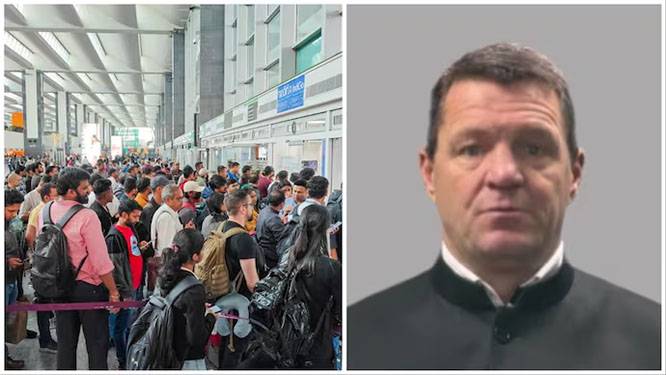
New Delhi, Dec 5: IndiGo CEO Pieter Elbers issued a public apology this evening after more than a thousand flights were cancelled today, making it the "most severely impacted day" in terms of cancellations. The biggest airline of the country cancelled "more than half" of its daily number of flights on Friday, said Elbers. He also said that even though the crisis will persist on Saturday, the airline anticipates fewer than 1,000 flight cancellations.

"Full normalisation is expected between December 10 and 15, though IndiGo cautions that recovery will take time due to the scale of operations," the IndiGo CEO said. 

IndiGo operates around 2,300 domestic and international flights daily.

Pieter Elbers, while apologising for the major inconvenience due to delays and cancellations, said the situation is a result of various causes.

The crisis at IndiGo stems from new regulations that boost pilots' weekly rest requirements by 12 hours to 48 and allow only two night-time landings per week, down from six. IndiGo has attributed the mass cancellations to "misjudgment and planning gaps".

Elbers also listed three lines of action that the airline will adopt to address the issue.

"Firstly, customer communication and addressing your needs, for this, messages have been sent on social media. And just now, a more detailed communication with information, refunds, cancellations and other customer support measures was sent," he said.

The airline has also stepped up its call centre capacity.

"Secondly, due to yesterday's situation, we had customers stranded mostly at the nation's largest airports. Our focus was for all of them to be able to travel today itself, which will be achieved. For this, we also ask customers whose flights are cancelled not to come to the airports as notifications are sent," the CEO said.

"Thirdly, cancellations were made for today to align our crew and planes to be where they need to start tomorrow morning afresh. Earlier measures of the last few days, regrettable, have proven not to be enough, but we have decided today to reboot all our systems and schedules, resulting in the highest numbers of cancellations so far, but imperative for progressive improvements starting from tomorrow," he added.

As airports witnessed chaotic scenes, the Directorate General of Civil Aviation (DGCA) stepped in to grant IndiGo a temporary exemption from stricter night duty rules for pilots. It also allowed substitution of leaves with a weekly rest period. 

Civil Aviation Minister Ram Mohan Naidu has said a high-level inquiry will be ordered and accountability will be fixed.

Comments

Add new comment

  • Coastaldigest.com reserves the right to delete or block any comments.
  • Coastaldigset.com is not responsible for its readers’ comments.
  • Comments that are abusive, incendiary or irrelevant are strictly prohibited.
  • Please use a genuine email ID and provide your name to avoid reject.