Rahul Gandhi criticises PM Modi's economic policies

Agencies
September 12, 2017

Washington, Sep 12: Congress vice president Rahul Gandhi today criticised Prime Minister Narendra Modi's economic policies, accusing him of causing "tremendous damage" to India's economy with "reckless and dangerous" decisions like demonetisation and "hastily-applied" GST.

Gandhi, 47, who arrived in the US yesterday on a two- week-long tour, addressed students at the University of California, Berkeley, to reflect on contemporary India and the path forward for the world's largest democracy.

He said the November 8 demonetisation decision was taken without asking the Chief Economic Advisor and Parliament, which caused tremendous damage to the economy. Demonetisation, he alleged, imposed a devastating cost on India.

"Ignoring India's tremendous institutional knowledge and taking such decisions is reckless and dangerous," he charged. He said 30,000 new youngsters were joining the job market every single day and the government was only creating 500 jobs a day.

"This does not include the massive pool of already employed youngsters," he said. "The decline in economic growth today is leading to an upsurge of anger in the country. The government's economic policies demonetisation and hastily-applied GST have caused tremendous damage," he alleged.

Goods and Services Tax, a tax regime which combines all of India's states and union territories into a single market, was launched at midnight on June 30. Gandhi also accused the government of wiping out millions by demonetisation.

"Millions of small businesses were simply wiped out as a result of the demonetisation, farmers and many who use cash were hit extremely hard. Agriculture is in deep distress and farmers suicides have skyrocketed across the country."

Finance Minister Arun Jaitley, however, had said the fallout of demonetisation was on predicted lines and the economy will benefit in medium and long term.

Jaitley's remarks came after the Reserve Bank of India said that 99 per cent of the demonetised currency came back into the system. Jaitley had also insisted that money getting deposited in banks does not mean that all of it is legitimate.

But Gandhi described demonetisation "a completely self- inflicted wound" that caused approximately 2 per cent loss of the GDP.

India, the Congress leader said, cannot afford to grow and create jobs at the current rate. "If we continue at the current rate, if India cannot give the millions of people entering the job market employment, anger will increase and it has the potential to derail what has been built so far. That would be catastrophic for India and the world beyond," Gandhi warned.

The Congress vice president said that the central challenge for the country today is creating jobs. Noting that roughly 12 million young people join the Indian job market every year with nearly 90 per cent of them having a high school education or less, Gandhi said India, being a democratic country, cannot follow the Chinese model of coercion.

"Unlike China it has to create jobs in a democratic environment," he said, adding that India does not "want China's coercive" instruments. "We cannot follow the model of massive factories controlled by a few," Gandhi said.

Jobs in India, he said, are going to come in from small and medium scale industry. India, he asserted, needs to turn colossal numbers of small and medium businesses into international companies.

Alleging that currently all the attention in India is being paid to the top hundred companies, he said: "Everything is geared towards them, the banking systems are monopolised by them and the doors of government are always open to them."

"And laws are shaped by them," he said, adding that entrepreneurs running small and medium businesses are struggling to get bank loans.

"They have no protection and no support. Small and medium businesses are the bedrock of India and the world's innovation. Big businesses can easily manage the unpredictability of India. They are protected by their deep deep pockets and connections," he said. India, he said, has triggered a massive process of human transformation.

The momentum is so powerful that India's failure is no longer an option, he said, "Our success impacts the world," Gandhi said, warning that this momentum can be destroyed by "hatred, anger and violence".

"The politics of polarisation has raised its ugly head in India," he said, adding that liberal journalists are being shot. He was apparently referring to rights activist and journalist Gauri Lankesh's killing.

"People being lynched because they are Dalit," he alleged. "Muslims were killed on suspicion of eating beef. This is new in India and damages India very badly."

He said the politics of hate divided and polarised India and was making millions of people feel that they have no future in their own country.

"In today's connected world this is extremely dangerous," he said. Gandhi at the same time also acknowledged that Prime Minister Narendra Modi is a better communicator than him.

"I'm an opposition leader. But Mr Modi is also my prime minister. Mr Modi has certain skills. He's a very good communicator. Probably much better than me. He understands how to give a message to three or four different groups in a crowd. So his messaging abilities very subtle and very effective," Gandhi said.

He was responding to a question on what does he think about Modi as the prime minister. "What I sense is that he doesn't converse with the people he works with. Even members of Parliament of the BJP come to me and tell me that 'sunte nahi hain' (he does not listen to us)," Gandhi added.

He said Modi must speak to the people who work with him. "I mean there is a lot of information that the opposition for example has. He is not really interested in that input. So that is what has been going on," he said.

Gandhi described Modi's flagship policies like 'Make in India' and 'Swachh Bharat' as a good idea. "On what they have done well? What I like? I like the concept of 'Make in India'. But the orientation of 'Make in India' is slightly different than what I would. So, the orientation of Make in India is big business and a lot of it is defence.My orientation of 'Make in India' would be small and medium businesses," he said.

Gandhi said he would like to carve out space for small and medium businesses and bring in experts from Silicon Valley and take these small and medium businesses and transforming them into global companies.

"Swachh Bharat is something that Mr Modi likes. The idea of hygiene I think is a good one. And I think I think the sort of stuff that they are doing on open defecation is not a bad thing," Gandhi said.

The Congress vice president said the impression that he was a reluctant politician was a result of the campaign against him by the other political camp.

"There is a BJP machine about a thousand guys sitting on computers that basically tell you about me," he said as the audience burst into laughter.

"They tell you, I am reluctant, I'm stupid. They tell you all these things," he said amidst another round of laughter and applause.

"All they do is spread abuse about it. And the operation is basically run by the gentleman who is running our country," Gandhi said.

Responding to a question, Gandhi said the country needs political reform. "Administrative reform is important. But much more important than administrative report is actually political reform. Today, the real problem in India is that our political machine.. they are not empowered the way they should be... The laws in India are made by the ministers and five or six people surrounding the minister.

"And until you make that process transparent and out into the open, you are not really going to transform the system," he said.

He said the lawmakers who should be formulating policies are today more worried about building roads.

"Today our MPs don't make laws. They are worried about building roads in villages. And they get punished for not building roads in villages. They should be making laws. They should be empowered to make laws. That's their job. And that is the fundamental thing that has this gone wrong in India," he said.

Comments

Add new comment

  • Coastaldigest.com reserves the right to delete or block any comments.
  • Coastaldigset.com is not responsible for its readers’ comments.
  • Comments that are abusive, incendiary or irrelevant are strictly prohibited.
  • Please use a genuine email ID and provide your name to avoid reject.
News Network
January 20,2026

iran.jpg

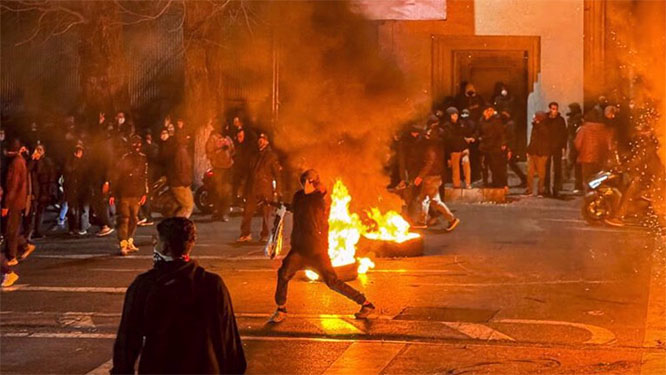
Iranian security and intelligence forces have captured more than 470 individuals in three provinces, identified as key figures behind the recent wave of violent unrest and terrorist activities linked to foreign-backed networks.

The Intelligence Ministry's provincial office in Khorasan Razavi announced on Monday the arrest of 192 armed terrorists, identified as the main agents behind recent riots in the region. 

According to an official statement, the detainees were involved in the killing of several security personnel and civilians, setting fire to mosques, public service facilities, and buses, as well as attacks on military and law enforcement centers.

The seized items from the group include several bulletproof vests, Kalashnikov rifles, hunting weapons, Winchester rifles, and various cold weapons such as daggers, swords, brass knuckles, tactical knives, crossbows, and chains.

Evidence indicates that some of the individuals were tied to hostile movements and terrorist organizations, with links overseas. Others were identified as members of violent criminal gangs, actively taking part in the unrest alongside their associates.

Simultaneously, in the western province of Lorestan, the IRGC announced the arrest of 134 individuals as the main leaders and influential field agents of a US-Israeli terrorist network.

The IRGC statement stated that these individuals formed terrorist cells during the recent unrest, committing "Daesh-like" acts.

They wounded security forces with firearms and cold weapons, and burned and destroyed public and private properties, including mosques, shops, banks, and private and public vehicles.

In the northwestern province of Zanjan, the police reported detaining 150 people identified as principal leaders and agents behind recent riots.

Authorities noted that these individuals were responsible for destroying public and private property and intentionally setting fire to vehicles in the province's squares.

Their crimes include shedding the blood of innocent people, destroying public and private property, attempting to enter military sites, disrupting public order, and spreading terror among citizens.

A variety of cold weapons were reportedly seized from the detainees.

What began late last month as peaceful protests over economic hardship across Iran turned violent after public statements by US and Israeli regime figures encouraged vandalism and disorder.

During the unrest, foreign-backed mercenaries rampaged through cities, killing security forces and civilians and damaging public property.

Comments

Add new comment

  • Coastaldigest.com reserves the right to delete or block any comments.
  • Coastaldigset.com is not responsible for its readers’ comments.
  • Comments that are abusive, incendiary or irrelevant are strictly prohibited.
  • Please use a genuine email ID and provide your name to avoid reject.
News Network
January 23,2026

oscar.jpg

The Voice of Hind Rajab, inspired by the tragic final moments of a young Palestinian girl killed by Israeli fire in Gaza, has been nominated for an Academy Award in the Best International Feature Film category.

Directed by Tunisian filmmaker Kaouther Ben Hania, the film recounts the true story of five-year-old Hind Rajab, who lost her life in January 2024 while fleeing Israeli bombardment with her family.

The film features the real audio of Hind’s desperate call to the Palestinian Red Crescent Society, where she pleaded for help moments before the vehicle she was in was struck by 355 bullets.

The haunting narrative begins with a brief call made from the besieged Tel al-Hawa neighborhood of Gaza, where gunfire and armored vehicles drowned out every sound.

After witnessing the brutal killing of her family, she made a trembling call, her voice reduced to a whisper as she spoke of the massacre and her unbearable loneliness as the sole survivor.

Premiering at the Venice International Film Festival in September 2025, The Voice of Hind Rajab garnered widespread acclaim, receiving a record-setting 23-minute standing ovation and the Silver Lion Grand Jury Prize, the festival’s second-highest honor.

In her acceptance speech, Ben Hania dedicated the film to humanitarian workers and first responders in Gaza, emphasizing that Hind's voice symbolizes countless civilians affected by war.

She aims to give voice to victims often reduced to mere statistics, highlighting the broader suffering of civilians in war zones.

The film’s Oscar nomination underscores its powerful storytelling and ethical approach to depicting real-life tragedy, making it a crucial piece of contemporary cinema.

It serves not only as a narration of individual tragedy but also as an artistic and documentary response to the silence and censorship that often overshadow West Asian struggles and wars.

Using an innovative method she calls docufiction, Ben Hania bridges unvarnished reality and narrative structure, creating a work that is both artistically valuable and socially impactful.

Born in 1977 in Sidi Bouzid—later the epicenter of the Arab revolution—her background profoundly influenced her worldview and artistic approach.

She is a graduate of the Higher School of Audiovisual Arts of Tunis, Pantheon-Sorbonne University, and La Fémis in Paris, where her studies equipped her with the technical and theoretical tools needed to address complex subjects. 

Comments

Add new comment

  • Coastaldigest.com reserves the right to delete or block any comments.
  • Coastaldigset.com is not responsible for its readers’ comments.
  • Comments that are abusive, incendiary or irrelevant are strictly prohibited.
  • Please use a genuine email ID and provide your name to avoid reject.
coastaldigest.com news network
January 19,2026

rizwanzameer.jpg

Bengaluru: As the dust settles on the recent legislative session, the corridors of Vidhana Soudha are buzzing with more than just policy talk. A high-stakes game of political musical chairs has begun, exposing a deepening rift within the Congress party’s Muslim leadership as a major Cabinet reshuffle looms.

With the party hierarchy signaling a "50% refresh" to gear up for the 2028 Assembly elections, the race to fill three projected Muslim ministerial berths has transformed from a strategic discussion into an all-out turf war.

The "Star Son" Spark

The internal friction turned public this week following provocative remarks by Zaid Khan, actor and son of Wakf Minister Zameer Ahmed Khan. Zaid’s claim—that his father "helped" secure a ticket for Shivajinagar MLA Rizwan Arshad in 2023—has acted as a lightning rod for resentment.

Rizwan’s camp was quick to fire back, dismissing the comment as a desperate attempt by Zameer to manufacture seniority. "Rizwan’s political pedigree was forged in the NSUI and Youth Congress long before Zameer even stepped into the party," a supporter noted, highlighting Rizwan’s tenure as an AICC secretary and his two-term presidency of the State Youth Congress.

A Tale of Two Loyalists

While both Zameer Ahmed Khan and Rizwan Arshad are staunch allies of Chief Minister Siddaramaiah and represent Bengaluru strongholds, their political DNA could not be more different:

•    Zameer Ahmed Khan: A four-time MLA who crossed over from JD(S) in 2018. Known for his "overzealous" and often polarizing outreach during communal flashpoints—from the DJ Halli riots to the recent Wakf land notice controversy—his style has frequently left the Congress high command in a state of "discomfort."

•    Rizwan Arshad: A homegrown organizational man. Seen as a "quiet performer," Arshad represents the sophisticated, moderate face of the party, preferred by those who find Zameer’s brand of politics too volatile.

The Outsiders Looking In

The bickering isn't limited to a duo. The "Beary" community, represented by leaders like N A Haris and Saleem Ahmed, is demanding its pound of flesh. Saleem Ahmed, the Chief Whip in the Legislative Council, has dropped the veil of diplomacy, openly declaring his ministerial aspirations.

"I was the only working president not included in the Cabinet last time," Saleem noted pointedly, signaling that the "loyalty quota" is no longer enough to keep the peace.

As Chief Minister Siddaramaiah prepares to finalize the list, he faces a delicate balancing act: rewarding the aggressive grassroots mobilization of Zameer’s camp without alienating the organizational stalwarts and minority sub-sects who feel increasingly sidelined by the "Chamarajpet-Shivajinagar" binary.

Comments

Add new comment

  • Coastaldigest.com reserves the right to delete or block any comments.
  • Coastaldigset.com is not responsible for its readers’ comments.
  • Comments that are abusive, incendiary or irrelevant are strictly prohibited.
  • Please use a genuine email ID and provide your name to avoid reject.