



Allahabad Sept 29: Uttar Pradesh Health Minister Siddharth Nath Singh said he is confident that the Ram Temple in Ayodhya will be constructed before 2019.
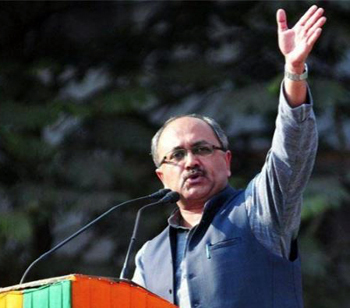
Speaking to the media, the Bharatiya Janata Party (BJP) leader said the situation in the country is changing and people who were earlier opposing to it now want a grand Ram temple.
"Swami Brahma Yogananda had predicted Modi ji will become PM, and he now predicted a grand Bhavya Ram Temple before 2019. Also, now situation in the country is changing. People who earlier opposed to it now want a grand Ram temple," he added.
Earlier on July 6, at least three trucks of red stones were brought for building the Ram temple in Ayodhya, under the supervision of the Vishwa Hindu Parishad (VHP).
The carving of stones for the temple is being done under the supervision of an organisation of VHP, 'Ram Janmabhoomi Nyas' and saints.
In August this year, the Supreme Court had said that it will commence final hearing of the long-standing Ram Janmabhoomi-Babri Masjid title dispute from December 5, a day before the 25th anniversary of the demolition of the medieval-era structure.
The apex court, after an intense deliberation for more than one-and-half-hours on August 12, reached a consensus on commencement of the hearing on a total of 13 appeals filed against the 2010 judgement of the Allahabad High Court in four civil suits.
Another sect of the Muslims under the banner of Shia Central Waqf Board of Uttar Pradesh recently went to the court offering a solution that a mosque could be built in a Muslim- dominated area at a "reasonable distance" from the disputed site in Ayodhya.
In 1946, an offshoot of the Hindu Mahasabha called Akhil Bharatiya Ramayana Mahasabha (ABRM) started an agitation for the possession of the site.
In 1949, Sant Digvijay Nath of Gorakhnath Math joined the ABRM and organised a nine-day continuous recitation of Ramcharit Manas, at the end of which the Hindu activists broke into the mosque and placed idols of Rama and Sita inside.
People were led to believe that the idols had 'miraculously' appeared inside the mosque. The date of the event was December 22, 1949.
Former Prime Minister Jawaharlal Nehru insisted that the idols should be removed. However, K. K. K. Nair, a then local official known for his Hindu nationalist connections, refused to carry out orders, claiming that it would lead to communal riots. The police locked the gates so that the public (Hindus and Muslims) could not enter.
On December 6, 1992, the VHP and its associates, including the BJP, organised a rally involving 150,000 VHP and BJP kar sevaks at the site of the mosque.
The ceremonies included speeches by the BJP leaders such as L.K. Advani, Murli Manohar Joshi and Uma Bharti.
The mob grew restive through the duration of the speeches, and stormed the mosque shortly after noon.
A police cordon placed there to protect the mosque was heavily outnumbered.
The mosque was attacked with a number of improvised tools, and brought to the ground in a few hours.

Comments
Add new comment